A visitor lands on your pricing page at 10 pm, reads for two minutes and leaves. Maybe they had one question. Maybe they were ready to buy. You will never know, because nobody was there to ask.
That gap is what conversational AI for sales fills. It is software that talks to prospects in plain language on your website, WhatsApp, Instagram or email, answers their questions, qualifies them and moves them to the next step: a booking, a purchase or a call with your sales team. It works at any hour and in many languages.
In this guide we explain how it works, the use cases that actually make money, the best AI sales chatbots in 2026, where the tech falls short and how to set it up without annoying buyers. We build an AI agent for sales and customer support, so we'll also be clear about where ours fits and where it doesn't.
What is conversational AI for sales?
Conversational AI is a mix of large language models, natural language processing and your own business data. It can understand and respond to human language the way a helpful person would: it reads what someone types, works out what they want and replies in a natural way.
In sales, an AI sales agent (some vendors call it an AI assistant for sales) handles jobs like:
- Answering product and pricing questions instantly.
- Asking qualifying questions so you can qualify leads without a long form.
- Booking meetings on a sales rep's calendar.
- Recommending products based on what the buyer needs.
- Following up with quiet prospects.
- Passing hot leads to a human with the customer information already filled in.
Advanced conversational AI is not the same as an old rule-based bot. Those follow a fixed script of buttons. Modern AI chat handles free text, typos, follow-up questions and mixed languages, which is how real buyers actually write. Think of it as full AI understanding instead of keyword matching.
How does it work in the sales process?
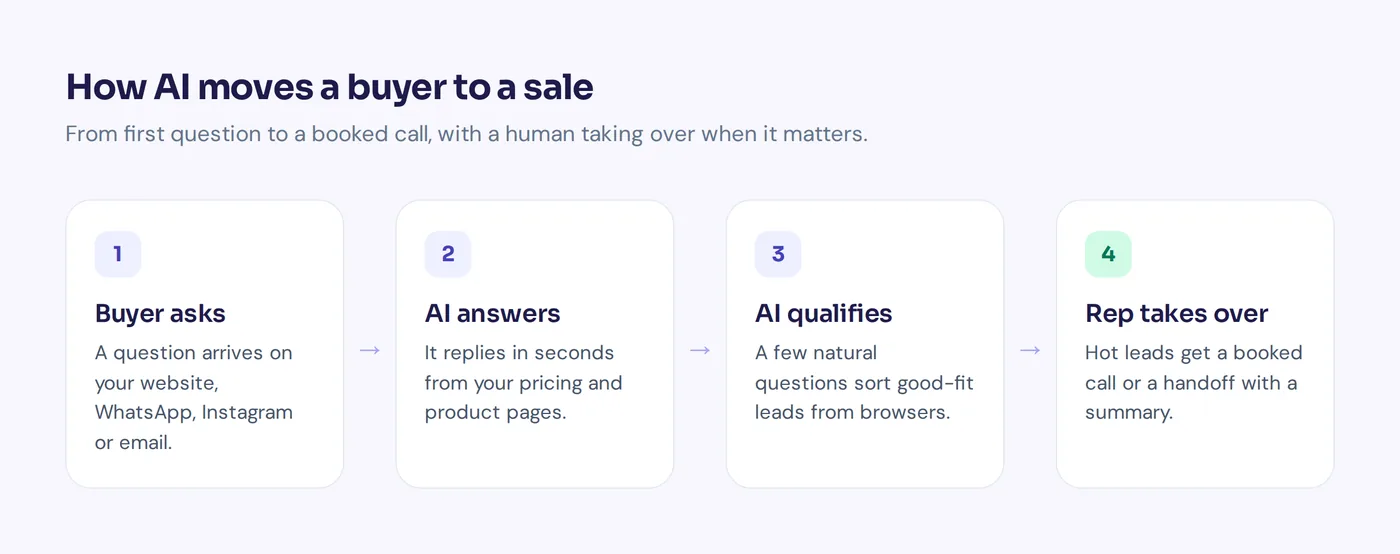
Under the hood, most tools follow the same loop:
- Understand. The AI system reads the message and works out the intent: a pricing question, a feature question, a demo request, an objection.
- Look up. It searches your knowledge: website, product pages, pricing, FAQs and sometimes customer data from your CRM. Good tools answer from your content, not general internet knowledge.
- Reply. Using generative AI, it writes a short, natural answer in the buyer's language.
- Act. If needed, it does something: captures an email, books a meeting, creates a lead in your CRM, shows a product card.
- Hand over. When the buyer is ready for a human, or the question is too complex, it routes the chat to the right person with a summary. Some tools can also detect when a customer is frustrated and escalate early.
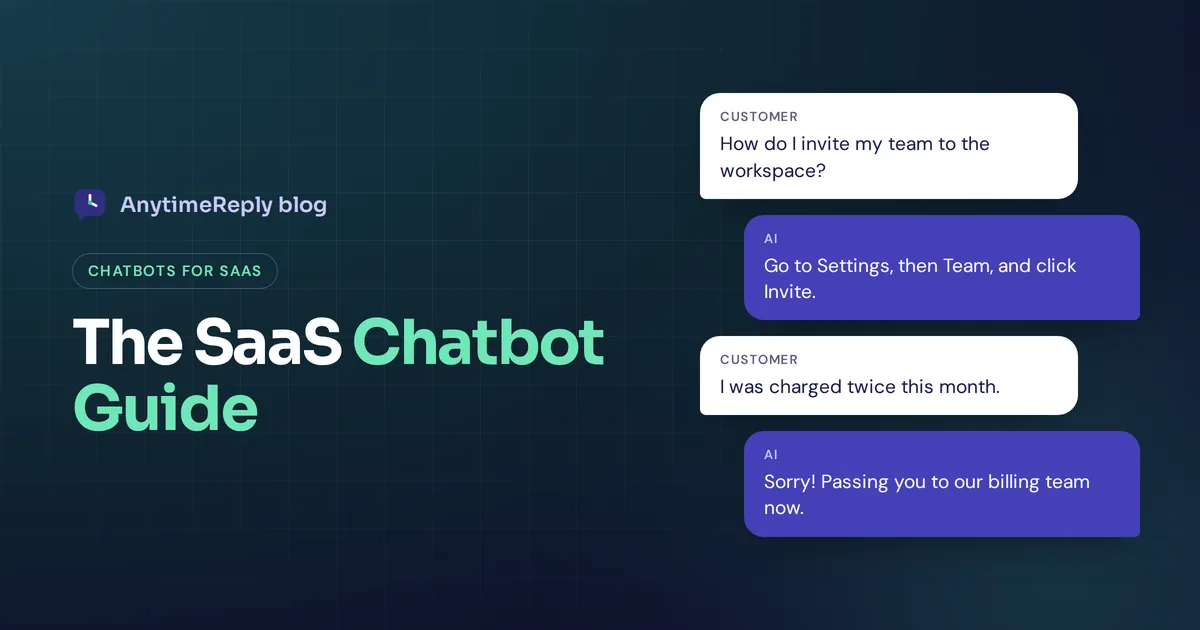
The important part is step 2. An AI trained on vague or outdated content gives vague or outdated answers. Clean product and pricing pages matter more than the model you pick.
Ways you can use AI in sales: 8 practical use cases
1. Instant answers to buying questions
"Does this integrate with Shopify?" "Is there a discount for annual billing?" "Do you ship to Germany?" These questions decide whether someone buys today. An AI that answers in seconds keeps the buyer on the page instead of sending them to a competitor's tab.
2. Lead qualification and routing
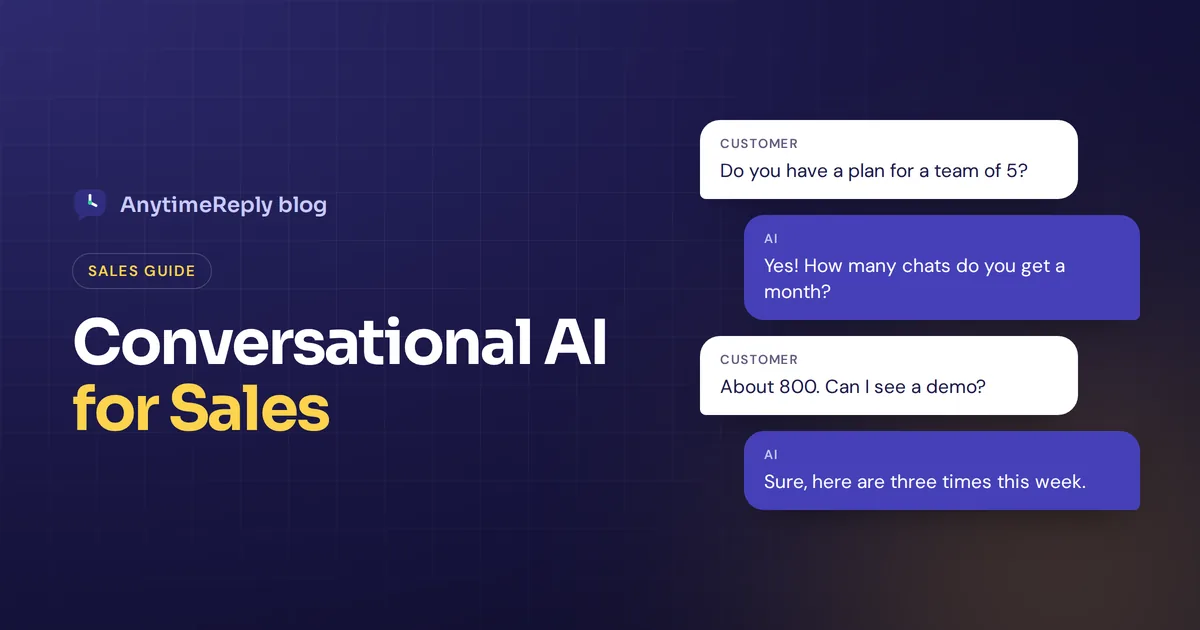
Instead of a long form, the AI asks a few natural questions during the chat: team size, use case, timeline, budget range. It can then route good-fit leads to sales and send smaller leads to self-serve signup.
"Happy to help. So I can point you to the right plan, roughly how many customer conversations does your team handle each month?"
3. Meeting and demo booking
The moment a prospect says "can I see a demo?", the AI offers time slots and books the call. No form, no email ping-pong, no lead going cold over the weekend.
4. Product recommendations
For online shops, a sales AI works like a store assistant. The shopper describes what they need, and it suggests a few products with price and stock. This works especially well for big catalogs where browsing is tiring.
5. Follow-ups and outbound messages
Not every buyer decides in one chat. You can automate one polite follow-up to a quiet prospect, run WhatsApp broadcasts to opted-in customers, or start a proactive chat when someone shows buying intent (time on the pricing page, exit intent). Done well, this brings back deals that would have been lost.
6. Social selling on Instagram and Facebook
For social sellers, the sale often starts with a comment: "price?" The AI can reply publicly, send details in a private message and keep the conversation going in DMs. That turns comment sections into part of your sales funnel.
7. Objection handling
Common objections ("too expensive", "we already use X", "is my data safe?") have good answers. Write them down once and the AI uses them every time, instead of each rep improvising their own sales pitch.
8. Sales call analysis (a different category)
Some tools record and analyze sales calls to coach reps and spot deal risks. This is usually called conversation intelligence. The AI can analyze talk time, objections and next steps across thousands of calls. Useful, but it is a different job from talking to buyers. Gong is a well-known example. Chat-focused tools, including ours, don't analyze phone calls.
Benefits: how AI features help your sales team
- Speed. Buyers get an answer in seconds, not hours, which lifts sales engagement and the customer experience. For many purchases, the first company that answers wins.
- Always available. Nights, weekends and holidays are covered without overtime.
- Scale. A launch or a viral post can bring hundreds of chats at once. The AI handles all of those customer interactions at the same time.
- Enabling sales professionals. Reps spend their time on qualified buyers and complex deals instead of repetitive sales tasks like answering "what does it cost?" for the hundredth time.
- Consistency. Every prospect gets the same accurate pricing and policy answers.
- Languages. The AI replies in the buyer's language, which opens markets your team can't cover.
- Insight. Every chat shows sales trends: what buyers ask, where they hesitate and which objections come up most. That feeds into your sales strategies, website and pricing, and helps teams improve their sales over time.
Industry reports like Salesforce's State of Sales report and various "state of AI" surveys track how quickly sales teams are adopting these tools. They're worth a read if you want market numbers; we'd rather you measure your own results.
Can AI replace human reps in a sales conversation?
No, and we'd be suspicious of any vendor that says yes. Here's an honest split:
- Where AI can help most: sales prospecting replies, first replies, FAQs, qualification, booking, product suggestions, follow-ups and after-hours cover.
- Where humans win: six-month enterprise deals with procurement and legal, negotiation, custom pricing, relationship building and reading the room.
The best setup is AI first, with a fast handoff to a person. Long sales cycles still need people. The AI just makes sure no one waits and no lead slips through.
Risks and limits to plan for
- It's only as good as your content. If your website doesn't say whether you offer annual discounts, the AI can't either. A bad AI tool will guess. A good one says "I'm not sure, let me get the team".
- Pushy bots hurt trust. A popup on every page, or an assistant that keeps asking for an email, drives people away.
- Privacy and consent rules apply. Outbound messages on WhatsApp and email need opt-in. Respect STOP requests every time.
- AI costs can creep up. Most tools charge per message, per conversation or per resolution. Model choice matters, so check how pricing works at your volume.
- It needs ongoing care. Prices change, products launch, policies update. Someone has to keep the knowledge current and read a few chats every week.
Conversational AI vs chatbots vs live chat
| Rule-based bot | AI sales agent | Live chat (human) | |
|---|---|---|---|
| Understands free text | Poorly | Yes | Yes |
| Available 24/7 | Yes | Yes | Only team hours |
| Handles many chats at once | Yes | Yes | A few per rep |
| Answers new questions | No, only scripted ones | Yes, from your knowledge | Yes |
| Negotiation and judgment | No | Limited | Strong |
| Cost as volume grows | Low | Low, mostly per message | Grows with headcount |
| Best for | Simple menus | Questions, qualification, booking | High-value, complex deals |
We wrote more about combining the two in chatbot vs live chat.
Best AI sales chatbots and tools in 2026
The market is crowded. Here are the main types of AI sales chatbot tools and well-known names in each, from simple AI customer service bots to full sales software. Features and pricing change often, so check each vendor's site before you decide, and look for a free plan or trial to test with your own content.
- AnytimeReply. An AI agent with a built-in helpdesk. Answers on website chat, WhatsApp, Messenger, Instagram, Telegram and email, books meetings and hands chats to your team. Suits online shops, social sellers, SaaS and service businesses, especially multilingual ones.
- Tidio with Lyro AI. Tidio is known for live chat for small online stores, and Lyro AI is its AI agent for answering customer questions.
- Freshworks with Freddy AI. Freddy AI runs across Freshworks' sales and customer service tools, a fit for teams already in that ecosystem.
- HubSpot's chatbot and AI features. Best if your sales operations already live in HubSpot CRM, since it works directly with your contacts and helps you manage sales and deals.
- Intercom. Known for its Fin AI agent and messaging for software companies, often used by sales and support teams.
- Qualified and Drift (now part of Salesloft). Focused on B2B pipeline: identifying website visitors, qualifying them and booking meetings for sales reps.
- Rep AI. Aimed at Shopify stores that want an AI sales assistant to guide shoppers.
- Gong. Conversation intelligence for analyzing sales calls, not a chat tool. Useful alongside one.
Compare AI capabilities on your own real questions, not on demo scripts. And pick based on where your buyers actually talk to you. If most sales start on WhatsApp or Instagram, a tool built for B2B website meetings is a poor fit, and the other way around. Also think about separate tools vs one platform: running sales chat, support chat and email in one inbox saves a lot of switching.
How to choose the right AI sales tool (free or paid)
- Channels. Does it cover the channels your buyers use: website, WhatsApp, Instagram, Messenger, email?
- Knowledge. Can you train it on your website, files and product catalog, and correct its answers easily?
- CRM and calendar integration. Can a qualified lead reach the right record or book a meeting without anyone copying details across?
- Handoff. How smoothly does a chat move to a human, and does the rep get a summary?
- Languages. Does it reply well in your customers' languages, including mixed ones?
- Pricing model. Per seat, per message, per resolution? Model it at your real volume.
- Testing. Can you test answers before going live and after every change?
How to implement AI and automate sales workflows
- Pick one goal. More demo bookings, more qualified leads or more online sales.
- Collect real buyer questions. Ask your sales team and read old chats and emails. List the top 20 questions and the top 5 objections.
- Fix your content first. Make sure your pricing, product and FAQ pages answer those questions clearly.
- Train the AI. Add your website, product sheets and written Q&A. Write short instructions: tone, what to ask, when to book a call, what never to promise.
- Connect your tools. Calendar for bookings, CRM for leads, store for product data.
- Set handoff rules. For example: enterprise leads go straight to a rep, angry buyers go to a person, anything uncertain gets escalated.
- Test like a buyer. Ask hard questions, rude questions and questions with typos.
- Launch on one channel, then expand. Start on your website, then add WhatsApp, Instagram or email.
- Review every week. Read a few AI conversations and see what the AI couldn't answer. Add those answers.
How to measure sales performance and ROI
- Response time on sales chats (should drop to seconds).
- Leads captured and how many are qualified.
- Meetings booked from chat.
- Conversion rate of visitors who chatted vs those who didn't.
- Handoff rate: how often the AI passes to a human, and why.
- Unanswered questions: the gaps in your knowledge.
- Customer satisfaction ratings after chats.
Compare these against the cost of the tool and the hours your team saves. That's your real ROI, and it's more reliable than any vendor's case study.
How AnytimeReply helps with sales and AI support
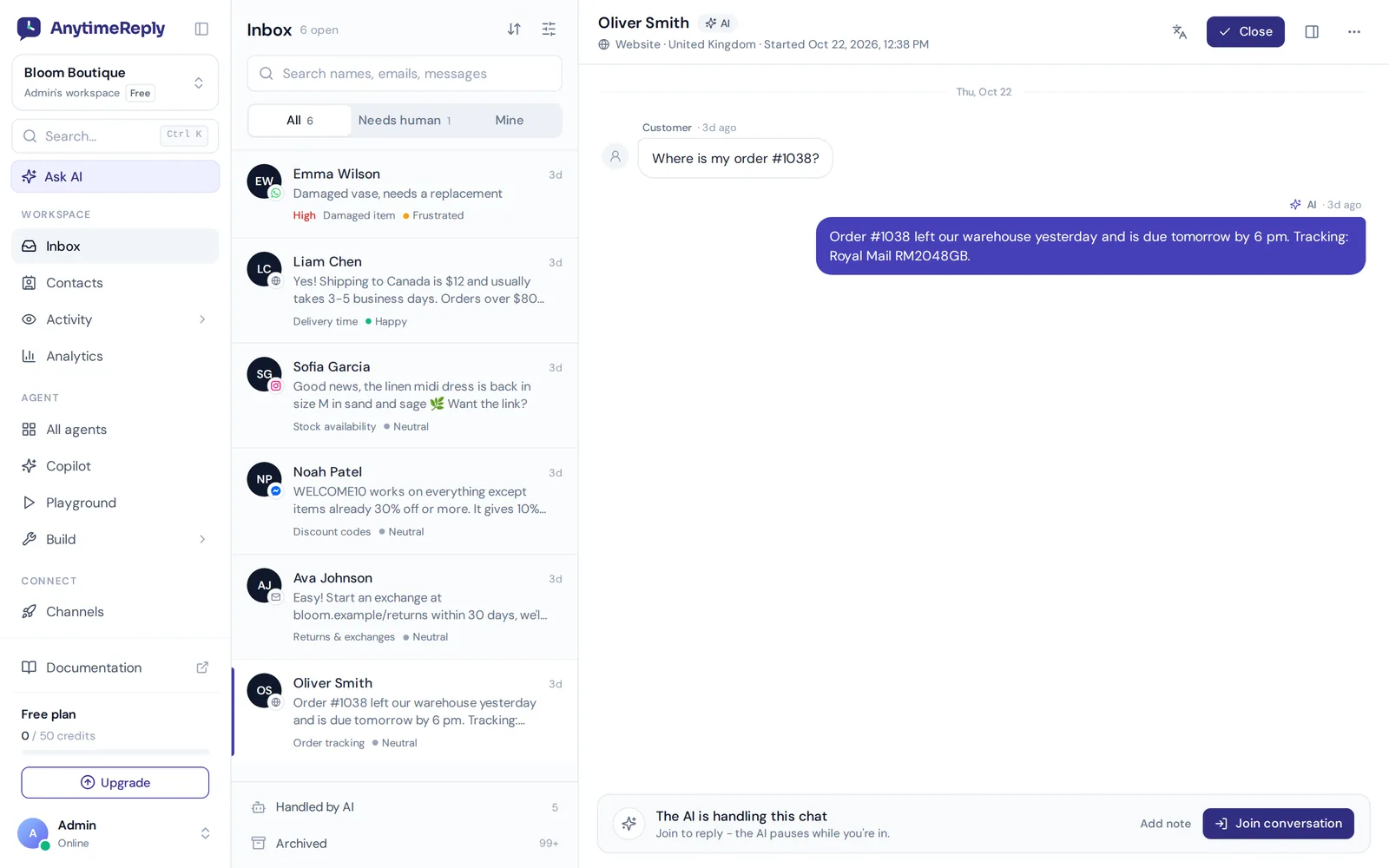
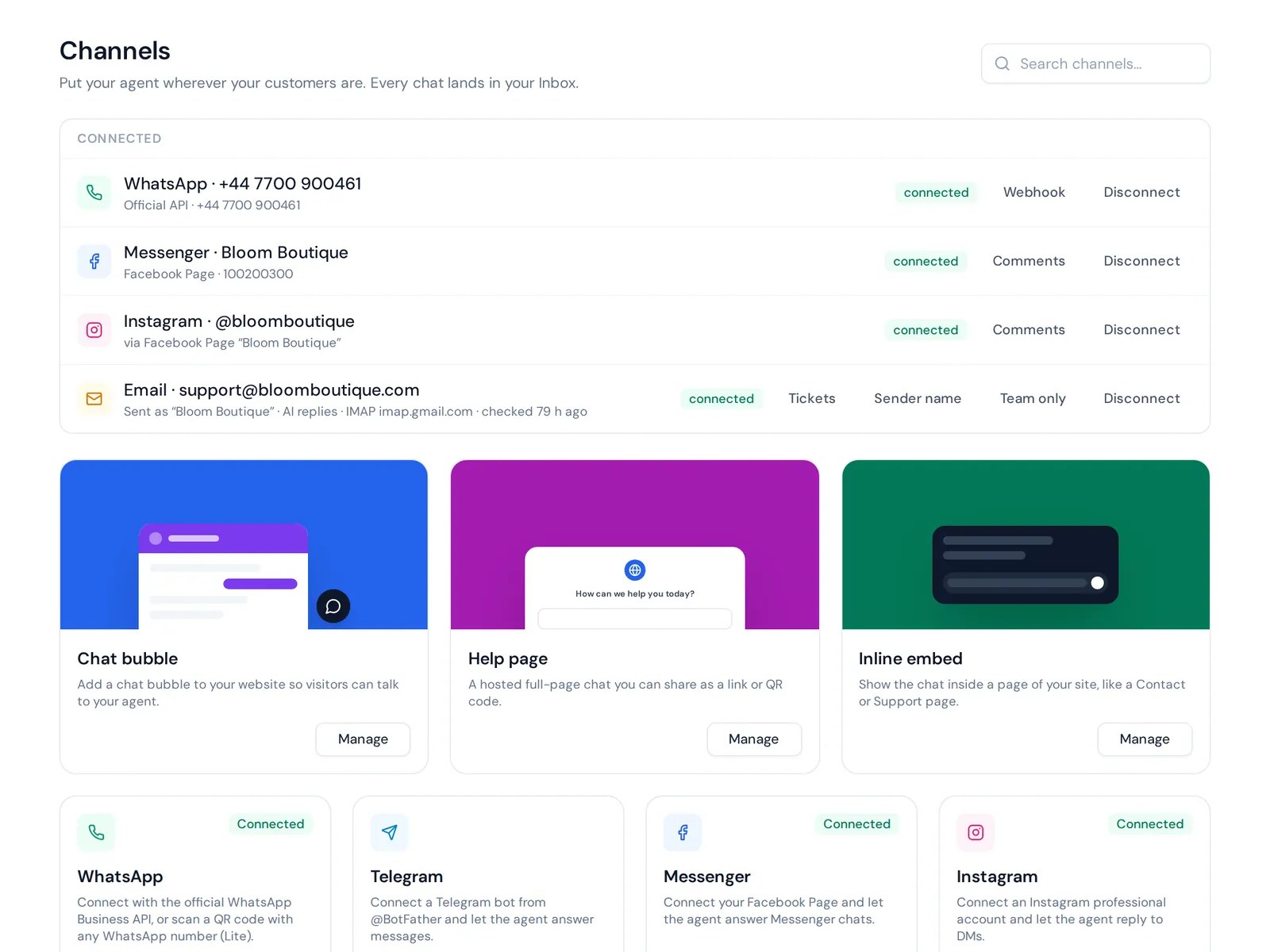
AnytimeReply is an AI customer support and sales agent with a built-in helpdesk, so one tool covers the entire sales conversation and the support that follows. You train it on your website, documents and Notion pages, and it answers buyers in their language across your website, WhatsApp, Messenger, Instagram, Telegram and email.
- Answer and qualify: the AI agent answers product and pricing questions, and flows capture leads with buttons and questions.
- Book and sell: actions connect to Cal.com, Calendly, HubSpot, Shopify and WooCommerce, so the AI can book meetings or show products with price and stock for verified customers.
- Follow up: outbound messages include WhatsApp broadcasts at a safe pace with STOP opt-out, proactive website messages on scroll or exit intent, one follow-up to quiet customers, and replies to Facebook and Instagram comments.
- Hand over: when a buyer wants a person, the chat moves to your team inbox with a summary.
Where we're not a fit: calling is not part of the product. We don't make or take phone calls, send SMS or analyze sales call recordings. If your sales motion is mostly cold calling, look at a calling or conversation intelligence tool instead. Website chat is free; messaging channels, actions and broadcasts are on paid plans. See pricing.
Frequently asked questions
How does conversational AI help sales teams?
It answers buyer questions instantly, qualifies and routes leads, books meetings and follows up, so reps spend their time on serious buyers instead of repeat questions.
How is conversational AI different from a chatbot?
The chat window is the interface. Conversational AI is the technology that lets it understand free text and reply naturally. Older bots used scripts; modern ones use AI technology.
Can an AI chatbot qualify leads automatically?
Yes. It asks qualifying questions during the chat, scores the answers against your rules and sends good-fit leads to sales or your CRM.
Can AI handle complex sales questions?
It handles a lot, as long as the answer is in your content. For custom pricing, negotiation or anything sensitive, it should hand over to a person.
Are AI sales chatbots easy to set up for small businesses?
Usually, yes. A basic AI agent trained on your website can be live in under an hour. Connecting calendars, CRMs and stores, and tuning answers, takes a few days of testing.
How much does it cost to implement?
It depends on the tool and volume. Many tools have free plans or trials and charge by messages, conversations or seats. AnytimeReply has a free plan; paid plans are on our pricing page.
Start small and let your data guide you
AI in sales works best when it does a few things very well: answers fast, asks the right questions and gets serious buyers to a human. Start with your website, track bookings and leads, and expand from there.
Want to see it with your own content? Start free with AnytimeReply, add your website and test the agent in a few minutes. No card needed.
Published 6 November 2026 by AnytimeReply team