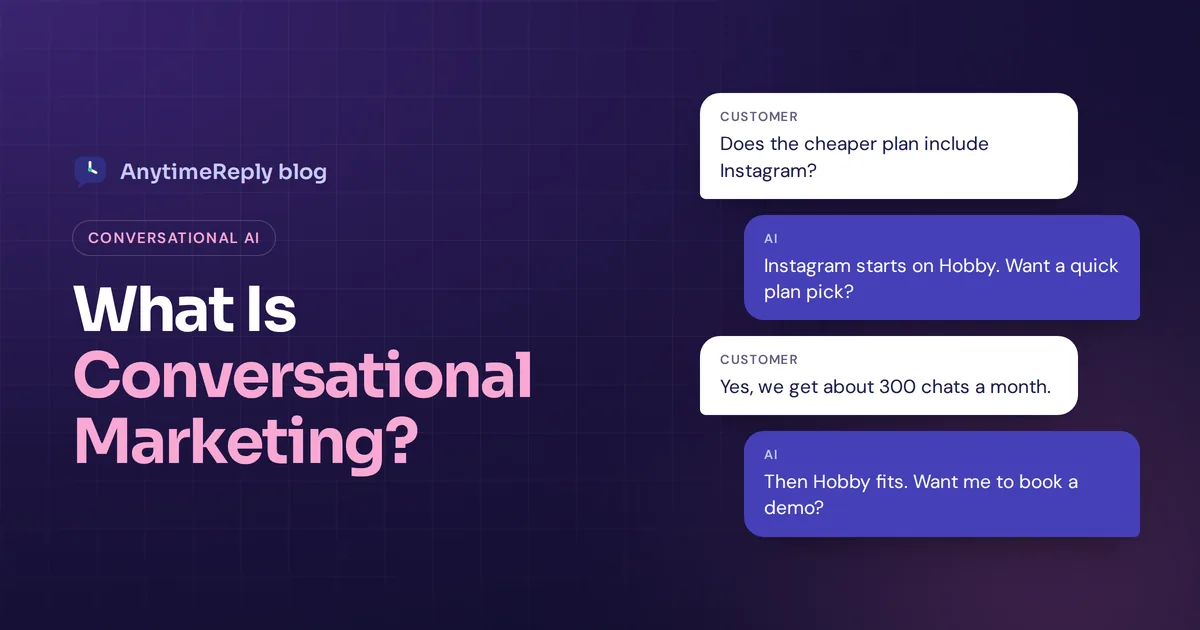
Someone is on your pricing page at 10 pm. They have one question: "Does the cheaper plan include Instagram?" On most websites, their only options are a contact form and a long wait. On a site that uses conversational marketing, they ask in a chat window, get an answer right away, and sign up.
So, what is conversational marketing? It's a marketing approach built on real-time, one-to-one conversations instead of forms, cold emails and "we'll get back to you in 48 hours". Website live chat, chatbots, Instagram DMs, Facebook Messenger and comment replies all count. The idea is simple: talk with buyers while they're interested, not days later.
Below we explain how it works, the benefits, real examples you can copy, and a step-by-step strategy for a small team. We build an AI chat platform, so we have a point of view, but we'll be honest about where this approach doesn't fit.
What is conversational marketing?
Conversational marketing is a customer-first approach where businesses use live chat, chatbots, AI agents and messaging apps to have two-way communication with customers and prospects. Instead of pushing one message to everyone, you answer each person's inquiry in the moment and guide them to the next step in the buying process.
The term became popular in the late 2010s, when chat software companies (Drift is the name most people link to it) argued that B2B websites should replace lead forms with chat. Today it's much wider. A clothing shop answering size questions on Instagram is doing conversational marketing too.
Three things define it:
- Real time. Replies come in seconds or minutes, not days.
- One-to-one. Each person gets answers about their own situation, needs and preferences.
- Two-way. The customer talks back. You learn their pain point instead of guessing it.
It also fits naturally into an inbound strategy. Your content and ads bring people in, and a conversation turns that interest into a lead or a sale.
Why conversational marketing helps your marketing efforts
People are used to messaging friends, family and businesses all day. Filling in a form and waiting feels slow by comparison. Conversational marketing helps because it meets buyers where they already talk and answers them at the exact moment they have a question.
It also changes what you know about your audience. Traditional marketing methods tell you who clicked. Conversations tell you why people buy, why they hesitate, and which words they use. That makes the rest of your digital marketing better too.
How conversational marketing works
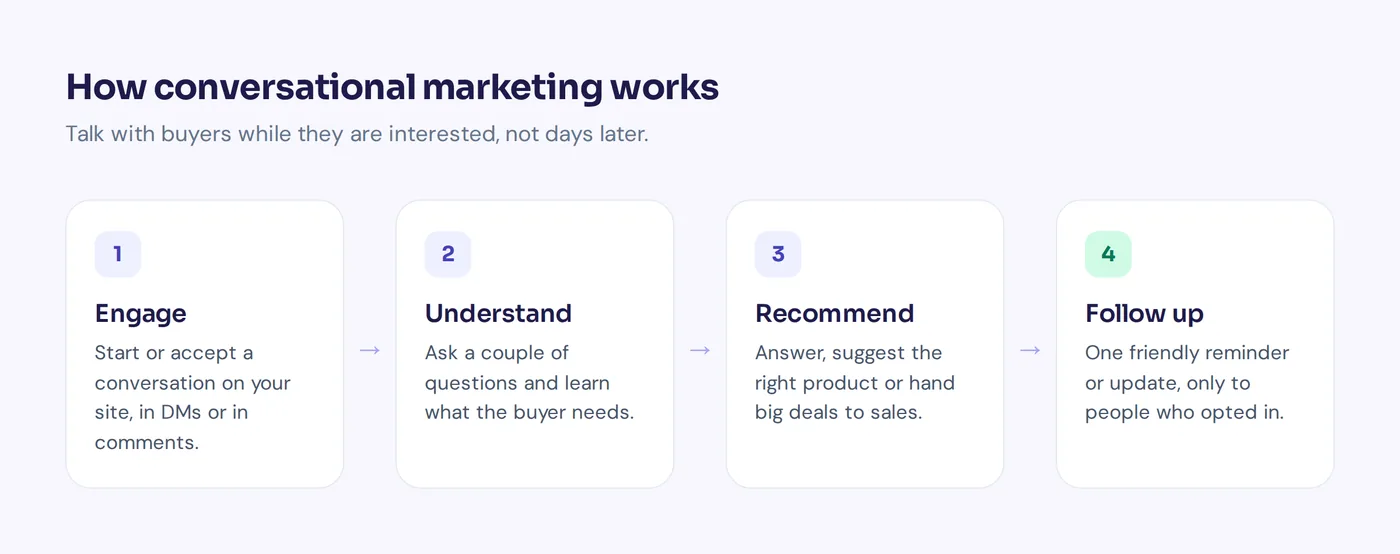
Most conversational marketing follows a simple loop: engage, understand, recommend.
- Engage. Start a conversation, or accept one, where the customer already is: a widget on your site, a DM, a comment on your post.
- Understand. Ask a couple of questions, or let the customer explain. What are they looking for? What's stopping them?
- Recommend. Give the answer, suggest the right product or plan, book a demo, or hand the chat conversation to a sales rep when it's a big deal.
Then you follow up. A quiet lead gets one friendly reminder. A customer gets an update when their order ships. Every customer interaction teaches you something you can feed back into your marketing campaigns.
Conversational marketing vs traditional marketing
| Classic approach | Conversational approach | |
|---|---|---|
| Direction | One-way: ads, emails, landing pages | Two-way: chats, DMs, replies |
| Timing | Forms and callbacks, often days later | In real time, while interest is high |
| Message | Same message for a whole segment | Personal answers for each person |
| Lead capture | Long forms | A few questions inside a conversation |
| What you learn | Clicks and opens | Real questions, objections and customer needs |
| Scale | Easy to scale | Needs chatbots or AI beyond a few people |
It's not either-or. Ads and content still bring people to you. Conversational marketing is what happens when they arrive with a question.
The benefits of conversational marketing
Here are the main conversational marketing benefits, in plain words.
Faster answers, fewer lost sales
Every hour a buyer waits is a chance for them to go elsewhere. Answering in seconds keeps them moving, which usually helps your conversion rate.
Better leads with fewer forms
For example, a form asks for an email and gives nothing back. A chat answers first, then asks for contact details when it makes sense. You can also qualify leads naturally by asking about team size, budget or timeline.
A personalized experience that builds trust
People like being treated as individuals. A quick, personal reply helps you build trust and makes your brand feel approachable. That kind of personalization is hard to fake with a mass email.
More customer loyalty
When people know they can message you and get a real answer, they come back. Good conversations after the sale build loyalty, not just the first order.
Customer data you can actually use
Your chat history is full of customer data: questions your site doesn't answer, objections that stop sales, products people keep asking for. Use it to optimize your pages, your FAQs and even your products and services.
Available outside business hours
With AI, conversations don't stop when your team logs off. An AI agent answers at night and on weekends, then hands hot leads to your sales team in the morning. The overall benefit is a better customer experience across the whole customer journey.
Conversational marketing examples you can copy
Each example of conversational marketing below works for a different kind of business. Use each example as a starting point, then change the words to fit yours.
1. Pricing page chat for a SaaS company
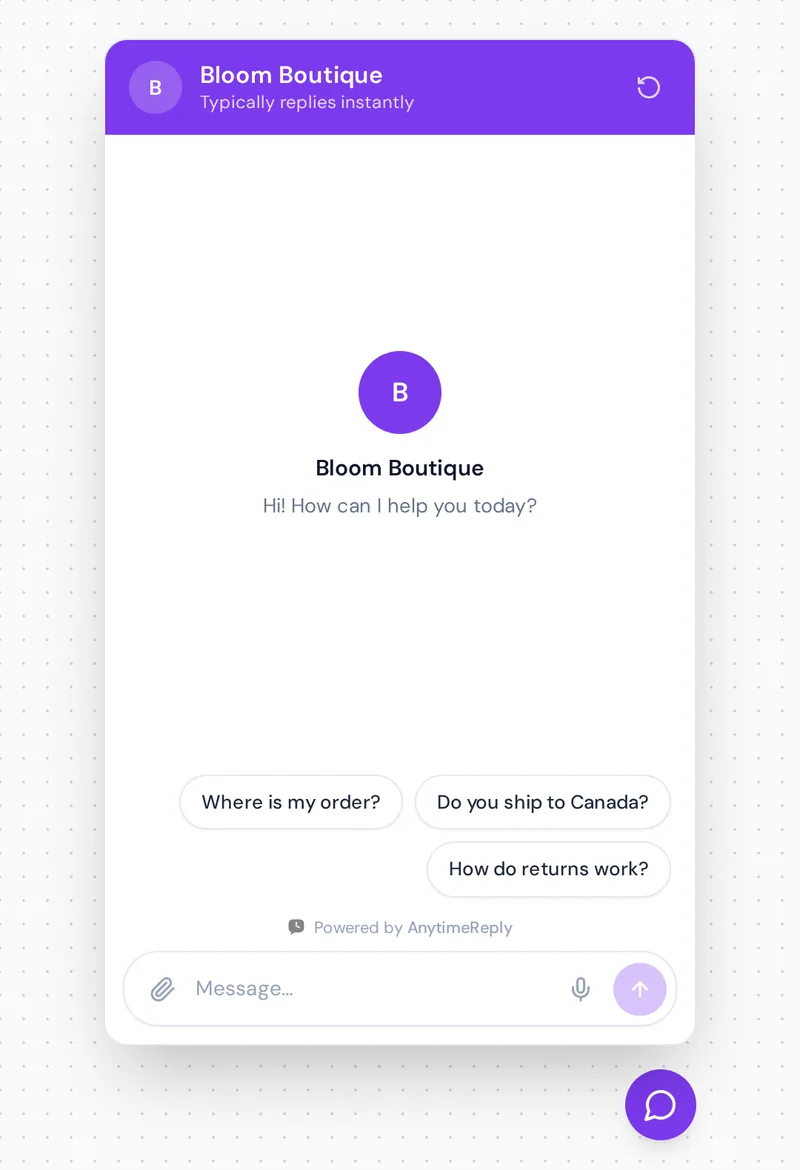
A proactive message appears after 20 seconds on the pricing page:
Hi! Trying to pick a plan? Tell me roughly how many chats you get a month and I'll suggest one.
The chatbot answers plan questions and offers to book a demo for bigger teams.
2. Size and fit questions for an online store
On a product page, the AI answers "Is this true to size?" from the size guide, shows the product with stock, and offers a code to first-time buyers.
3. Instagram comment to DM
Someone comments "price?" under a post. The brand replies publicly ("Sent you a DM!") and sends the price and link privately. This is how many sellers use social media platforms to sell every day.
4. A broadcast people can reply to
A bakery sends a WhatsApp message to customers who opted in: "Eid pre-orders are open. Reply with what you'd like and we'll confirm." Replies land in the inbox, where AI or staff take the orders. That's a simple conversational marketing campaign.
5. Exit-intent chat
When a visitor moves to close a checkout page:
Before you go, any questions about shipping or returns? I can answer in seconds.
6. Meeting booking inside the chat
A consultancy's bot asks two qualifying questions, then shows open times from the team calendar. No back-and-forth emails.
7. One follow-up to a quiet lead
A visitor asked about a plan but didn't sign up. The next day: "Still deciding? Happy to answer anything else." One message, not five.
Conversational marketing strategy: how to start in 7 steps
You don't need a big team or budget. Here's a simple conversational strategy for a small business.
- Pick one goal. More demo bookings? Fewer abandoned carts? More orders from DMs? One goal keeps you focused.
- Choose your communication channels. Go where your customers already talk. For B2B SaaS that's usually website chat. If you use social media to sell, it's Messenger and Instagram.
- List the questions buyers ask before buying. Pull them from emails, DMs and sales calls.
- Decide who answers what. Let chatbots handle common questions and simple qualification. Send big deals, complaints and custom requests to people.
- Write your openers and conversation flows. A short greeting for each key page, a few qualifying questions, and a clear handoff to sales.
- Set up follow-ups carefully. Order updates, one reminder to quiet leads, broadcasts only to people who opted in, with an easy way to stop.
- Measure and improve. Use analytics to track conversations started, leads captured, meetings booked, sales from chat, response time and customer satisfaction. Read real chats every week.
The role of AI, chatbots and conversational AI
Doing this by hand works while you're small. Once you get dozens of chats a day from various channels, you need help. That's the role of AI.
Older rule-based chatbots used button menus. They're fine for simple choices but break when someone types a real query. Modern AI chatbots use conversational AI to understand natural language and answer from your own website and documents, so conversational experiences feel much more natural.
The best setup for most businesses is AI first, human when it matters. The AI answers instantly, qualifies leads and collects details. Your team jumps in where a person adds value. Neither works as well alone.
Conversational marketing tools, channels and CRM
- Website live chat and AI agents. The core of most setups, especially for products or services people research before buying.
- Social media messaging. Instagram DMs, Facebook Messenger and comment replies.
- Chat apps. WhatsApp and Telegram for order updates, broadcasts and support.
- A shared inbox. So every customer communication lands in one place, not five apps.
- A CRM. To keep contact details and history, and connect chat leads to sales.
- Marketing automation. Proactive messages, follow-ups and flows, with a person always reachable.
Pick conversational marketing tools that work together. A great chatbot that can't hand over to your team, or leads that never reach your sales team, will waste the effort.
Best practices to personalize without being pushy
- Personalize with context. Use the page they're on, their past orders or their language. Don't fake familiarity.
- Don't spam. Broadcast only to people who opted in, and not too often. Some apps restrict numbers that get reported as spam.
- Skip the pushy popups. A chat that opens on every page after two seconds feels like a salesperson following you around the shop.
- Never trap people. If someone wants a human and can't reach one, you lose them.
- Keep answers accurate. An AI that guesses prices or policies does more harm than no chat at all.
- Think about user experience. Short messages, clear buttons, a fast path to the answer.
And to be fair: this isn't for everyone. If you sell a cheap product that nobody asks questions about, a clear product page may be enough.
How AnytimeReply supports conversational marketing
AnytimeReply is an AI customer support and sales agent with a built-in helpdesk. You train the AI agent on your website and documents, and it answers on your website and messaging channels day and night, in the customer's language (including Bangla, Banglish, Hindi and Hinglish).
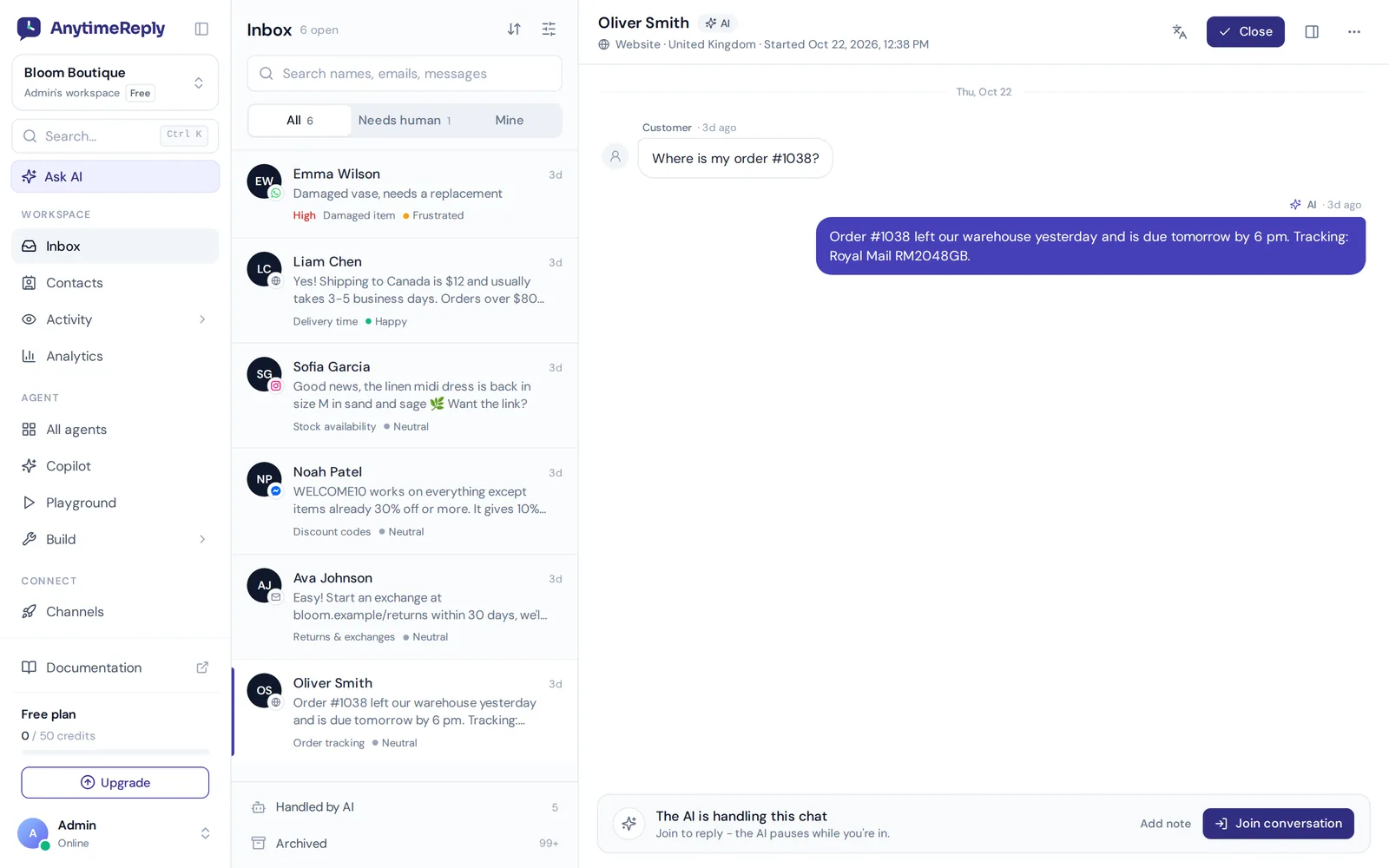
For the marketing side, outbound messages let you send WhatsApp broadcasts at a safe pace with daily limits and STOP opt-out, show proactive website messages after a few seconds, on scroll or on exit intent, send one follow-up to quiet customers, and reply publicly or privately to Facebook and Instagram comments. Flows handle lead capture with buttons and questions, and actions can book meetings through Cal.com or Calendly, or connect to HubSpot.
When a lead needs a person, the conversation moves to your shared inbox with a summary. Website chat and flows are on the Free plan. Messaging channels, broadcasts and actions start on Hobby. See pricing for details.
Frequently asked questions
What is conversational marketing in simple words?
It's marketing through real conversations. Instead of making people fill in forms and wait, you chat with them in real time on your website or social channels and help them decide.
Why is conversational marketing important?
Buyers expect quick, personal answers. Conversations remove friction before a purchase, surface objections you didn't know about, and build relationships that last after the sale.
Is conversational marketing the same as a chatbot?
No. A chatbot is one tool. Conversational marketing is the approach. It can use chatbots, AI agents, live chat with people, and social media messages.
What's the difference between conversational marketing and conversational commerce?
They overlap. Conversational marketing focuses on engaging and qualifying buyers. Conversational commerce usually means buying inside the chat itself.
Does conversational marketing work for small businesses?
Yes, often better than for big companies, because small businesses can be personal and fast. An AI agent lets a small team keep up without hiring.
Final thoughts
Conversational marketing is really good old selling, done in chat. Answer people quickly, listen to what they need, recommend the right next step, and don't spam them. With AI handling the first reply, even a two-person team can do it around the clock.
Want to try it on your own site? Start free with AnytimeReply, train the agent on your website and watch the conversations come in. No card needed.
Published 3 November 2026 by AnytimeReply team