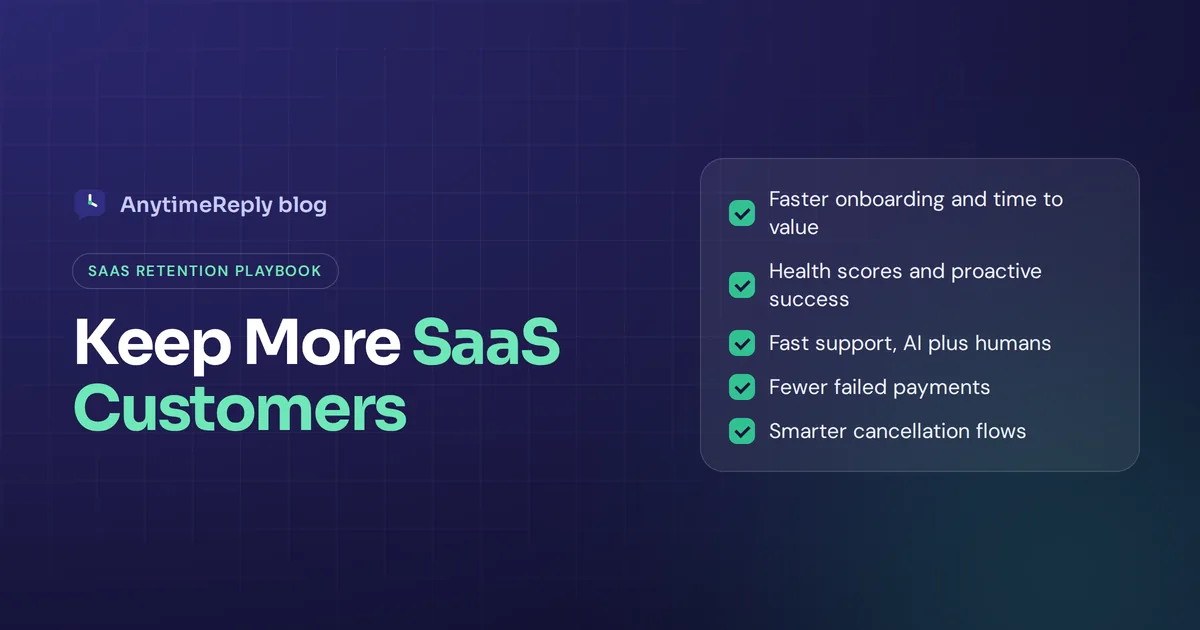
Getting a new customer to sign up for your SaaS product is hard. Watching them quietly cancel three months later is worse. In a subscription business, every customer who leaves takes their future payments with them, so retention often matters more to growth than one more marketing campaign.
The good news: most churn is predictable and a lot of it is preventable. Below are the top strategies for SaaS customer retention that work for small and large teams, from onboarding and account check-ins to support, billing and cancellation flows. Each one comes with a practical example you can use this month.
We build a support platform used by software companies, so we have opinions about the support part. We'll keep them honest.
What is customer retention in SaaS?
Customer retention is your ability to keep paying customers subscribed over time. The opposite is customer churn: customers who cancel, don't renew or let their payment fail and never come back.
Retention isn't just about stopping cancellations. It's about making sure every customer keeps getting value from your product, so renewing feels like an easy decision rather than something they forgot to cancel. A good customer retention strategy covers the whole customer lifecycle, from the first login to the tenth renewal.
Why customer retention is critical for SaaS
In a subscription model, revenue is earned month by month. A customer who stays three years is worth many times more than one who stays three months, and you paid roughly the same to win both.
- Customer acquisition is expensive. Ads, sales and marketing, free trials and demos all cost money. If customers churn before they pay back your customer acquisition costs, growth turns into a leaky bucket.
- Retained customers expand. A happy customer adds seats, upgrades plans and buys add-ons.
- Loyal customers refer others. They write reviews, recommend you to peers and give you case studies, which lowers the cost of new customer acquisition.
- Feedback gets better. Long-term users tell you what to build next.
Retention is crucial because you can't grow a healthy SaaS business on new sign-ups alone. Your customer base has to stay and grow too.
SaaS retention metrics to track
You can't improve what you don't measure. These are the retention metrics most SaaS companies track:
| Metric | What it tells you | Simple formula |
|---|---|---|
| Customer churn rate | Percentage of customers lost in a period | Customers lost ÷ customers at start of period |
| Customer retention rate | Percentage of customers you kept | (Customers at end minus new customers) ÷ customers at start |
| Gross revenue retention (GRR) | Revenue kept from existing customers, ignoring upgrades | (Starting MRR minus churn and downgrades) ÷ starting MRR |
| Net revenue retention (NRR) | Revenue kept including upgrades and expansion, also called net retention rate | (Starting MRR minus churn and downgrades plus expansion) ÷ starting MRR |
| Customer lifetime value (LTV) | The total revenue a customer brings over time | Average revenue per account ÷ churn rate (a common shortcut) |
| Net promoter score (NPS) | How likely customers are to recommend you | % promoters minus % detractors |
Track both the number of customers and revenue. Losing ten small accounts and losing one big one look very different depending on which metric you watch. And look at retention by cohort (customers grouped by signup month) so you can see whether changes you make actually help newer customers stay longer.
What leads to customer churn
Before picking a strategy, understand what can lead to customer churn in your product. The usual reasons:
- They never got value. Poor onboarding, so they didn't reach the result they signed up for.
- Bad customer service experience. Slow replies, unclear answers or being bounced between people. One bad customer experience can undo months of good work.
- The product doesn't fit anymore. Their needs changed, the team shrank or a key feature is missing.
- Price. The plan feels too expensive for the value they get, or budgets got cut.
- Failed payments. An expired card, not a decision. This is involuntary churn.
- A champion left. The person who chose your tool moved on, and nobody else cares about it.
Read exit surveys, cancellation reasons and support history to find your top two or three. Then pick the strategies below that fix them.
Top strategies for SaaS customer retention
Here are 14 SaaS customer retention strategies to help you keep customers longer, roughly in the order a customer experiences them along the customer journey.
1. Get new users to value fast
Many users decide whether a product is worth keeping in their first days or weeks. If they never reach the "aha" moment, they churn, often without telling you why.
Map the shortest path to value and remove everything that gets in the way. Use a short setup checklist, sensible defaults, sample data and a welcome email sequence that points to one next step at a time.
Example: a project management tool asks new users to create one project and invite one teammate before showing anything else, because teams who do both tend to stay.
2. Define activation and track product usage
Pick the few actions that separate customers who stay from those who leave. Then track them. Login frequency, key feature usage, active seats and connected integrations are common signals of user retention.
When usage drops, that's your early warning. A customer who logged in daily and suddenly stops is a renewal risk long before they click cancel.
3. Build simple customer health scores
Combine usage, support tickets, payment status and customer feedback into one score per account: green, yellow or red. It doesn't need to be fancy. A spreadsheet that flags "no login in 14 days" and "three tickets about the same bug" is already useful.
The point of customer health scores is to know which accounts need attention this week, not to build a perfect model. Use customer data you already have before buying a new tool.
4. Be proactive with customer success
Don't wait for customers to come to you with problems. Reach out when the health score drops, when a renewal is two months away or when a new feature solves something they asked about.
For larger accounts, a regular business review that shows results ("your team closed 1,200 tickets this quarter") reminds the buyer why they pay. Your customer success team or account managers own this.
5. Offer fast, always-available customer support
Slow support is a quiet churn driver. A customer who waits two days for an answer to a simple question starts wondering if the product is worth the hassle, and starts looking at competitors.
Answer the easy questions instantly and make the hard ones easy to escalate. An AI assistant trained on your docs can handle "how do I export my data?" at 2 am, while your team focuses on bugs, billing problems and complex setups. Just make sure customers can always reach a person. Good customer support is one of the strongest levers for customer satisfaction and customer loyalty.
6. Invest in self-service: help center and in-app guidance
Many customers would rather find the answer themselves than open a ticket. A searchable help center, short how-to videos and in-app tooltips help them get unstuck without waiting.
Keep articles short, update them with every release and watch which searches return nothing. Those are your next articles.
7. Collect feedback and close the loop
Use short surveys (NPS, CSAT after a support chat) and actually read the comments. Then tell customers what you did with their feedback: "You asked for a Slack integration. It's live."
Customers who feel heard are far more forgiving when something goes wrong. This builds strong customer relationships over time.
8. Reduce involuntary churn from failed payments
Not every churned customer chose to leave. Expired cards and failed payments cause a lot of silent churn. Set up automatic retries, reminder emails before a card expires and an easy way to update payment details.
This is often the fastest way to reduce churn, because these customers wanted to stay.
9. Offer flexible plans, downgrades and pauses
Some customers cancel because their needs changed, not because they're unhappy. A cheaper plan, fewer seats or a pause option keeps them in your product instead of sending them to a competitor.
A customer on a smaller plan can upgrade again later. A cancelled one usually doesn't.
10. Encourage annual plans
Annual billing gives customers a full year to build habits in your product and fewer monthly moments to reconsider. A modest discount for paying yearly is common in SaaS.
Be careful though: annual plans delay churn, they don't fix it. If the product isn't delivering value, you'll see it at renewal.
11. Grow accounts through expansion and upselling
Customers who use more of your product are harder to replace. Suggest upgrades when an existing customer hits a limit or would clearly benefit from a feature, not just to hit a sales target. Expansion is what pushes NRR above 100%.
12. Personalize the experience for different customer segments
A solo founder and a 200-seat enterprise need different onboarding, emails and check-ins. Segment by plan, company size, use case or industry, and tailor your messages. Personalization keeps customer engagement high because each customer sees what's relevant to them.
13. Design a thoughtful cancellation flow
When someone clicks cancel, ask why in one quick question. Then offer something relevant: a downgrade if price is the problem, a call with support if it's a bug, a pause if they're just busy. Don't make cancelling hard. Dark patterns create angry customers and bad reviews.
Use exit survey answers to find patterns, and send a win-back email a few weeks later to customers who left for fixable reasons.
14. Build relationships with several people in each account
If one champion loves your product and then leaves the company, the account is at risk. Build relationships with the admin, the daily users and the person who signs the contract. More people who depend on the product means a safer renewal. This is one of the most reliable b2b customer retention strategies.
Customer retention in B2B SaaS vs B2C
| B2B SaaS | B2C or prosumer SaaS | |
|---|---|---|
| Who decides to renew | A buyer, often not the daily user | The user themselves |
| Best retention levers | Business reviews, several contacts per account, integrations | Onboarding, habit-building, pricing, self-service |
| Main churn signals | Seat drops, champion leaves, low usage before renewal | Fewer logins, failed payments, no activation |
| Support style | Named contacts, SLAs, escalation paths | Fast self-service and chat |
Many SaaS companies sell to both. If that's you, segment your retention strategy instead of running one playbook for everyone.
How to build a customer retention strategy in 6 steps
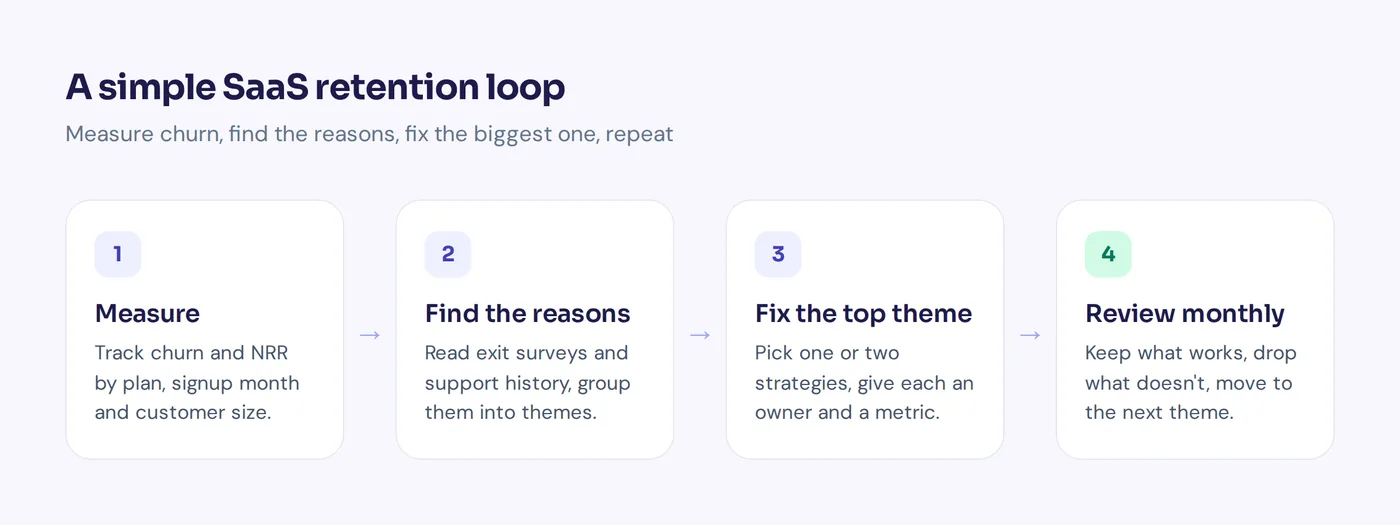
- Measure your current churn and NRR. Split by plan, signup month and company size to see where it hurts most.
- Talk to churned customers. Read exit surveys and support history. Group reasons into a few themes.
- Pick the two biggest themes. Onboarding, support speed, missing features, price or failed payments.
- Choose one strategy for each. Use the list above, and keep it small enough to finish.
- Assign an owner and a metric. For example, "Head of support, reduce month-two churn".
- Review monthly. Keep what works, drop what doesn't, then move to the next theme.
If you want to increase customer retention, don't wait for one big project. A successful retention strategy is a steady habit of monitoring customer retention, finding the next reason customers leave and fixing it.
Common retention mistakes to avoid
- Only acting at cancellation. By then the decision is usually made. Watch the signals months earlier.
- Treating every customer the same. A 200-seat account and a solo user need different attention.
- Making it hard to reach a human. AI support is great for speed, but customers who can't reach a person when it matters will leave.
- Ignoring failed payments. Easy revenue to save.
- Chasing scores instead of fixing problems. The NPS number matters less than what you do with the comments.
How AnytimeReply helps SaaS companies improve customer support
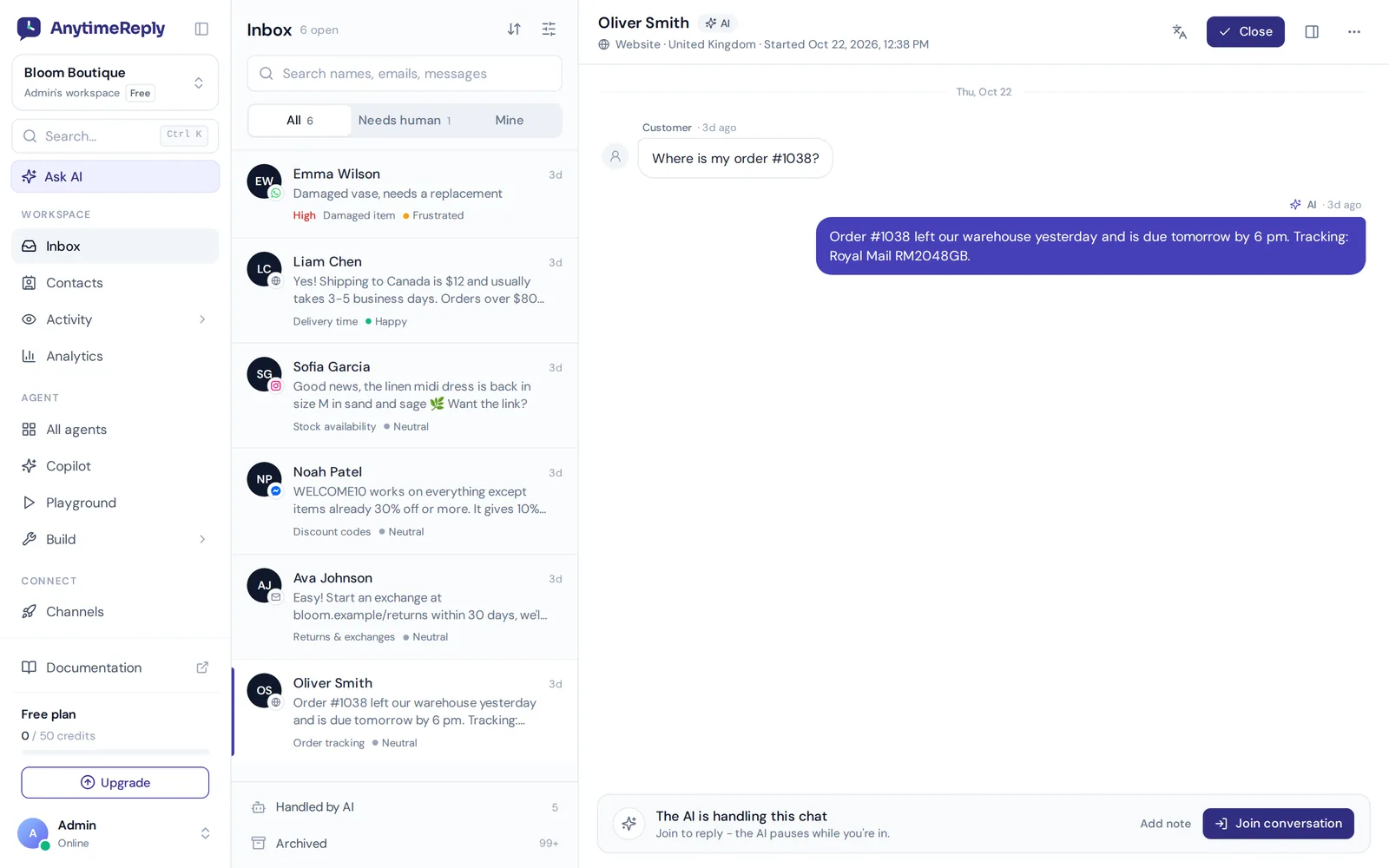
Support is one piece of any retention strategy, but it's the piece customers feel every week. We built AnytimeReply to make that piece fast without losing the human side. Here's what software teams use it for (see our SaaS use case):
- Instant answers from your docs. The AI agent learns from your website, help articles, PDFs and Notion pages, answers in the customer's language and says when it doesn't know instead of guessing.
- A help center on your own domain. Publish articles from the agent's knowledge on help.yourdomain.com with AI search that answers questions instead of listing links. See the help center.
- Handoff to your team. When a customer asks for a person, gets frustrated or the AI can't answer, the chat moves to a shared inbox with a summary.
- Actions for verified customers. On paid plans, the agent can manage subscriptions through Stripe or book a call with Calendly or Cal.com, with confirmation and limits.
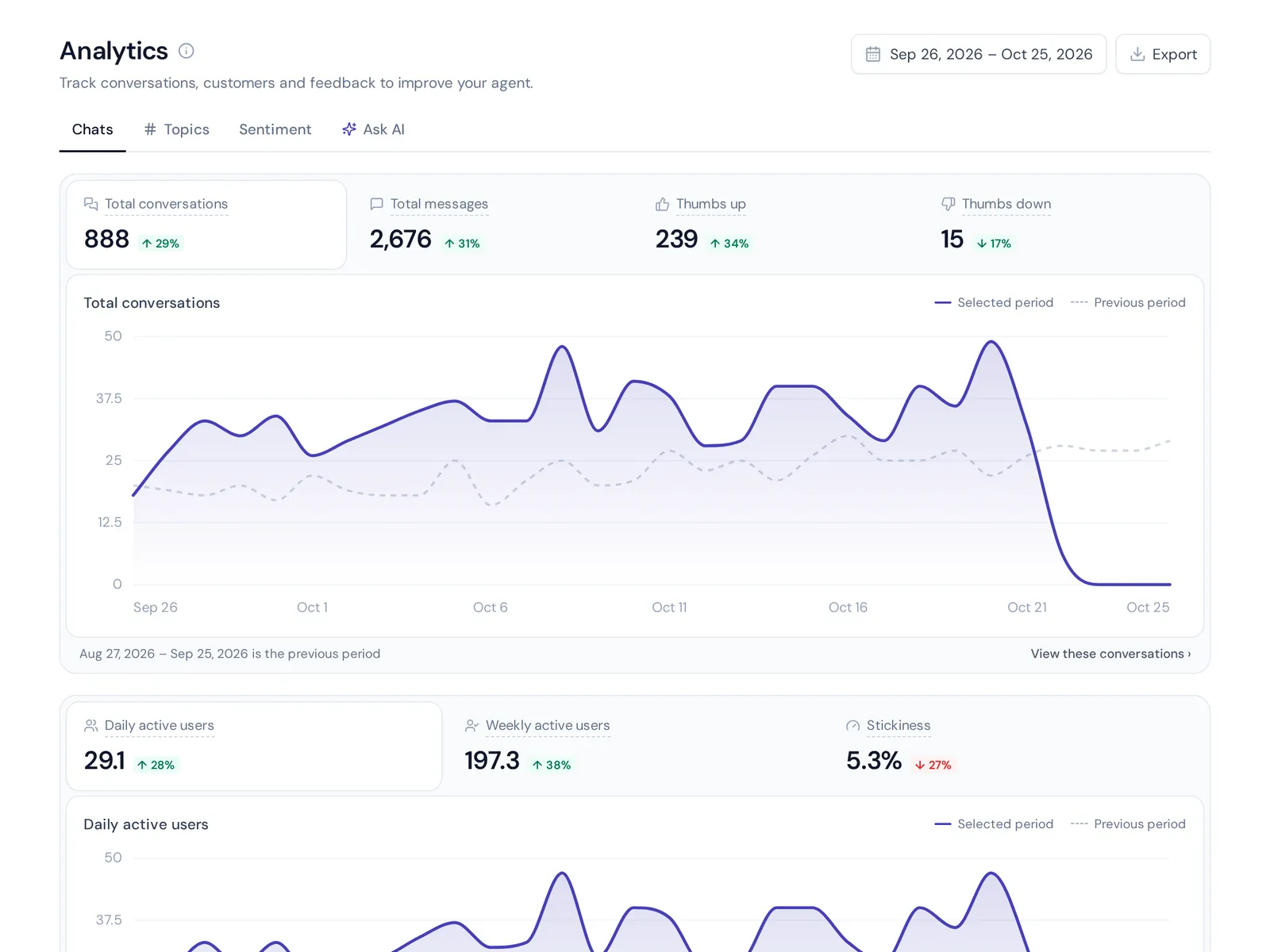
- Analytics that show risk. Topics, sentiment, CSAT ratings and knowledge gaps show what frustrates customers. See analytics.
Where it's not the fit: AnytimeReply isn't a customer success platform with health scores, and it doesn't do phone support. Use it alongside your billing and CS tools, not instead of them.
Frequently asked questions
What is a good retention rate for SaaS?
It depends on your market. Products sold to large companies usually retain better than tools for small businesses or consumers. Compare yourself with companies of a similar size and price point, and focus on improving your own trend over time.
What are five effective strategies for retaining customers?
Fast onboarding to value, proactive check-ins based on usage, quick and friendly support, fixing failed payments, and a cancellation flow that offers a downgrade or pause. Together they cover the most common reasons customers leave.
What is the difference between churn and retention?
They're two sides of the same number. Churn is the percentage of customers or revenue you lose in a period. Retention is the share you keep.
What is the rule of 40 in SaaS?
It's a rule of thumb that a healthy SaaS company's revenue growth rate plus its profit margin should add up to at least 40%. Strong retention helps both sides: it keeps growth up and acquisition costs down.
How does customer support affect retention?
Slow or unhelpful support makes customers doubt the product and look at alternatives. Fast answers, easy escalation and a good help center remove friction and build trust.
Increase retention by being easy to work with
There's no single trick to retain customers. It's onboarding that gets people to value, support that answers quickly, billing that doesn't fail silently and a team that notices when something is off.
If faster support is on your list, start free with AnytimeReply, no card needed, and train an AI agent on your docs in an afternoon.
Published 28 October 2026 by AnytimeReply team