It's November. Orders are up, which is great. But so are the "where is my order?" emails, the size exchange requests and the Instagram DMs asking if the red jacket is back in stock. You're answering tickets at midnight instead of planning next month's products.
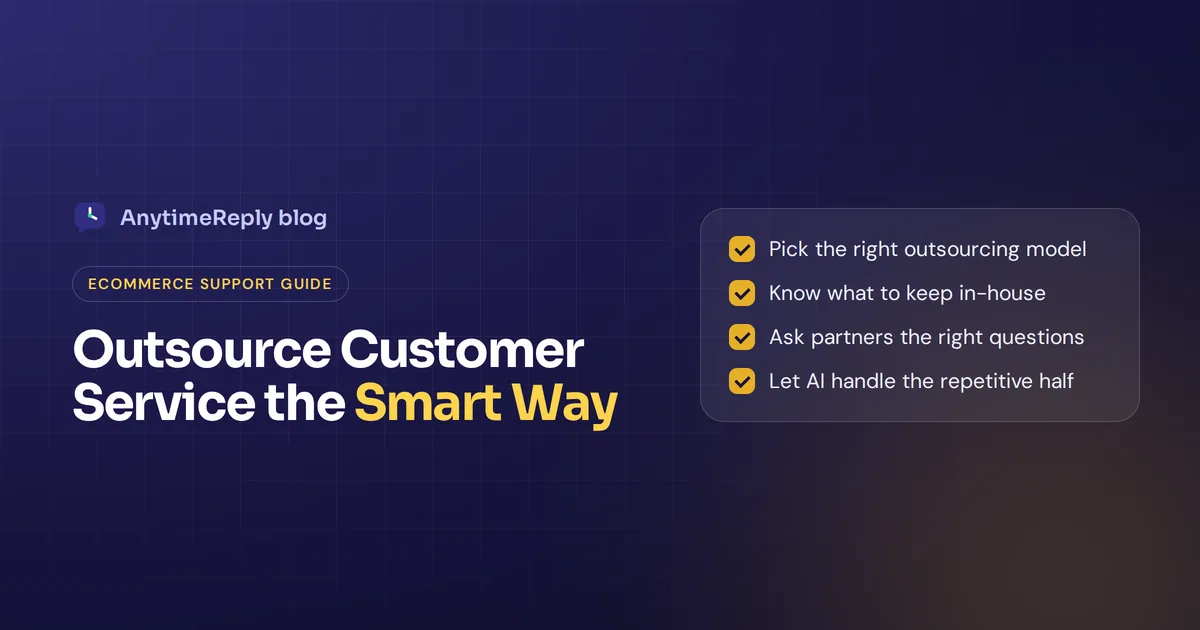
That is usually the moment store owners start looking at how to outsource ecommerce customer service. Handing support to an outside team can buy back your time and give customers faster answers. Done badly, it can also make your brand sound like a call center script and hurt the customer experience you worked hard to build.
This guide walks through when outsourcing makes sense, the different models, what it typically costs, how to choose and onboard a partner, and where AI fits in now. We'll be honest about the downsides too.
What is ecommerce customer service outsourcing?
First, what is e-commerce customer service? It's every way an online store helps shoppers before and after they buy: product questions, order tracking, returns, payment problems and complaints, across email, live chat, social media and sometimes phone.
Outsourcing ecommerce customer service means paying an outside company or freelancer to do that for you. Their customer service agents reply to support tickets, live chat support, social media support and sometimes phone support, using your policies, your tools and (ideally) your brand voice. Larger providers call this business process outsourcing (BPO).
It can be full or partial. Some stores hand over everything. Others outsource only nights and weekends, only email, only Black Friday, or only the simple "where is my order" tickets while keeping complaints in-house.
Signs your ecommerce business should outsource customer support
- You or your customer service team are answering tickets instead of growing the business. Founder time is the most expensive support in the world.
- Response times are slipping. Customers wait a day for a reply to a question that takes 30 seconds to answer.
- Your volume is seasonal. Hiring full-time staff for a peak that lasts six weeks rarely makes sense.
- You sell across time zones. Customers in other countries message while you sleep.
- You need languages you don't speak. Expanding to new markets means multilingual support.
- Most tickets are repetitive. Order status, returns, sizing and shipping questions follow clear rules that someone else can learn.
If only the last point is true, read the section on AI before you sign a contract. You may not need people for those at all.
Pros and cons of ecommerce customer support outsourcing
| Pros | Cons |
|---|---|
| Frees your time for product, marketing and growth | Less control over tone and quality |
| 24/7 coverage without night shifts for your team | Agents know your products less deeply than you do |
| Easy to scale up for peaks like Black Friday | Onboarding takes real effort and time |
| Often cheaper than hiring in-house, especially offshore | Costs can grow quickly with volume |
| Access to trained support agents, tools and processes | Sharing customer data with another company |
| Omnichannel support in more languages | Risk of generic, scripted replies that hurt service quality |
Our honest view: outsourcing works best for clear, repeatable work with good documentation. It struggles with complex products, emotional complaints and brands whose voice is a big part of what they sell.
What your outsource partner should handle, and what to keep in-house
You don't have to choose all or nothing. Many online retail brands keep a small in-house customer service team and split the work like this:
Good to outsource
- Order status and tracking questions
- Shipping times, costs and countries
- Standard returns and exchanges that follow a clear policy
- Product questions answered by your product pages (sizes, materials, care)
- Discount code problems, checkout help and basic technical support
- Night, weekend and holiday coverage
- Peak season overflow
Better kept in-house
- Angry customers, chargebacks and disputes
- Refunds above a set amount
- VIP and wholesale customers
- Influencer and partnership messages
- Product defects and quality issues (you need to hear about these)
- Anything involving legal or safety concerns
Ecommerce outsourcing models: freelancers, agencies and call center outsourcing
The right outsourcing model depends on your volume, budget and how much control you want.
Freelancers and virtual assistants
A single person working a set number of hours, found on freelance marketplaces or through referrals. Cheap and flexible, great for small stores. The catch: one person means no cover for sick days, holidays or sudden spikes.
Specialist ecommerce support agencies
Companies that only offer ecommerce support services and customer care for online stores. A good ecommerce customer service outsourcing company knows the ecommerce and retail world. Agencies like this usually know Shopify, WooCommerce and common helpdesk tools, and understand returns, shipping carriers and fraud. Often the best fit for growing brands.
Call center outsourcing and large BPOs
BPO companies run big contact centers with hundreds of customer service representatives. Ecommerce call center outsourcing (UK providers often say ecommerce call centre outsourcing) suits high-volume stores, especially if you need phone lines. It can feel less personal for small brands.
Dedicated vs shared agents
With dedicated support, the same agents work only on your store and learn it deeply. With shared agents, a pool of people handles several brands. Shared is cheaper; dedicated usually gives better quality.
Onshore, nearshore and offshore
Onshore teams are in your own country (best language and culture fit, highest cost). Nearshore teams are in nearby countries with similar time zones. Offshore teams are further away, often much cheaper, and can give natural overnight coverage.
How much does ecommerce support outsourcing cost?
Prices vary a lot by country, language, channel and quality, so be careful with any single number you read. What we can explain is how pricing usually works:
- Per hour: you pay for agent hours, common with freelancers and dedicated agents.
- Per agent per month: a fixed fee for a full-time dedicated agent. Common when you outsource ecommerce call center or chat seats.
- Per ticket or per contact: you pay for each conversation the outsourcing service handles. Good for spiky volume, but watch for costs on simple follow-ups.
- Setup and training fees: some agencies charge for onboarding, tools or minimum contract terms.
A simple way to compare: say you get 1,500 tickets a month. Ask each customer service outsourcing provider for a full monthly price at that volume, at your peak volume, and for the minimum contract length. Then compare that with what it would cost to automate the repetitive half with AI and outsource only the rest.
How to outsource customer service, step by step
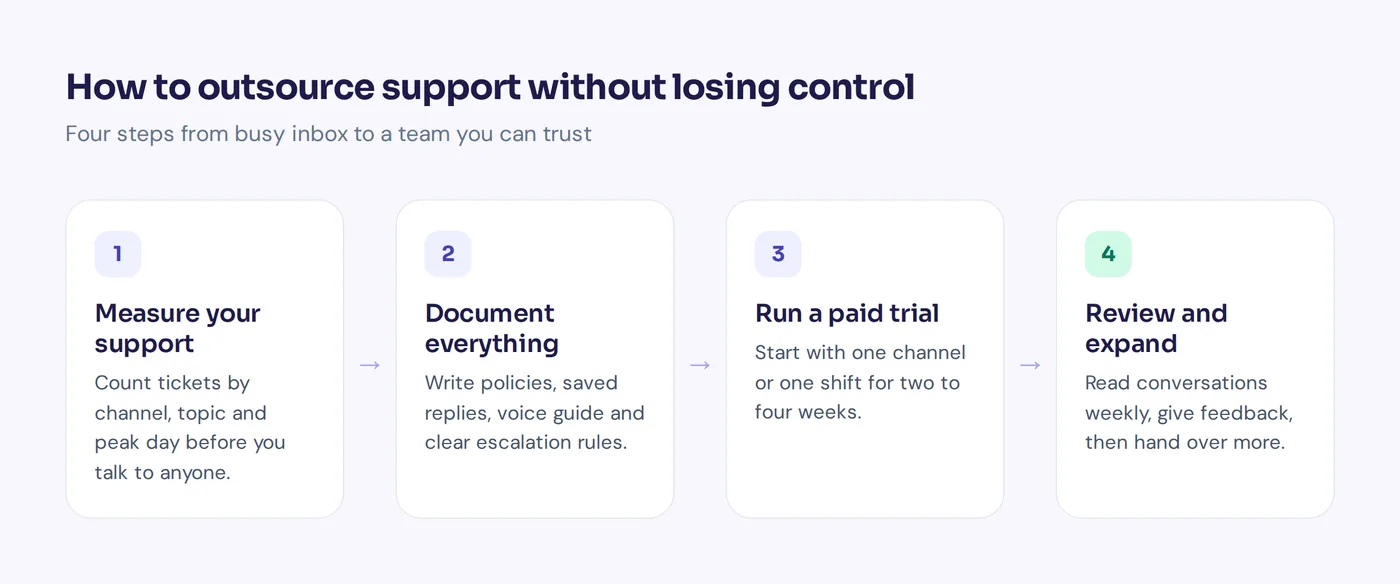
- Measure your support. Count tickets per month, per channel and per topic. Note your peak days and response times. You can't brief a partner without this.
- Decide the scope. Which support channels, hours, languages and ticket types will the partner handle? Email support only, or live chat too? What stays in-house?
- Write down your customer service process. Create or update your knowledge base: policies, FAQs, product info, saved replies, and clear rules for refunds and exceptions.
- Shortlist outsourcing companies. Ask the questions in the next section and get references from stores like yours.
- Run a paid trial. Start with one channel or one shift for two to four weeks.
- Set up tools and access. Give agents access to your helpdesk and store admin with the lowest permissions they need.
- Agree on SLAs and QA. Response time, resolution time, quality checks, and who reviews what each week.
- Review and expand. Read a sample of conversations weekly, give feedback, and only then hand over more.
How to choose customer support outsourcing companies
Customer service outsourcing companies all promise great service. Before you pick a customer service outsourcing partner, ask these questions:
- Do you have experience with ecommerce brands? Which platforms and helpdesks (Shopify, Zendesk, Gorgias) have your agents used?
- Will we get dedicated agents or a shared team? Do you also offer help desk outsourcing, or only agents?
- What response times do you commit to, per channel?
- How do you train agents on a new brand, and how long does it take?
- How do you check quality, and can we see the reviews?
- How do you scale support for peak season and flash sales?
- What languages do your agents write in natively?
- How do you protect customer data and who can access our store?
- What is the minimum contract and notice period?
- Can you share references from stores of a similar size?
Onboarding your outsourced ecommerce support team
Most outsourcing failures are onboarding failures. The agents aren't bad; they just weren't told enough.
- Brand voice guide. One page: how you greet, sign off, use emojis or not, words you love and words you never use. Include five example replies you're proud of.
- Policy cheat sheet. Returns, exchanges, shipping, discounts and what agents can approve on their own (for example, refunds up to a set amount).
- Saved replies. Templates for the top 20 questions, written in your voice.
- Escalation rules. Exactly which tickets come back to you, who owns them, and how fast you respond to customer escalations.
- Product training. Short videos or notes on bestsellers, sizing and common issues.
- A shared channel. A place where agents can ask your team quick questions.
Ecommerce customer service best practices for a better customer experience
Whoever answers your customers, outsourced or not, these ecommerce customer service best practices make the biggest difference in practice:
- Be fast on simple questions. Order status and shipping questions should get answers in minutes, not days.
- Be where customers already are. Website chat, email, WhatsApp, Instagram and Messenger, ideally in one inbox. That is omnichannel customer service, and it is what customer expectations look like now.
- Make tracking easy. Most "where is my order" tickets disappear when customers can check themselves.
- Publish a clear help center. Good self-service answers questions before they become tickets.
- Personalize. Use the customer's name and order details. Nobody likes "Dear valued customer".
- Keep promises small and specific. "We'll email you by Thursday" beats "We'll look into it".
- Treat support as feedback. Tag tickets by topic and share the top issues with product and marketing every month.
- Measure what matters. First response time, resolution time, customer satisfaction (CSAT) and repeat contacts. Good data helps you manage customer service whether the team sits in your office or across the world.
AI customer service first, then outsource what's left
A few years ago, outsourcing was the main way to get 24/7 support. Today an AI agent trained on your store can answer a big share of repetitive questions instantly, any time, in the customer's language.
That changes the maths. Instead of paying people to answer "where is my order" hundreds of times, you can let AI handle the routine questions and use human agents (in-house or outsourced) for the conversations that need judgment. Customer support for ecommerce is moving to a hybrid model: AI answers first, and a small team or outsourced customer support partner handles handovers. That's how small brands get support at scale.
AI isn't perfect. It needs good data, it can't calm every angry customer, and it shouldn't approve big refunds on its own. But it is usually cheaper to try first, and it makes any outsourced team more efficient.
How AnytimeReply helps your support team and outsource partner
AnytimeReply is an AI support agent with a built-in helpdesk, built for ecommerce customer support in online stores (see AnytimeReply for ecommerce).
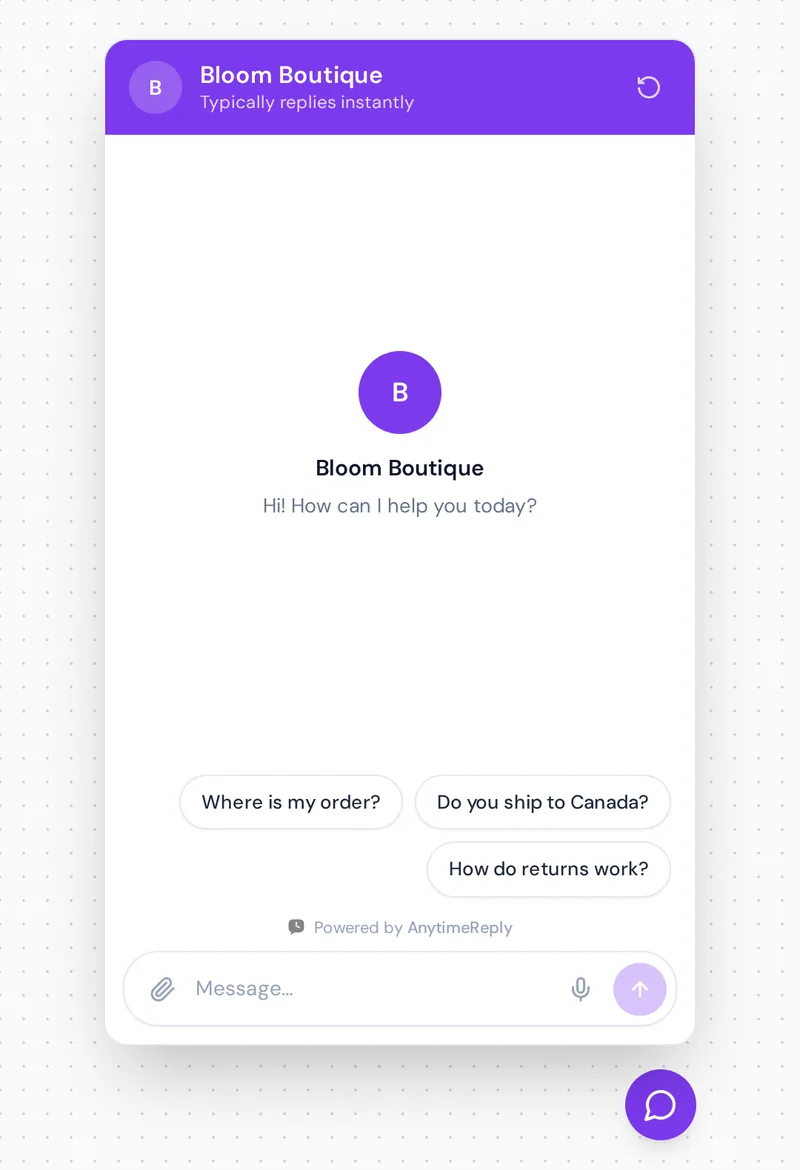
- AI answers first. Train it on your website, product pages and policies. With Shopify it knows products with price and stock and can show product cards.
- Real actions for verified customers. On paid plans, the agent can check orders through Shopify, WooCommerce or AfterShip with confirmations and limits. See actions and integrations.
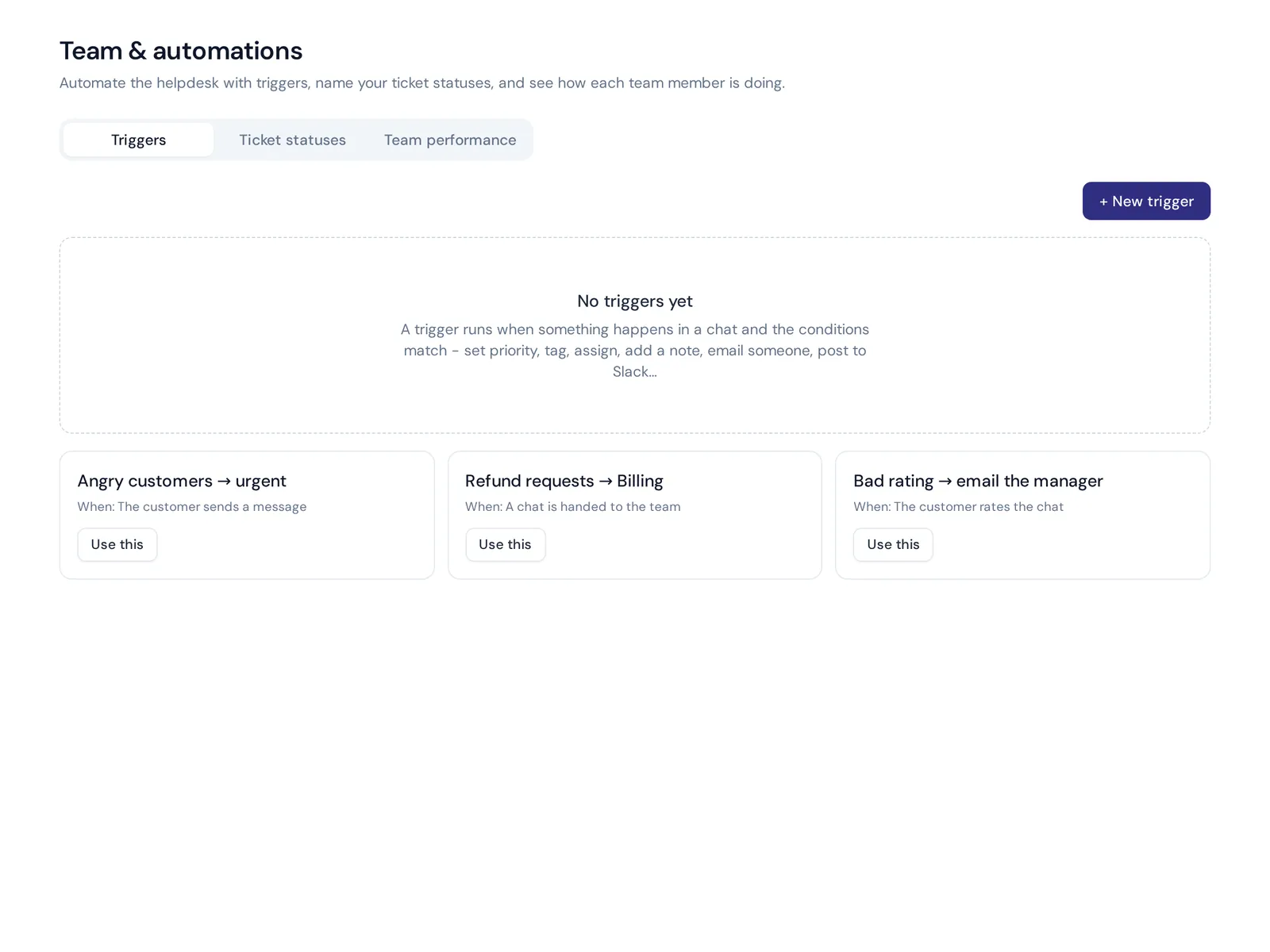
- One inbox for your people. Website chat, WhatsApp, Messenger, Instagram and email in one shared inbox, so you get support across every channel and all customer interactions in one place. Add outsourced agents as team members, use departments, assignment rules and internal notes.
- Rules everyone follows. Procedures let you write how refunds and exchanges work, with required steps, approvals and amount limits enforced, useful when people outside your company handle tickets.
- Already using another helpdesk? AnytimeReply can hand chats over to Zendesk, Freshdesk, Gorgias and others your partner may use.
Honest limits: there are no phone calls or SMS in our product, it's chat, messaging and email only. If phone support is a big part of your business, you'll still need a phone team or partner for that.
Frequently asked questions
Is ecommerce customer service outsourcing worth it?
It is worth it when support takes time you should spend on growth, when you need longer hours or more languages, or when volume is seasonal. It's less worth it if your product is complex or your brand voice is hard to copy.
Can you outsource customer service as a small online store?
Yes. Start small: document your top questions and policies, hire a freelancer or specialist agency for one channel or shift, run a short paid trial, and review conversations weekly before handing over more.
What customer service tasks should I outsource first?
Order status, shipping questions, simple returns and after-hours coverage. They follow clear rules and are easy to check. Keep complaints, disputes and big refunds in-house at first.
Can AI replace outsourced customer service?
For many repetitive questions, yes. For complex, emotional or high-value cases, you still want people. Most stores do best with AI answering first and humans, in-house or outsourced, handling the rest.
What is the 10/5/3 rule in customer service?
It comes from in-store retail and hospitality: acknowledge a customer with eye contact at about 10 feet and greet them at about 5 feet, and some versions add a third step at 3 feet. Online, the same idea means: acknowledge every message fast, even if the full answer takes longer.
How do I keep quality high with an outsourced team?
Give them a voice guide, saved replies and clear rules, agree on response times, review a sample of conversations every week and give specific feedback. Track CSAT and repeat contacts.
Get your time back without losing your customers
Outsourcing can free you to grow, as long as you choose the right model, document everything and keep an eye on quality. And before you pay people to answer the same question 500 times, see how much an AI agent can handle for you.
Start free with AnytimeReply, no card needed, train it on your store, and see which questions you still need people for.
Published 30 October 2026 by AnytimeReply team