A customer in Dhaka writes "order ta kobe asbe?" on WhatsApp. Another in Madrid asks "¿Hacéis envíos a España?" on your website. A third mixes Hindi and English in one sentence. If your support only works in English, two of those three people are already half gone.
A multilingual chatbot fixes that. It reads a message in whatever language the customer uses and replies in the same language, in seconds, day or night. This guide explains how these bots work, where they still trip up, and how to build a multilingual chatbot step by step without hiring a translator for every market.
What is a multilingual chatbot?
It's a chatbot that can understand and respond to customers in more than one language. It works in your website chat widget and on messaging apps like WhatsApp, Messenger and Instagram.
The best ones do three things well:
- Detect the user's language on every message, so nobody has to pick from a dropdown.
- Understand the meaning, not just the words, including typos, informal words and mixed languages.
- Reply in the user's preferred language with answers that still come from your own business information.
Older bots could only do this if you wrote every answer again in every language. A modern intelligent chatbot runs on large language models (LLMs) that already know dozens of languages, so one set of content can serve customers in multiple languages.
How multilingual chatbots work: language detection to reply
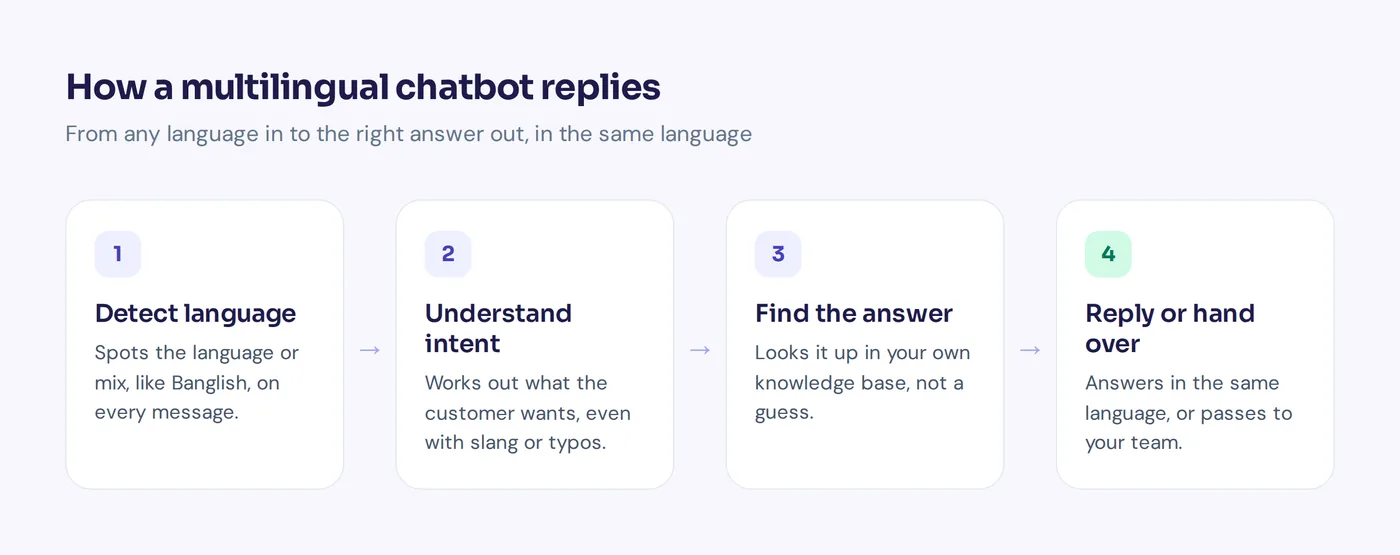
Under the hood, every incoming query goes through the same path:
- Language detection. The bot works out which language (or mix) the customer used. Good systems check every message, because people switch languages mid-conversation.
- Understanding the intent. Natural language processing (NLP) figures out what the person wants: order status, a refund, a size question, a price.
- Finding the answer. The bot searches your help articles, product pages and policies for the right information.
- Writing the reply. It answers in real-time, in the customer's language and your brand's tone, or hands the chat to a person if it can't help.
Translation layer vs multilingual conversational AI
There are two main ways to make a chatbot multilingual, and the difference matters more than most vendors admit.
The translation layer approach sends the customer's message through machine translation (like Google Translate or DeepL) into English, lets an English bot answer, then translates the reply back into another language. It's a quick way to upgrade an existing chatbot, but meaning gets lost twice, and literal translation often sounds stiff.
The native approach uses multilingual conversational AI: an LLM that understands the original message directly and writes the reply in that language. No round trip, fewer errors, and it copes far better with code-mixing.
| Translation layer | Native multilingual AI | |
|---|---|---|
| How it works | Translate in, answer in English, translate out | Understands and replies in the original language |
| Accuracy | Errors can stack up across two translations | Usually more natural and accurate |
| Mixed languages (Banglish, Hinglish) | Often breaks | Handles them far better |
| Tone and politeness | Can sound too literal | Can match formal or casual tone |
| Setup | Needs a translation API and rules | Usually works out of the box |
| Best for | Old rule-based bots you can't replace yet | Most new chatbots built today |
Our honest opinion: if you are starting fresh, skip the translation layer. Native AI is simpler to run across multiple languages and sounds like a real person.
Benefits of multilingual customer support
- Break down language barriers. People buy more easily when they can ask questions in their own language. A shop selling to Bangladesh, India and the Gulf doesn't need three separate teams.
- 24/7 multilingual support. You may have one Spanish speaker on the team. The bot works across languages, covering Spanish at 3 am, on weekends and during Eid.
- Lower costs. Hiring native speakers for every market is expensive. The bot handles repeat questions so your people can focus on harder cases.
- Serve a global audience. Global customers and non-English speakers get the same quick help as everyone else, which means better customer satisfaction across your whole customer base.
- Consistent answers. Every language gets the same prices, policies and facts, because they all come from one source.
- Experiences at scale. Ten chats or ten thousand, in five languages or fifty, the bot handles them at the same time.
Use cases for multilingual AI chatbots
Which use case fits you? A few places where multilingual AI chatbots earn their keep, much like human virtual assistants who speak several languages:
- Online stores selling across regions: stock, sizes, shipping and returns questions.
- Facebook and Instagram sellers whose customers write in local languages or in Roman script.
- SaaS companies with users worldwide asking how-to questions.
- Internal HR and IT help desks in companies with staff in several countries.
- Travel, education and real estate, where inquiries come from many countries.
Challenges: dialects, slang and when to localize
These bots are good now, but not perfect. Here is where they still struggle.
Mixed languages and Roman script
Real customers don't write textbook language. In South Asia, many people type Bangla or Hindi in English letters ("apnar shop kothay?", "kitne ka hai?") and mix in English words. Translation-based bots fall apart here. Native AI models handle it much better, but test with real messages from your customers.
Dialects and regional words
Spanish in Mexico and Spain, Arabic in Egypt and Saudi Arabia, Portuguese in Brazil and Portugal: same language, different words. Tell the bot which markets you serve, and add verified answers for local terms customers use. That's localization, not just translation.
Formal vs casual tone
Some languages have formal and informal "you" (German "Sie" vs "du", Hindi "aap" vs "tum"). Decide what fits your brand and write it into the bot's instructions.
Accuracy in less common languages
AI models are strongest in widely used languages, because that's where most of their training data comes from. In low-resource languages, quality can drop. If a market matters, have native speakers review a batch of answers first.
Names, prices and product terms
Product names, sizes and currencies should stay exact. A good bot keeps "Bloom Midi Dress" as it is instead of translating it. Add a rule for this if your brand names are real words.
How to build a multilingual chatbot (and make it good)
Here is how to make a multilingual chatbot that actually helps people, using a no-code chatbot platform. You don't need machine learning tools or chatbot frameworks, and you don't need to train a model.
- List your languages. Check past chats, emails and website analytics. Which languages do customers really write in? Include mixed ones like Banglish or Hinglish.
- Pick a platform with real multilingual capabilities. Look for automatic detection, replies in the customer's language, and every channel your customers use.
- Train it on your content. Add your website, FAQs, product pages, shipping and return policies. Your content can be in one language; a strong AI model can answer in others from it.
- Add verified answers for sensitive topics. For prices, refunds and delivery times, write exact Q&A answers so the bot never guesses.
- Write clear instructions. "Always reply in the customer's language. Keep product names in English. Use a friendly, polite tone." Good chatbot design is mostly good instructions.
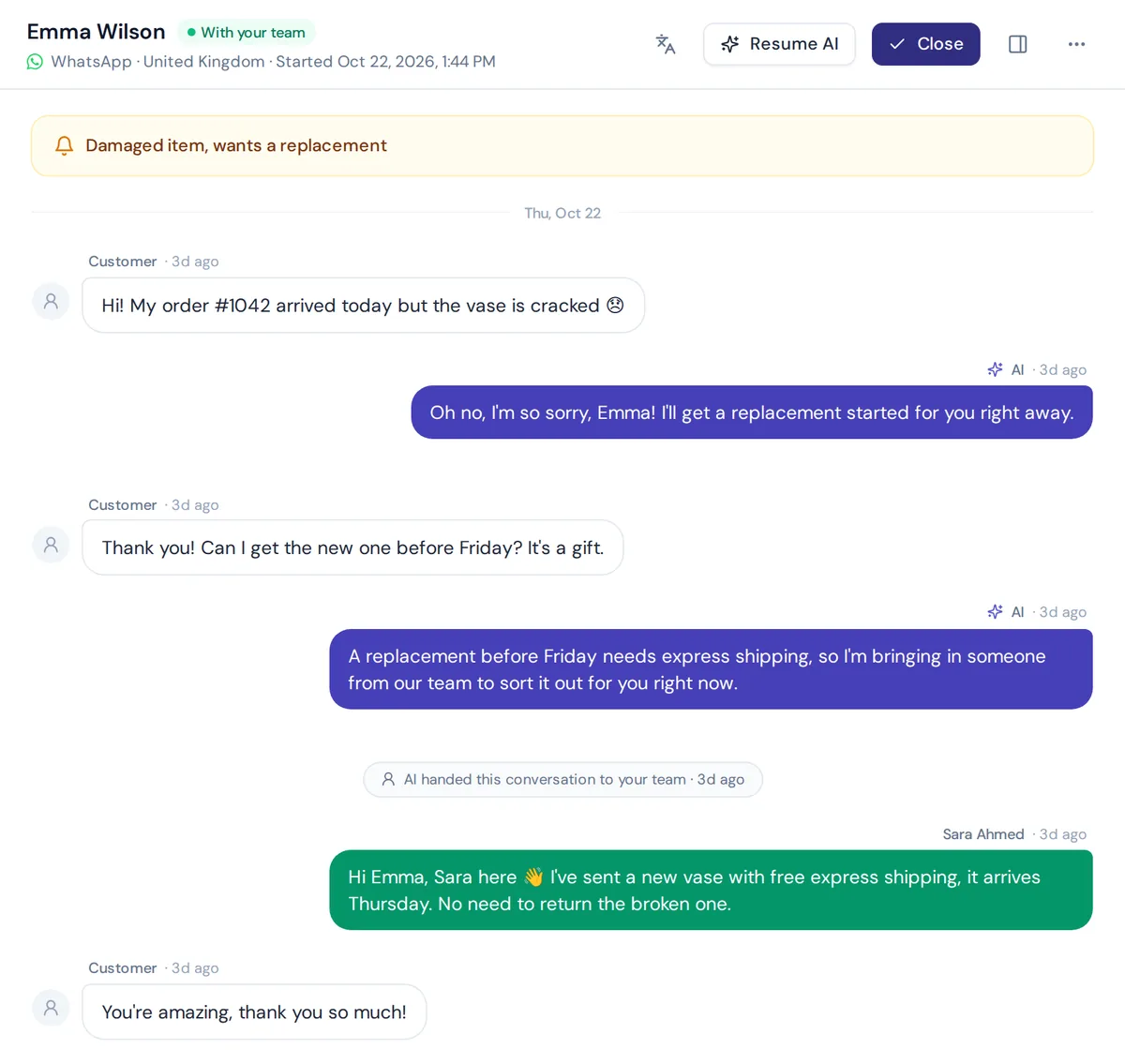
- Set up the handoff to humans. Decide when chats go to a person: angry customers, refunds, or questions the bot can't answer. Your team should get a summary, ideally with a translation.
- Test in every language. Ask real questions with typos and mixed language. Ask a native speaker to check replies.
- Go live on one channel first. Start with website chat or WhatsApp and watch the first week closely.
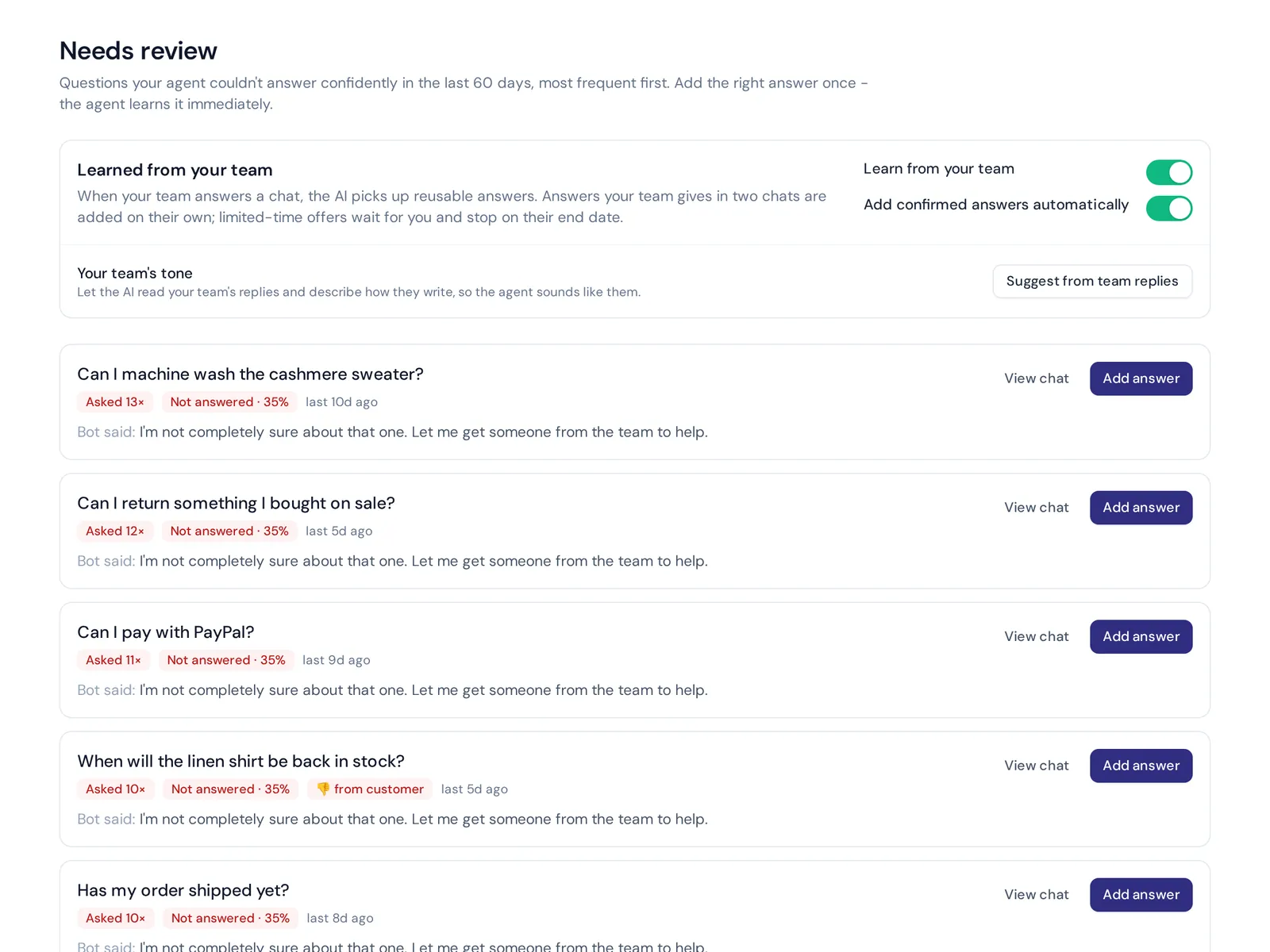
- Improve every week. Look for questions the bot couldn't answer and add the missing information.
Creating a multilingual chatbot this way takes an afternoon, not months of multilingual chatbot development. To build a chatbot from scratch in code, expect weeks.
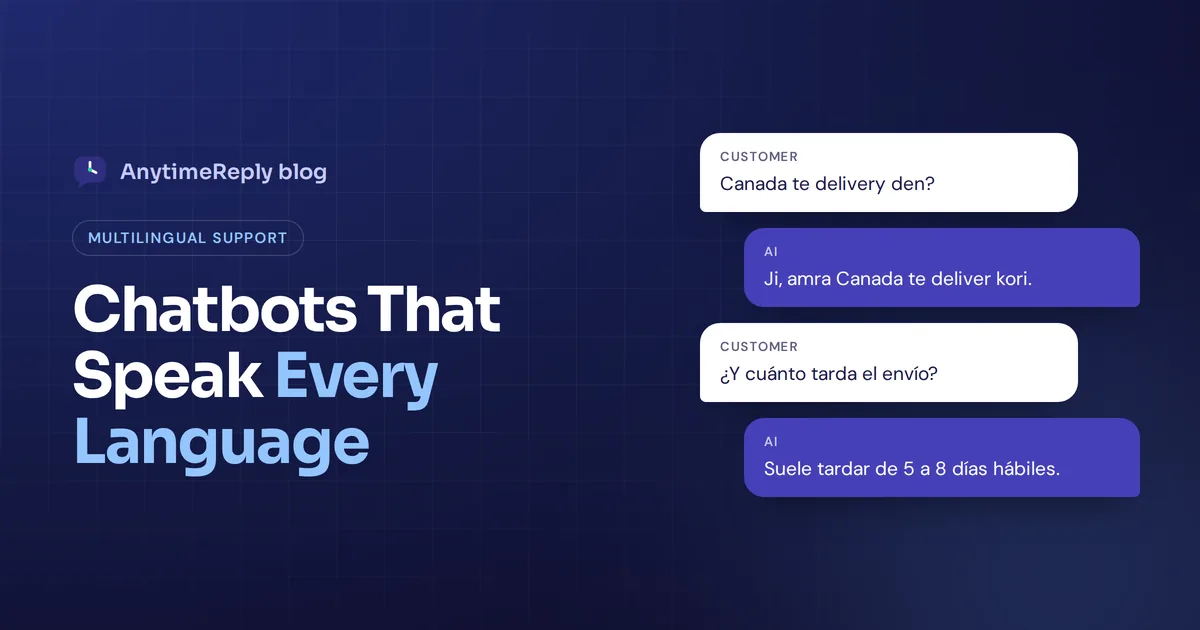
Example: one knowledge base, five languages
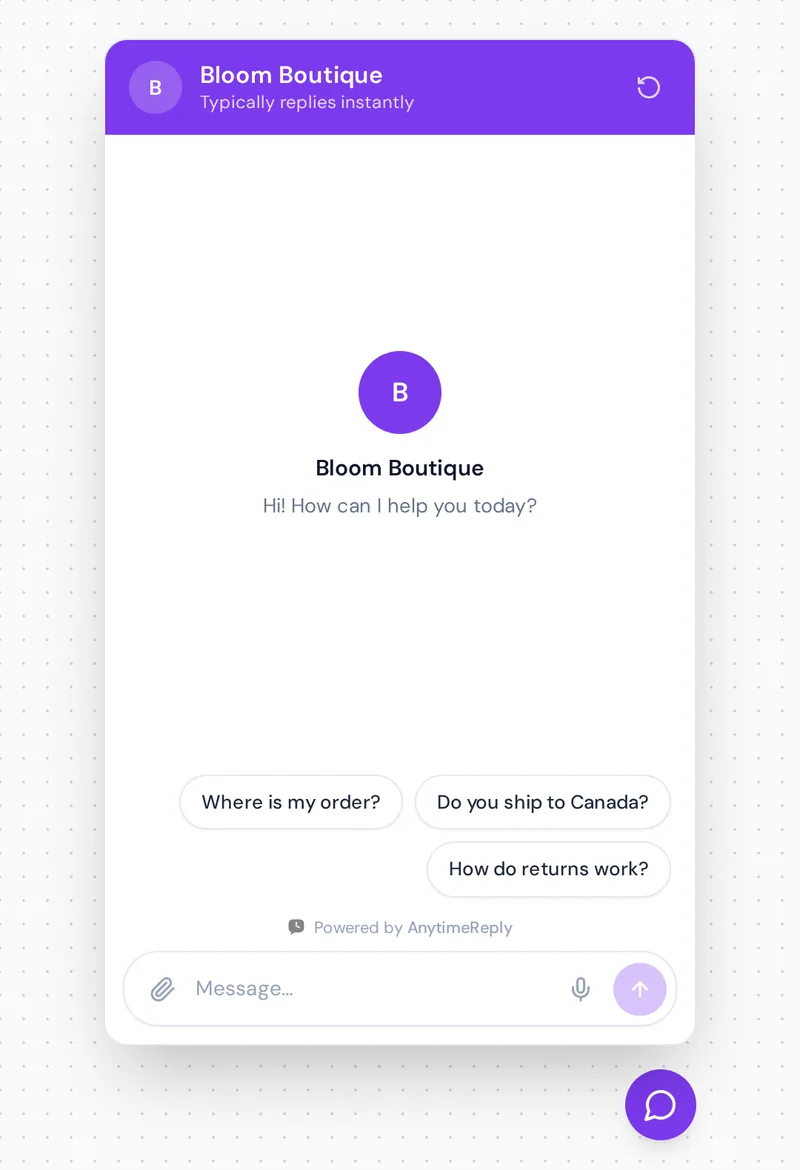
Here is what it looks like when a bot can handle multilingual conversations well. Same store, same content, same answer.
English: "Do you ship to Canada?"
Bot: "Yes, we ship to Canada. Delivery usually takes 5 to 8 business days."
Spanish: "¿Hacéis envíos a Canadá?"
Bot: "Sí, enviamos a Canadá. La entrega suele tardar de 5 a 8 días hábiles."
Banglish: "Canada te delivery den?"
Bot: "Ji, amra Canada te deliver kori. Shadharonoto 5 theke 8 working day lage."
Hinglish: "Canada mein shipping hai kya?"
Bot: "Haan, hum Canada ship karte hain. Delivery mein usually 5 se 8 business days lagte hain."
French: "Vous livrez au Canada ?"
Bot: "Oui, nous livrons au Canada. La livraison prend généralement 5 à 8 jours ouvrables."
(Example replies with a made-up delivery time.) Notice the bot answers Banglish in Banglish, not formal Bangla script. Matching how the customer writes feels far more natural.
Best practices to translate less and answer in the preferred language
- Let the customer lead. Reply in the language of each message. Don't force a language menu.
- Switch when they switch. If a customer starts in English and moves to Hindi, follow them.
- Keep one knowledge base. Don't maintain five copies of your FAQ. Fix it once and every language gets the update.
- Give your team translation help. When a human takes over a chat in a language they don't speak, AI translation of the chat and reply saves the day.
How AnytimeReply handles multilingual customer support
We built AnytimeReply for businesses whose customers write in more than one language, so this part is close to our heart.
- Replies in the customer's language. The AI agent answers in whatever language the customer uses, including Bangla, Banglish, Hindi and Hinglish, on every channel.
- Trained on your own content. Add your website, PDFs, Word files, Notion pages or Shopify products in the knowledge section. Q&A answers you write always win over other sources.
- Doesn't guess. Answers come with a confidence score. When the agent doesn't know, it says so.
- One inbox for your team. Website, WhatsApp, Messenger, Instagram, Telegram and email chats land in one shared inbox. The AI hands over with a summary, and your team gets AI help to rewrite and translate replies.
- Choose your model. GPT, Claude, Gemini or DeepSeek per agent, with side-by-side comparison in tests.
Where it's not the right fit: AnytimeReply is text chat and email only. It isn't multimodal in the voice sense (no phone or voice agents), so for multilingual phone support look elsewhere. It does understand WhatsApp voice notes and photos. Website chat and the helpdesk are free; WhatsApp, Messenger, Instagram and email start at $9 a month (see pricing).
How to test before launch
Build a test set of 10 to 20 real questions per language and check each answer for language, facts, tone and a clean handoff.
- A normal question in each language ("Where is my order?")
- The same question with typos and no punctuation
- A mixed-language message ("my order ekhono ashe nai, ki korbo?")
- A switch mid-chat (starts in English, continues in Arabic)
- An angry message that should go to a human
- A question the bot can't know, to check it doesn't invent an answer
In AnytimeReply you can write these as plain-language tests that run in a sandbox after every change, so an update doesn't quietly break your Spanish answers.
Frequently asked questions
Is ChatGPT available in different languages?
Yes, ChatGPT understands and writes many languages. But on its own it doesn't know your prices, stock or policies. For support you need a platform that connects a model like GPT to your content, your channels and your team.
What is NLP in an AI chatbot?
Natural language processing is the part that lets a bot understand normal human writing, with its typos, informal words and different phrasings, instead of only matching exact keywords.
Which AI chatbot offers the best multilingual capabilities?
The best multilingual results today come from bots built on modern language models rather than translation layers. Test any tool with real messages in your customers' languages, including mixed ones, before you decide.
Can a chatbot converse in English and Hindi at the same time?
Good ones can. LLM-based bots handle Hinglish and Banglish much better than older tools. AnytimeReply replies in Hinglish and Banglish when customers write that way.
Can multilingual chatbots understand regional dialects?
Mostly yes, for widely spoken languages. For local terms, add verified answers and tell the bot which regions you serve.
Final thoughts
Your customers already write to you in their own languages. A bot that answers customers in their own language lets you reply properly at any hour, without a team for every market. Start with the languages you see, train on one solid source, test with real messages and keep a human in the loop. That's what makes an effective chatbot.
Want to try it with your own content? Start free with AnytimeReply, add your website and ask it something in Bangla, Hindi or Spanish. No card needed.
Published 5 November 2026 by AnytimeReply team