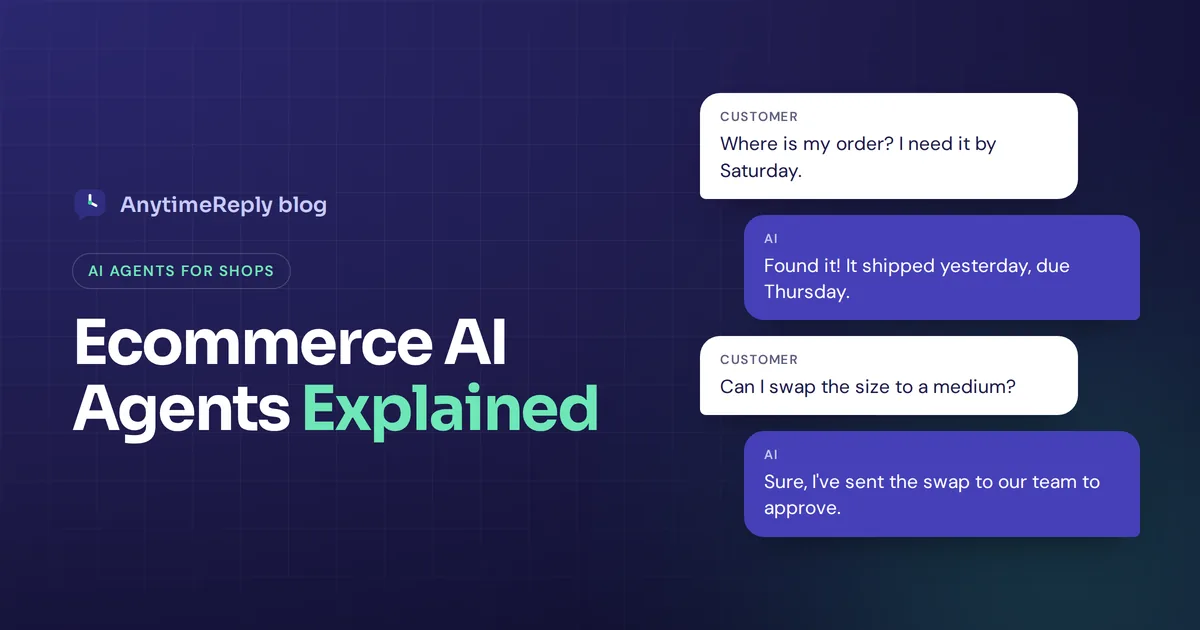
It's 11 pm. A customer in another time zone wants to know where her order is, whether the blue jacket comes in a medium, and if she can swap her size before it ships. Your team is asleep. A few years ago she waited until morning, or gave up. Today, e commerce AI agents can answer all three questions in under a minute, check the order in your store, and pass the size swap to a person if it needs approval.
An AI agent for ecommerce is more than a chatbot that recites your FAQ. It understands what the shopper wants, looks things up in your systems, and takes simple actions for them, inside rules you set.
In this guide we cover what AI agents in e-commerce actually do, the main types, real use cases, the best tools to look at in 2026, what they cost, and how to roll one out without upsetting customers. We build one ourselves (AnytimeReply), so we'll tell you where we fit and where we don't.
What are e commerce AI agents?
An AI agent is software that uses a large language model (the same kind of generative AI behind ChatGPT) to reach a goal, not just reply to a message. In an online store, that goal might be "get this customer the right answer about her order" or "help this visitor find a jacket that fits".
To get there, the agent can read your product catalog, policies and help content, connect to tools like Shopify, payment and shipping apps, and decide what to do next based on the conversation. That's the "agentic" part: it plans steps and uses tools instead of following a fixed script.
Here's a simple example. A shopper writes: "my parcel says delivered but I don't have it, and I need it for Saturday." A scripted bot shows a tracking link. An agent verifies who she is, pulls the order, checks the carrier status, explains what happened, and opens a case for your team if the parcel looks lost.
So is ChatGPT an intelligent agent? On its own, it's mostly a conversational AI. It becomes an agent when it's given tools, data and a goal, which is exactly what ecommerce platforms and support tools now do with these models.
AI agent vs chatbot vs traditional AI tools
People use these words loosely, so here's how we think about the difference.
| Rule-based chatbot | Traditional AI tools | AI agent | |
|---|---|---|---|
| What it does | Follows a button script | One narrow task, like product recommendations or search ranking | Works toward a goal across several steps |
| Understands free text | Keywords only | Usually not conversational | Yes, in the shopper's own words and language |
| Knowledge | Answers you typed in | Behavior and catalog data | Your website, policies, catalog and docs |
| Takes actions | Rarely | No | Checks orders, tracks parcels, books calls, updates subscriptions |
| Handles surprises | Breaks or loops | Not built for it | Asks a follow-up or hands over to a human agent |
Scripted flows still have a place. For a simple "track my order" button, a flow is fast and cheap to run. The best setups mix both: buttons for the obvious paths, an agent for everything else.
Types of AI agents: from AI shopping assistant to agentic commerce
Most AI systems sold to an ecommerce store fit into one of five groups, and many products blend two or three. Some are close to autonomous AI agents, others are simple helpers with a few AI capabilities added.
1. Customer support agents
A support agent like this can answer questions and handle orders, returns and exchanges across chat, email and messaging apps. They're the most common starting point, because support questions repeat so much.
2. Shopping assistants
A shopping assistant helps visitors find the right product. It asks a few questions ("what's it for? what's your budget?"), then makes product recommendations from your catalog. Good ones improve product discovery on stores with big catalogs.
3. Sales agents
An AI sales agent focuses on conversion: answering pre-sale doubts, recovering abandoned carts, suggesting add-ons, and capturing leads for high-value items.
4. Operations and back-office agents
These work behind the scenes on ecommerce operations, the AI automation side of the business: inventory forecasting, stockout alerts, pricing checks, writing product descriptions, or answering "why did revenue drop last week?" from your data.
5. Agentic commerce (agents that shop for customers)
This is the newest group, and where agentic AI gets the most attention. Instead of your agent talking to shoppers, the shopper's own AI does the browsing and buying for them inside assistants like ChatGPT. Agentic commerce is still early for online shopping, but it means your product data, prices and policies need to be clear enough for both humans and AI shopping agents to read.
Top use cases for product recommendations and customer service
Here is each use case most stores hand to AI agents for e-commerce customer service first, because they are frequent, repetitive and easy to check.
Order status and tracking
"Where is my order?" is the classic support question. A connected agent verifies the customer, pulls the order from Shopify or WooCommerce, checks tracking, and replies with the real status based on real-time data instead of a generic link. Order data in real time is what separates an agent from a FAQ bot.
Product questions
Sizing, materials, compatibility, stock. "Do you have this in a 38?" gets a real answer, with a product card showing price and availability, instead of a link to the size chart.
Returns, exchanges and refunds
The agent explains your policy, checks if the order is eligible, and starts the process. For money decisions, keep a person in the loop with approval steps and amount limits.
Pre-sale questions and cart recovery
Shipping costs, delivery times, payment options, discount codes. Answering these at the moment of doubt helps you lose fewer carts. Some tools also send a follow-up to shoppers who went quiet.
Multilingual support
If you sell across borders, an agent that replies in the customer's language opens markets you couldn't staff for. A shop in Dhaka can answer a buyer writing in Banglish and another writing in English, at 3 am, with the same quality.
Social and messaging channels
Many shoppers never visit your site's chat. They message on WhatsApp or Instagram, or comment on a post. An agent can cover those touchpoints from one inbox.
Benefits for your ecommerce business and shopping experience
- Instant replies, 24/7. Shoppers don't wait for business hours, and neither do sales.
- Handles peaks. A flash sale or a viral post can bring hundreds of chats at once. An agent answers them in parallel.
- Better shopping experience. Fast, specific answers feel more like a helpful store assistant than a form.
- Lower cost per conversation. Your team handles the tricky cases, not the hundredth "do you ship to Canada?"
- Useful data. You see what customers ask, what blocks purchases and where your content has gaps.
We're careful not to promise numbers here. How much you save depends on how repetitive your questions are and how good your content is. Run a pilot and measure it yourself. Businesses adopting AI agents should judge them on their own numbers.
The honest limits and risks
AI agents are useful, but they're not magic. Here's what can go wrong.
- Bad content in, bad answers out. If your shipping page is outdated, the agent repeats it confidently.
- Hallucinations. A poorly set up agent may guess. Choose one that shows confidence and says "I don't know" when it should.
- Risky actions. Refunds, cancellations and address changes need verification, limits and sometimes human approval.
- Emotional customers. Someone whose birthday gift arrived broken wants a person. Make handover easy, and pass a summary so they don't repeat themselves.
- Customer data. Ask every vendor how data is stored and whether it's used to train AI models.
- Setup time. Expect a few weeks of reading conversations and fixing answers before it runs smoothly.
Can AI agents replace human work completely? Not in our view. They take the repetitive load. People still handle judgment, empathy and exceptions.
Best e-commerce AI agents: top AI tools for ecommerce in 2026
There's no single best AI tool for every business, and no list of the best AI shopping assistants or support agents for ecommerce in 2026 fits every store. The right AI agent depends on your size, your platform and what you want to automate. Here are well-known options worth a look, from small-shop tools to top AI suites for AI in retail. We describe what each is known for and leave pricing to their own pages, because plans change often.
| Tool | Known for | Good fit for |
|---|---|---|
| AnytimeReply | Conversational AI platform for support and sales, with built-in helpdesk, actions and multilingual replies | Small and mid-size stores, Facebook and Instagram sellers |
| Gorgias | Ecommerce-focused helpdesk with an AI agent | Shopify brands with busy support teams |
| Tidio (Lyro AI agent) | Live chat plus AI answers for small stores | Small shops starting with chat |
| Intercom (Fin) | AI agent on a large customer service platform | Growing brands with bigger budgets |
| Zendesk | Enterprise support suite with AI agents | Large teams and enterprise ecommerce |
| Ada | Enterprise AI customer service automation | High-volume retail and enterprise |
| Rep AI | AI sales agent and shopping assistant for Shopify | Stores focused on conversion |
| Klevu | AI search and product discovery | Large catalogs that need better search |
| Salesforce Commerce AI | AI personalization and agents inside Salesforce | Enterprise brands already on Salesforce |
Even the best AI agents need testing on your own store. Our advice: shortlist two or three, run the free trials with 30 of your real customer questions, and judge the answers yourself. Don't pick based on a demo script.
How to choose the right AI agent for your store
- Store integration. Does it connect to your ecommerce platforms (Shopify, WooCommerce, others) and read live price and stock?
- Actions with safeguards. Can it check orders and start returns only for verified customers, with confirmation and limits?
- Human handover. Does your team get the conversation with a summary? Can they join any chat?
- Channels. Website chat, plus WhatsApp, Instagram, Messenger and email in one inbox?
- Accuracy tools. Confidence scores, tests, and a quick way to fix wrong answers.
- Languages. Does it reply well in the languages your customers actually write in?
- Pricing model. Per seat, per resolution, per message or per credit? Model your real volume first.
- Data privacy. Is customer data used to train AI models? Is there a DPA?
How much e-commerce AI agents cost (and how to measure ROI)
Pricing models vary a lot across the AI platform market, from off-the-shelf plans to custom AI builds:
- Per seat: you pay for each team member, AI included or extra.
- Per resolution: you pay each time the AI fully solves a conversation.
- Per message or credit: you pay for each AI reply, often with stronger models costing more.
- Flat plans: a monthly fee with a usage allowance.
To judge ROI, compare before and after over a month. Say you get 1,000 conversations a month and the agent fully handles 600 of them. Multiply the handled conversations by the time your team spent on each, and compare that with the tool cost. Then check customer ratings, so you know speed didn't come at the cost of quality.
How to deploy AI agents in your ecommerce store
- List your top 20 questions. Pull them from your inbox, WhatsApp and comments.
- Clean up your content. Make sure shipping, returns, sizing and pricing pages are current.
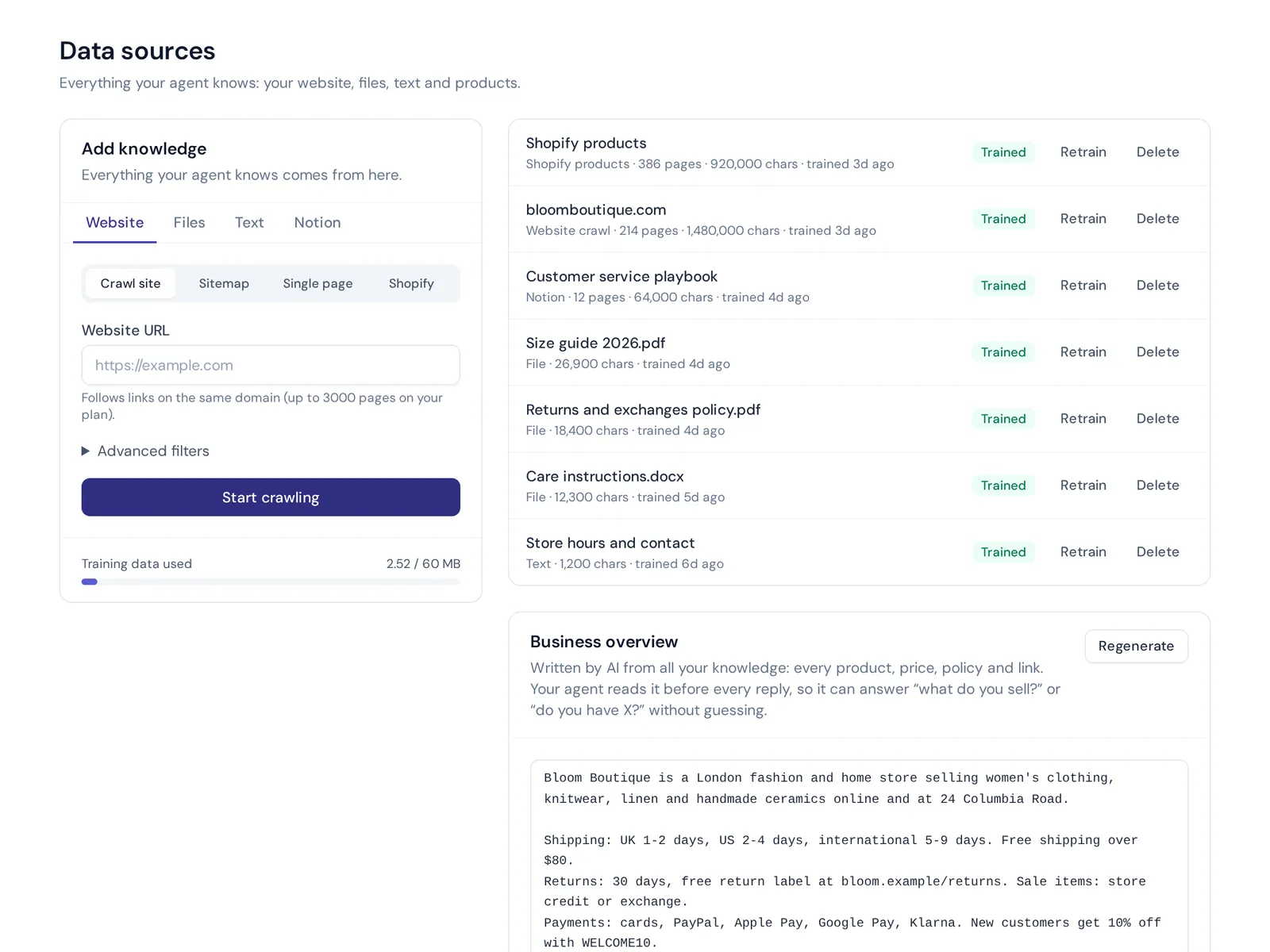
- Train the agent. Add your website, product catalog and policy documents. Write short Q&A answers for questions that must be exactly right.
- Connect your store. Link Shopify or WooCommerce, plus shipping and payment tools, so the agent can look up real orders.
- Write your procedures. Spell out how refunds and exchanges work, which steps are required and what needs approval.
- Set handover rules. Angry customers, high-value orders, or "talk to a person" go to your team right away.
- Test before launch. Run real and tricky questions, and fix weak answers.
- Launch on one channel, then expand. Start with website chat, then add WhatsApp or Instagram.
- Review every week. Read conversations, add missing answers, adjust rules. This is how the AI learns your business.
How AnytimeReply works as an AI agent for ecommerce
AnytimeReply is an AI customer support and sales agent with a built-in helpdesk. For online shops, it trains on your website, documents and Shopify products (with price and stock, shown as product cards), then answers shoppers in seconds in their own language, including Bangla, Banglish, Hindi and Hinglish.
With actions, it can check orders in Shopify or WooCommerce, look up tracking through AfterShip and manage Stripe subscriptions, but only for verified customers, with confirmation, optional team approval and limits. Procedures let you write how refunds and exchanges work as plain steps, and required steps, approvals and amount limits are enforced.
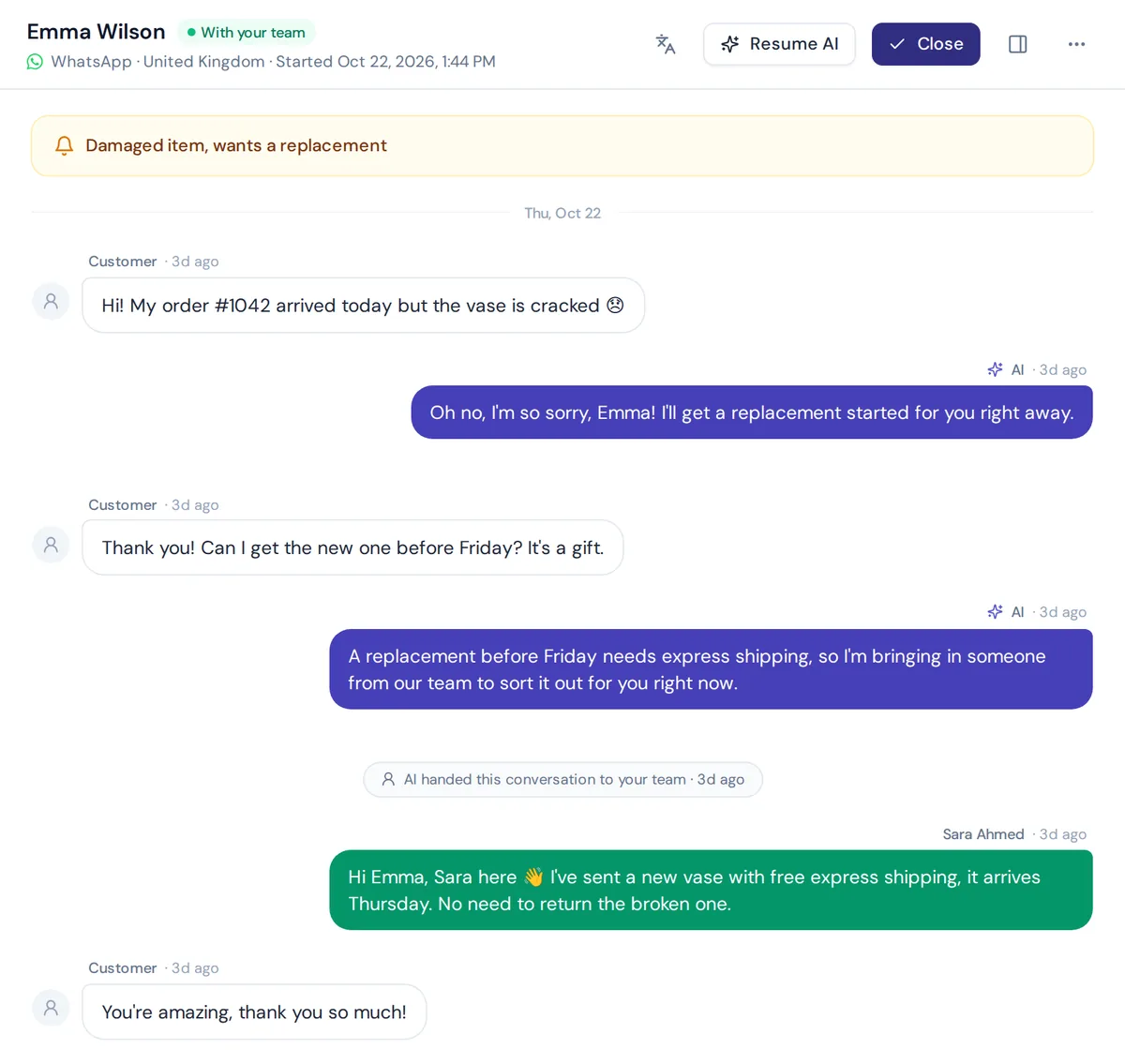
When a customer asks for a person, gets upset or the AI can't answer, the conversation goes to your shared inbox with a summary. Every answer carries a confidence score, and if the agent doesn't know, it says so. It works on your website, WhatsApp, Instagram, Messenger, Telegram and email from one place. See how online shops use it on our e-commerce page.
Where it's not the right fit: AnytimeReply doesn't offer phone, voice or SMS support. It's not an inventory forecasting or pricing tool either. Actions, WhatsApp, Instagram and Messenger are on paid plans (Hobby and up), while the Free plan covers website chat, the helpdesk inbox and 50 credits a month so you can test it. Check pricing for current details.
Example conversations with an AI agent
Customer: hi, ordered the linen shirt on monday, when will it arrive?
AI: Thanks! I found your order. It shipped yesterday and tracking shows delivery expected Thursday. Want the tracking link?
Customer: Is the black dress true to size? I'm usually a 10.
AI: Based on our size guide it runs slightly small, so a 12 may fit better. The 12 is in stock right now.
Customer: my vase arrived cracked and it was a gift. this is so annoying
AI: I'm really sorry, that's frustrating. I'm passing this to our team now so they can sort a replacement quickly.
Measuring if your AI agent is working
- Resolution rate: how many conversations end without a person.
- Handover rate and reasons: why chats go to your team.
- Customer ratings: thumbs up or down and CSAT.
- Unanswered questions: gaps to fill in your knowledge.
- First reply time: across every channel.
- Sales signals: chats that led to orders or captured leads.
Frequently asked questions
How is AI used in ecommerce?
Businesses use AI mostly for customer support, product recommendations and search, sales conversations, marketing content, and operations like inventory forecasting. AI agents combine several of these by talking to customers and taking actions.
Are AI agents ready for small and mid-size ecommerce brands?
Yes, for support and pre-sale questions. Many tools have free plans or trials, and setup takes hours, not months. Start with one channel and your top questions.
Are AI agents safe for handling customer data?
They can be. Look for verified customer identity before account actions, encrypted integrations, and a clear policy that your data isn't used to train AI models.
Can AI agents integrate with Shopify and WooCommerce?
Most ecommerce AI tools do. AnytimeReply connects to both, plus Stripe, AfterShip and others on paid plans.
Do AI agents replace human customer service teams?
No. They take the repeat questions so your team can focus on complaints, exceptions and sales conversations that need a person.
Is there a market for AI agents?
A big one, and it's growing fast. Most major helpdesk and commerce platforms now sell AI agents, and agentic commerce is pushing the idea further.
Start with one channel and grow
E-commerce AI agents work best when they handle the boring, repetitive questions and hand the human moments to your team. Start small, connect your store, keep people in the loop, and improve from real conversations.
The stores that use AI agents well treat them like a new team member: trained, tested and reviewed. Want to see one with your own store? Start free, no card needed.
Published 31 October 2026 by AnytimeReply team