Most businesses don't have a customer service strategy. They have a support email, a few people who answer it when they can, and a hope that customers are happy. That works until you get twice the messages, a bad review spreads, or your best support person goes on holiday.
A customer service strategy is your plan for how you help customers: which channels you offer, how fast you reply, who handles what, what you automate and how you measure success. It doesn't need to be a 40-page document. A clear one-page customer service plan beats a fancy one nobody reads.
Below are 12 practical tips, real customer service strategy examples and a simple template you can fill in this week.
What is a customer service strategy?
It is a written plan for how your business supports customers before, during and after a purchase, across the whole customer journey. It answers questions like:
- Which customer service channels do we offer? (website chat, email, WhatsApp, social media)
- What are our service standards for reply time on each channel?
- Which customer inquiries go to self-help or AI, and which need a person?
- Who owns refunds, complaints and technical customer issues across your products and services?
- Which numbers tell us if it's working?
Some teams call it a customer support strategy. Same idea. Marketing brings customers in. Customer care decides whether they stay, buy again and tell friends.
Why great customer service and customer loyalty need a plan
- Consistency. Every customer gets the same quality customer service, no matter who replies.
- Customer retention and customer relationships. Keeping a customer is usually cheaper than finding a new one, and good service is one of the main reasons people come back.
- Less chaos for your customer service team. Clear rules mean fewer "who handles this?" moments.
- Better decisions. With the right numbers you know when to hire, what to automate and which product or service problems to fix.
A positive customer experience earns repeat buyers. Poor customer service, on the other hand, rarely shows up in one big disaster. It's a slow leak of customers who simply don't come back.
Creating a customer service strategy: 12 tips to improve customer service
These are the key steps we'd follow to build a strong customer service strategy from scratch. Different businesses need different customer service strategies, so take what fits.
1. Start with customer needs, not tools
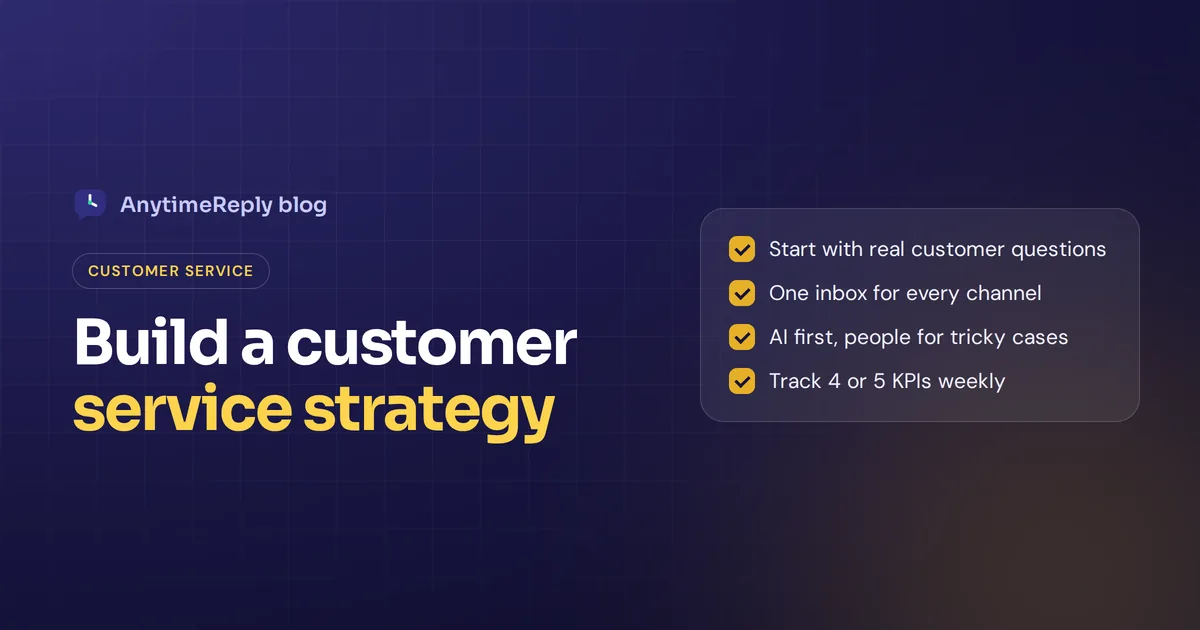
Before picking customer service tools, read your last 100 messages. Group them: order status, returns, pricing, how-to, complaints. A handful of types usually make up most of your volume. Build your plan around those.
2. Write a customer service vision
One or two sentences your team can remember. For example: "Every customer gets a helpful answer within 5 minutes on chat and 4 hours on email, and nobody has to repeat themselves."
3. Be where your customers already are
If your customers live on WhatsApp and Instagram, a support email alone won't cut it. A digital customer service strategy usually means website chat plus one or two messaging apps, plus email.
4. Set customer expectations honestly
Write reply time targets per channel and share them with the team. Then tell customers what to expect, like "we reply within a few hours on email". Meeting a modest promise beats missing a big one.
5. Bring every channel into one inbox
Separate apps for chat, email and social mean missed messages and double replies. A shared helpdesk inbox keeps all customer interactions and customer information in one place, which makes for a far better customer service experience.
6. Offer self-service for common questions
A help center or knowledge base with clear articles on shipping, returns and billing answers questions at 3 am without anyone awake.
7. Use AI for repetitive questions
An AI agent trained on your own content can answer "where is my order?" in seconds, day or night. That frees customer service agents for conversations that need a human. The AI should say when it doesn't know and hand over.
8. Make human handoff easy
Nothing frustrates customers more than a bot loop. Define when a chat must go to a person: they ask for one, they're upset, or the case is complex or high value.
9. Invest in customer service training
Product details can be taught in weeks. Patience, empathy and clear writing are harder. Hire for those, then train on products, tone, customer service best practices and your procedures.
10. Give your team power to fix things
If every refund needs a manager, customers wait. Set limits instead: "Agents can refund up to $50 without asking." Write down how refunds, exchanges and disputes work.
11. Be proactive
Proactive service means telling customers about a delayed shipment or planned outage before they ask. One message sent first prevents dozens of angry ones.
12. Build a feedback loop
Send a short survey after chats and tickets to collect customer feedback, read low ratings every week and share the top issues with product and marketing. If 30 people ask about sizing, the fix may be a better size chart. That feedback loop is how you improve the customer experience over time.
Customer service strategy examples by business type
Here are typical customer service strategies for five kinds of business. These are common examples of customer service setups, not case studies.
| Business | Main channels | Strategy focus |
|---|---|---|
| Small online shop | Website chat, WhatsApp, Instagram, email | AI answers order and shipping questions 24/7, team handles returns in one inbox |
| SaaS company | In-app chat, email tickets, help center | Strong self-help docs, AI for how-to questions, fast human help for billing and bugs |
| Local service business | WhatsApp, Messenger, website | Quick answers on prices and booking, follow-up after each job |
| Agency | Email, Slack, website chat | Named account owners, clear response times, monthly reports |
| Internal HR or IT desk | Slack, email | AI answers policy questions from internal docs, tickets for anything that needs action |
Some brands are famous for exceptional customer service. Zappos built its name on friendly, unhurried support, and Amazon made easy returns part of shopping. You don't need their budget: pick one thing you'll be great at and put it in your plan.
Ecommerce customer service strategy
Online shops have a pattern: most customer inquiries fall into a few predictable types, and they spike around sales. A good ecommerce customer service strategy plans for that:
- Automate order tracking. "Where is my order?" is often the most common question.
- Make the returns policy impossible to miss on product pages, in chat and in order emails.
- Answer pre-sale questions fast. A sizing question on a product page is a buying signal.
- Prepare for peak season with templates and a trained AI before Black Friday, not during it.
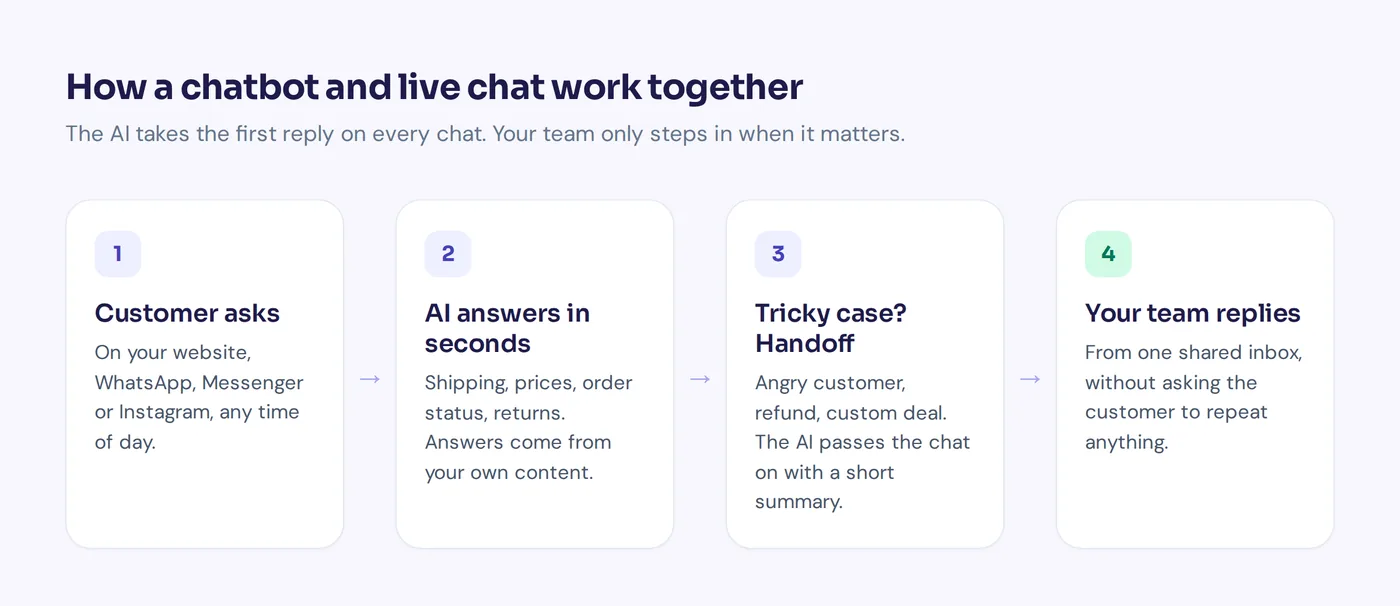
The AI first, human second model for a better customer experience
Many teams now use a simple model for better customer experiences at a lower cost, and for global customer service across time zones:
- A customer writes on chat, WhatsApp, Instagram or email.
- An AI agent trained on your business answers common questions in seconds.
- Tricky, emotional or high-value cases go to a person with a summary.
- Your team replies from one inbox, and the AI learns from the gaps.
The honest trade-off: AI is only as good as what you teach it. Review answers every week in the first month. This is one of the bigger trends in customer service, but it still needs people behind it.
A simple customer service strategy template
Copy this into a document and fill it in. One page is enough.
Vision: (one sentence on how customers should feel)
Customers and top questions: (who they are, the 5 most common reasons they contact us)
Channels and reply times: (per channel, in and out of business hours)
What we automate: (FAQ answers, order status, booking)
When a person takes over: (handoff rules)
Who owns what: (billing, technical, complaints, refund limits)
Numbers we review weekly: (see below)
Review date: (every quarter)
KPIs to measure customer service success
Successful customer service shows up in a few numbers. Track these weekly to see your overall customer service health:
- First response time: how long until the customer gets a first reply.
- Resolution time: how long until the problem is solved.
- Customer satisfaction score (CSAT): ratings after conversations.
- Customer effort score: how easy it was to get help.
- AI or self-help resolution rate: questions solved without a person.
- Top contact reasons: so you can fix the cause, not just the symptom.
Use customer data from these numbers to spot problems early, not to punish agents.
How AnytimeReply supports your customer service strategy
AnytimeReply is an AI customer support agent with a built-in helpdesk, made for the AI first, human second model.
- An AI agent trained on your website and documents answers in the customer's language on website chat, WhatsApp, Messenger, Instagram, Telegram, email and Slack.
- One helpdesk inbox with departments, assignment, internal notes and triggers. The AI hands over with a summary when a customer asks for a person or gets upset.
- A help center on your own domain, and analytics with topics, sentiment, CSAT and knowledge gaps.
Website chat, the inbox, help center and analytics are on the Free plan. Messaging channels start on Hobby. It's not the right fit if you mainly need phone support: we cover chat, messaging apps and email only.

Frequently asked questions
What are the key parts of an effective customer service strategy?
A clear vision, the channels you support, reply time goals, what you automate, handoff rules, who owns what, and the metrics you track.
What are the 5 P's of customer service?
Versions vary. A common one is politeness, professionalism, promptness, patience and personalized service. The point is the same: fast, kind and competent help.
What are the 7 Cs of customer service?
They come from the 7 Cs of communication: clear, concise, concrete, correct, coherent, complete and courteous. Lists differ slightly between sources.
What is the 10/5/3 rule in customer service?
It's a retail rule of thumb: acknowledge customers with eye contact at about 10 feet and greet them at about 5 feet. The "3" part differs between sources, so treat it as a guideline for being welcoming, not a law.
What are the top 5 skills for customer service?
Empathy, clear communication, patience, product knowledge and problem solving.
How do I choose the right customer service strategy?
Start with what your customers ask and where they ask it. Then pick the channels, tools and automation that solve those questions best and increase customer satisfaction.
Start small, then improve
The best customer service teams didn't start perfect. Write your one-page plan, bring your channels into one inbox and automate your top three questions. Then improve a little every week. If you want an AI agent and helpdesk to run that plan, start free, no card needed.
Published 2 November 2026 by AnytimeReply team