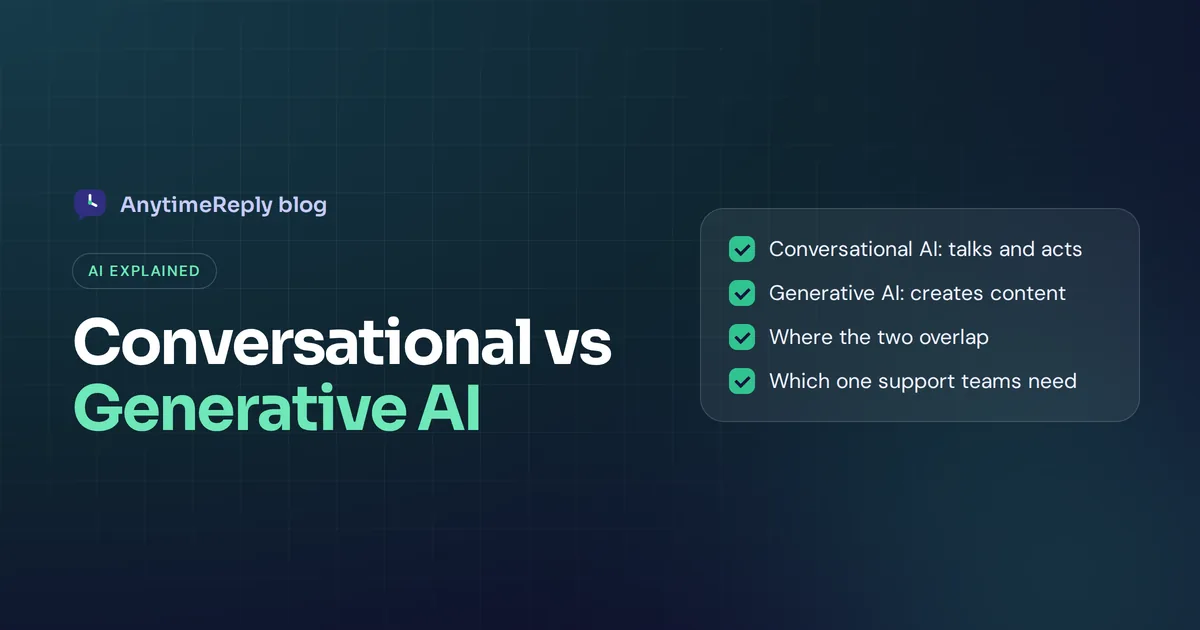
People use "conversational AI" and "generative AI" like they mean the same thing. They don't, but they overlap a lot, and that is exactly why the terms get mixed up. A customer service bot built on ChatGPT-style models is both. An image generator is only one of them. An old phone menu bot is only the other.
So here is the short version of conversational AI vs generative AI: conversational AI is about talking with people, holding a back-and-forth dialogue and getting something done. Generative AI is about creating new content, like text, images, code or audio. Today the best conversational AI uses generative AI under the hood.
Below we explain how each one works, how they compare in a simple table, real examples, and which one a business actually needs for customer support. We build an AI support agent, so we'll also show where the two meet in a real product.
What's the difference? The short answer
Both are types of artificial intelligence, but they solve different problems.
Conversational AI refers to technology that lets computers understand human language and respond in a natural conversation. Chatbots, virtual assistants and voice assistants like Siri and Alexa are all examples. The goal is an interaction: answer a question, book a table, reset a password.
Generative AI refers to technology that creates new content based on patterns it learned from huge amounts of training data. ChatGPT writing an email, Midjourney making an image and GitHub Copilot writing code are generative AI. Some people compare it with predictive AI, which forecasts numbers (like demand) instead of creating content. The goal is an output: a piece of content.
The difference between conversational AI and generative AI comes down to purpose. Conversational AI focuses on dialogue and getting a task done. Generative AI focuses on creating something new. When you put generative AI inside a chatbot, you get a system that does both.
What is conversational AI?
Conversational AI is a branch of AI made up of several AI technologies, mainly natural language processing (NLP) and machine learning, that allow software to have human-like conversations through text or voice. It has been around for years, long before ChatGPT. Early versions were mostly rule-based chatbots that matched keywords and followed a script.
A classic AI system has a few parts:
- Natural language understanding (NLU). Works out what the user means, also called intent recognition. "Where's my parcel?" and "my order hasn't arrived" both mean "track order".
- Dialogue management. Keeps track of the conversation, remembers context and decides what to do next, like asking for an order number.
- Natural language generation (NLG). Turns the answer into a sentence the user can read or hear.
- Speech recognition and text-to-speech. For voice assistants and phone systems, converting speech to text and back.
- Integrations. Connections to business systems, so the bot can actually check an order or book a meeting.
Typical examples: website chatbots, WhatsApp support bots, banking assistants, virtual agents in contact centers, and smart speakers.
What is generative AI?
Generative AI is a type of AI that produces new content. Unlike conversational AI, its main job is the output, not the dialogue. It learns patterns from massive datasets, then generates text, images, music, video or code that looks like the examples it learned from, without copying them directly.
The main technologies behind it:
- Large language models (LLMs). Models like GPT, Claude, Gemini and Llama, trained on huge amounts of text using deep learning and the transformer architecture. They predict the next word, over and over, to write answers, summaries and articles.
- Diffusion models. Used for images and video, like DALL-E, Midjourney and Stable Diffusion.
- Other generative models. Generative adversarial networks (GANs) and audio models that create voices or music.
Generative AI is used for drafting a blog post, summarizing a long document, writing code, creating product photos, translating text, or producing a voice-over.
Generative AI vs conversational AI: key differences
The key differences between conversational AI and generative AI come down to purpose, output and risk. Here they are side by side:
| Conversational AI | Generative AI | |
|---|---|---|
| Main purpose | Hold a conversation and complete a task | Create new content |
| Typical output | A reply in a dialogue, an action (booking, order lookup) | Text, images, code, audio, video |
| Interaction | Back-and-forth, multi-turn, remembers context | Often a single prompt and a single output |
| Core technology | NLU, intent recognition, dialogue management, today often LLMs | LLMs, diffusion models, GANs |
| Knowledge | Usually limited to a business's own data and systems | Broad general knowledge from training data |
| Main risk | Getting stuck, misunderstanding intent | Hallucinations: confident but wrong content |
| Typical use cases | Customer service, sales chat, virtual assistants, IT help desks | Content creation, marketing, coding, design, research |
| Success measured by | Resolved conversations, customer satisfaction | Quality and usefulness of the content |
How conversational AI works
Here is what happens when a customer types "I want to change my delivery address" into a support chat on a store's website:
- Input. The customer sends a message (or speaks, and speech recognition turns it into text).
- Understanding. The system figures out the intent (change address) and the details it needs (which order, new address).
- Context. It checks the conversation history and, if allowed, the customer's account.
- Decision. Dialogue management decides the next step: ask for the order number, check a policy, call an API, or hand over to a human.
- Response. The system writes a reply and sends it, then waits for the next message.
Older systems did step 2 with trained intent classifiers and step 5 with fixed response templates. Modern ones use AI models like a large language model for both, which is why they feel so much more natural. Put simply, the system is purpose-built to respond and keep the conversation moving.
How does generative AI work?
Generative AI models learn statistical patterns from training data using machine learning. A language model sees billions of sentences and learns which words tend to follow which, in which contexts. When you give it a prompt, it generates a response one token (a word piece) at a time, picking likely next tokens.
That makes generative AI very good at sounding fluent. It also explains its biggest weakness: the model doesn't "know" facts the way a database does. If it hasn't seen the right information, it can produce something that sounds right but isn't. That is called a hallucination.
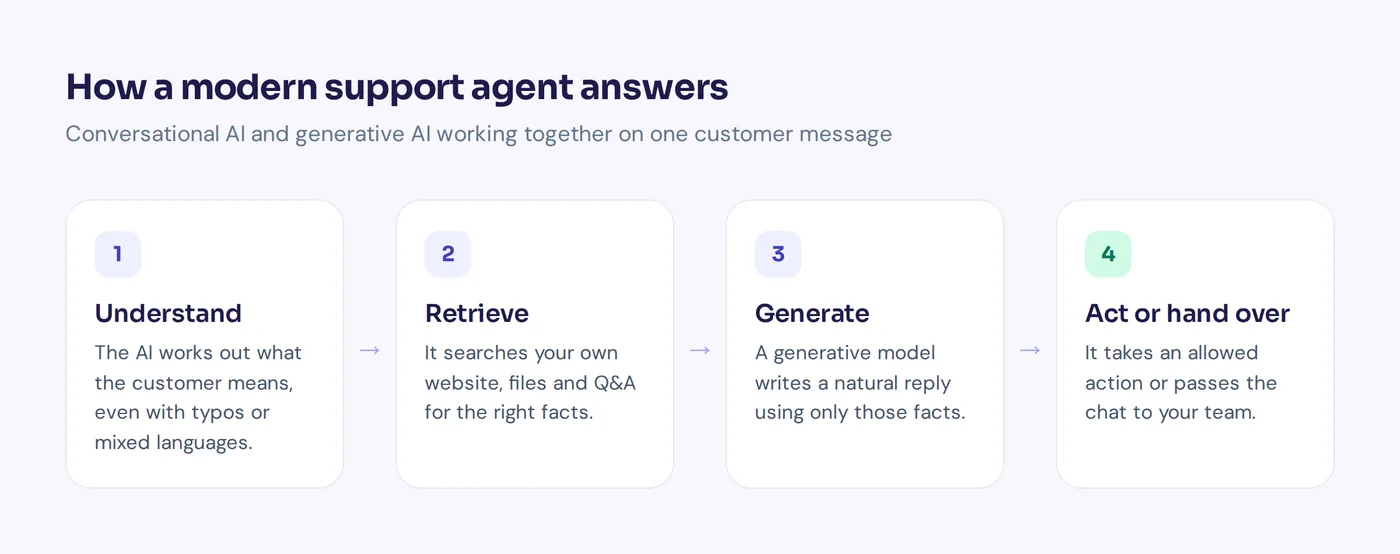
For businesses, the common fix is retrieval-augmented generation (RAG). The system first searches your own documents for relevant information, then asks the model to answer using only that. So the generative part writes the sentence, but your content supplies the facts.
Where generative AI and conversational AI overlap
This is where the line gets blurry. Most new AI chatbots are generative conversational AI: a conversational system that uses generative AI models to understand and reply.
ChatGPT is the best known example. It is generative AI (it creates text) delivered through a conversational interface (you chat with it). That's why people often ask "is ChatGPT conversational AI or generative AI?" The honest answer is both.
A modern customer service agent works the same way, with extra parts on top:
- It uses generative AI to understand messy messages and write natural answers.
- It uses retrieval to answer only from the company's knowledge base.
- It uses dialogue pieces like memory, handoff rules and integrations to actually solve the problem.
- It adds guardrails so it doesn't make promises the business can't keep.
Conversational AI vs chatbots vs AI agents
Three more terms get mixed into this debate, so here is the quick version:
- Chatbot: any software that chats with people. It can be a simple rule-based bot or an AI one.
- Conversational AI: the technology that makes a chatbot understand language and context. Not every bot uses it.
- AI agent: conversational AI that can also take actions, like checking an order, booking a meeting or updating a subscription, usually with generative AI doing the thinking.
So the difference between an agent and a chatbot is mostly about doing versus talking. A basic bot answers. An agent answers and then gets the job done, within rules you set.
Real examples of each type
Examples of conversational AI
- A store's AI assistant answering "Do you ship to Canada?" on the website
- A WhatsApp assistant that checks order status for a verified customer
- An HR bot answering "How many leave days do I have left?"
- Voice assistants like Alexa and Google Assistant setting reminders
- Banking apps that help you freeze a card in a chat
Generative AI examples
- Writing a first draft of a product description or email
- Summarizing a 40-page report into five bullet points
- Generating images for an ad campaign
- Writing and explaining code
- Translating a help article into another language
Benefits, limitations and AI ethics
Conversational AI
Good at: conversational AI handles high volumes of repeat questions, works 24/7, completes tasks through integrations and keeps answers consistent. Weak at: anything outside what it was built for. Old rule-based bots are rigid and frustrate users who phrase things differently.
Generative AI
Good at: natural language, creativity, speed, and handling questions nobody planned for. Weak at: accuracy without good source data, staying on topic, and knowing when to stop. It can be confidently wrong, and raw models can be steered off-topic by clever prompts.
AI ethics and privacy
Both types raise the same practical questions. Is customer data used to train the vendor's models? Is it clear to people that they are talking to an AI? Can a person step in? Generative AI adds copyright and misinformation concerns, because it can produce content that looks real but isn't.
That's why, for customer-facing work, you want generative AI inside a conversational system with clear limits, not a raw model talking to your customers freely.
When to use conversational AI and when to use generative AI
Ask what job you want done:
- You want to answer customers automatically on your website, WhatsApp or Instagram: you need conversational AI. In 2026 that should be an AI agent powered by generative models and trained on your content.
- You want to produce content faster (blog posts, ads, images, code): you need generative AI tools.
- You want both (a support agent that also drafts help articles and reply suggestions for your team): look for a platform that combines them.
One honest tip: if you're comparing AI for customer service, don't get stuck on the labels. Ask practical questions. Does it answer only from my information? Does it say "I don't know"? Can it hand over to a person? Can I see what it said?
How AnytimeReply combines conversational and generative AI
AnytimeReply is an AI agent for customer support and sales, powered by generative models. You choose GPT, Claude, Gemini or DeepSeek per agent. Here is how the two sides fit together:
- Generative side: the agent understands free text and replies naturally, in the customer's language, including mixed ones like Banglish and Hinglish. It can also help your team rewrite or translate replies and draft help center articles.
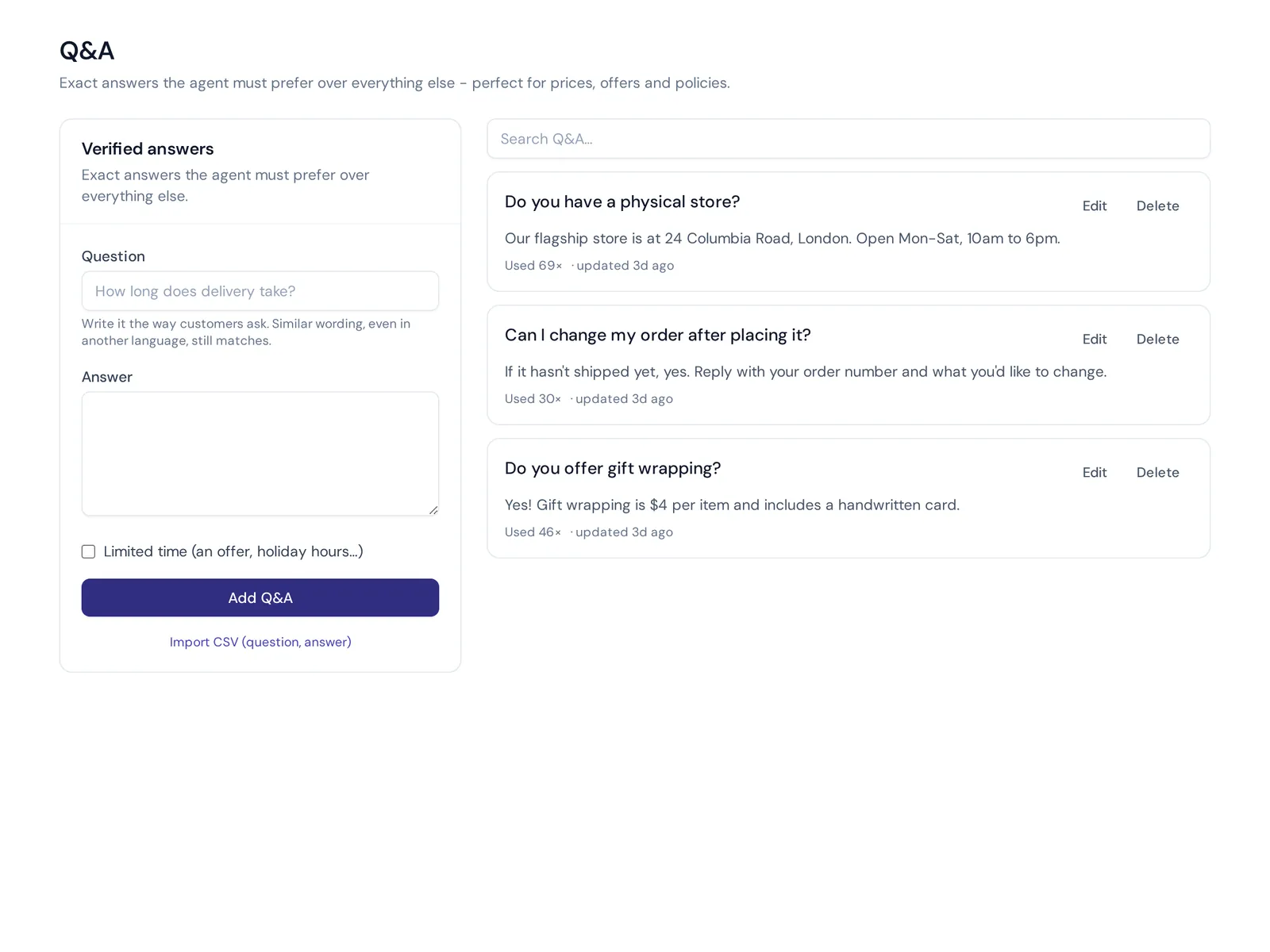
- Grounded in your content: it trains on your website, files and Notion pages, and Q&A answers you write always win over other sources. Every answer has a confidence score, and when it doesn't know, it says so instead of guessing.
- Conversational side: it hands over to your team with a summary when a customer asks for a person or gets upset, and on paid plans it can take actions like checking orders or booking meetings for verified customers.
It works on website chat, WhatsApp, Messenger, Instagram, Telegram, email and Slack. It does not do phone calls or voice. See how the AI agent works, or check the plans.
Frequently asked questions
Is ChatGPT conversational AI or generative AI?
Both. ChatGPT is a generative AI model (it creates text) that you use through a conversational chat interface. It's the most famous example of generative conversational AI.
What is the main difference between conversational AI and generative AI?
Purpose. Conversational AI is built to hold a dialogue and help a person get something done. Generative AI creates new content. Many modern tools combine the two.
Is conversational AI a type of generative AI?
Not always. Older conversational AI used rules and intent classifiers with fixed replies, which is not generative. Most new ones use generative models, so the two now overlap.
Can generative AI be used for customer service?
Yes, and it works well when it answers from your own knowledge base, has clear limits, and hands over to a human when needed. Without those, it can give wrong answers with confidence.
Are Alexa and Siri conversational AI?
Yes. They are voice-based virtual assistants. Newer versions are adding generative AI to make conversations more natural.
Which is better for customer service, generative AI or conversational AI?
For support, you want conversational AI powered by generative AI: natural answers from the generative model, plus the structure, memory, handoff and safety of a conversational system.
Final thoughts
Conversational AI talks. Generative AI creates. Understanding the difference helps you pick the right tool. The most useful modern AI tools for customer support do both: they understand what people mean, write a clear answer from your own information, and know when to bring in a human.
If you want to see that in action, start free with AnytimeReply, no card needed. Add your website, ask it your customers' real questions, and judge the answers yourself.
Published 3 November 2026 by AnytimeReply team