It is 11 pm and a customer sees a card payment they don't recognize. The bank's call center opens at 9. They don't want to wait. They want to type "What is this charge?" and, if it looks wrong, freeze the card right now.
That is what conversational AI in banking is about: letting customers talk to their bank in plain words, in the mobile app, on the website or in a messaging channel, and get a real answer or a real action in seconds. Done well, it cuts wait times and frees staff for the cases that need a person. Done badly, it is a chatbot that loops "Sorry, I didn't understand that" while the customer gets angrier.
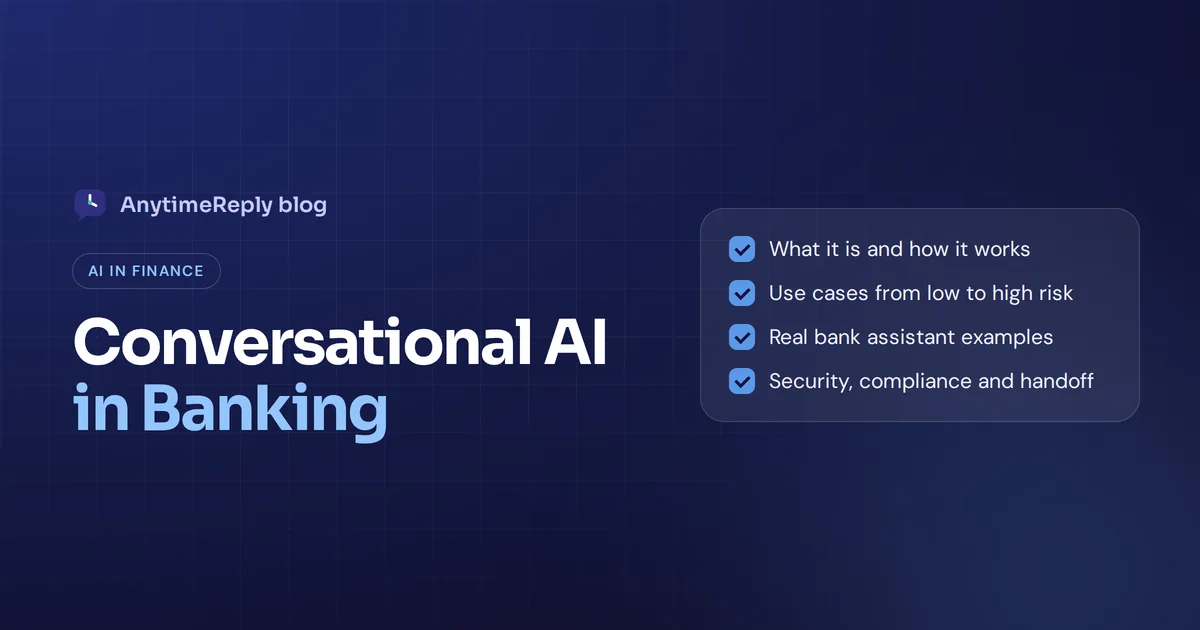
This guide covers how conversational AI works for banks, the use cases that make sense, real examples, the risks and rules you can't ignore, and how to start. Quick honesty note: we build a general AI support agent. It fits some financial businesses and not others, and we'll say exactly where.
What is conversational AI in banking?
Conversational AI is technology that lets software understand what a person writes or says and reply in a natural way. In a bank, it powers chatbots, virtual assistants and voice bots that answer customer queries and complete simple banking tasks. When a bank lets customers do their everyday banking through chat like this, people call it conversational banking.
Under the hood, conversational AI for banking combines a few pieces:
- Natural language understanding. Working out what the customer means, even with typos, slang or mixed languages. "send 5k to ammu" and "transfer 5,000 to my mother" are the same request.
- Generative AI. Large language models write clear responses to customer questions based on the bank's own approved content instead of a fixed script.
- Integration with core systems. Connecting to core banking, card and CRM software, so the AI can check a balance or block a card for a verified customer.
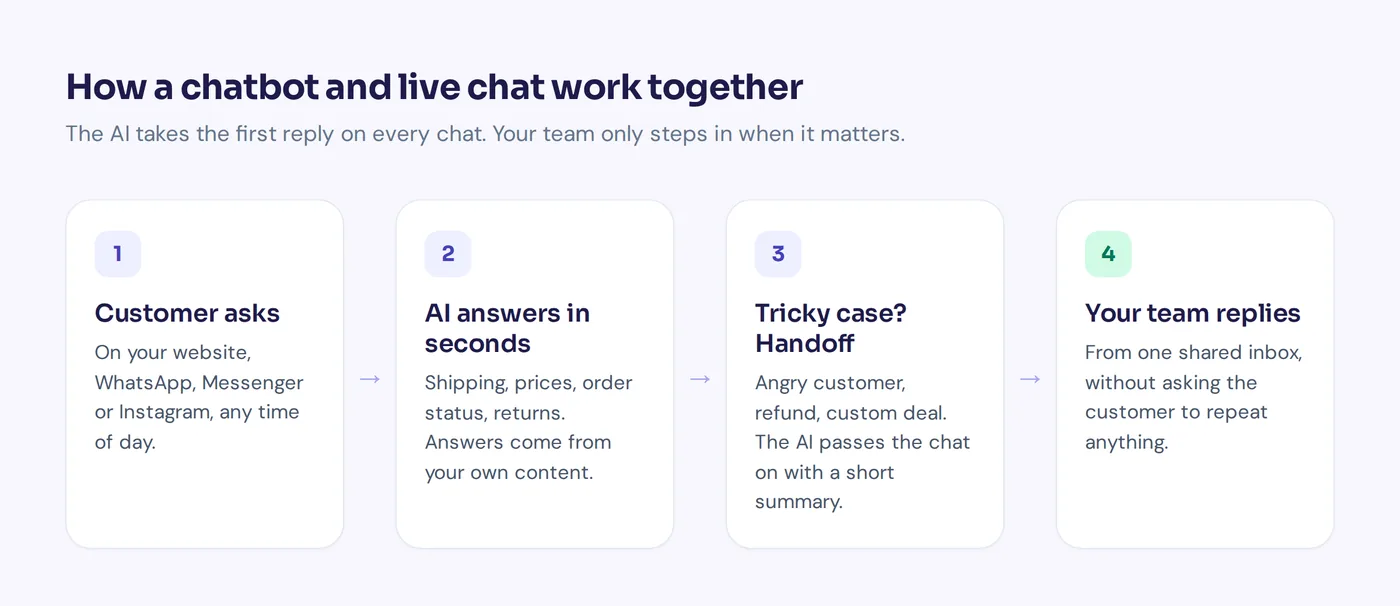
- Handoff to a human agent. Passing the conversation to a person, with context, when the request is complex, sensitive or risky.
The result is a conversational interface on top of the bank. Conversational AI enables a natural conversational flow: instead of tapping through five menus, the banking customer just asks. It allows customers to access financial services and transactions in the same chat where they ask questions.
Conversational AI vs chatbots vs IVR
These terms get mixed up, so here is the short version.
| Rule-based chatbot | Phone IVR | Conversational AI | |
|---|---|---|---|
| How it works | Buttons and keyword matching | "Press 1 for cards" | Understands natural language |
| Handles new wording | Poorly | No | Yes |
| Takes actions | Limited, scripted | Limited | Yes, when connected to systems |
| Channels | Website, app | Phone | App, web, messaging, sometimes voice |
| Main risk | Frustrated customers | Long menus | Wrong answers if not grounded |
Newer AI agents go one step further: they can plan several steps, like checking a transaction, freezing a card and ordering a new one, with confirmation at each step. That power is exactly why banks put strict limits on them.
Benefits of conversational banking for customer experience
Every bank and financial institution gets a huge volume of repeat questions. What is my balance? Where is my new card? What are your loan rates? How do I reset my online banking password? Answering each one by phone or email is slow and expensive. Here is where AI can help:
- 24/7 customer support. Customers get answers outside branch and call center hours. That meets modern customer expectations and makes it easier for customers to get help.
- Efficient customer service at lower cost. A routine query handled by automated customer service costs far less than a phone call with an agent. That is the strongest business case for most banks, and automation also speeds up service delivery.
- Shorter queues. When AI handles simple questions, human customer service staff have more time for fraud cases, complaints and complex products.
- Better banking experience. No hold music. Just ask. Fewer steps improve customer journeys and the overall customer experience.
- Personalized help. With consent, a bank can use what it knows to personalize replies: spending insights, bill reminders, a savings nudge based on customer behavior.
- Multiple languages. One AI can serve customers in many languages, which matters a lot for a bank in a multilingual market.
Over time, this can build customer trust and a stronger customer relationship, as long as the answers are right. One confident wrong answer about a fee undoes a lot of goodwill.
Conversational AI use cases in banking
Here are the conversational banking use cases that tend to work, grouped from low risk to high risk. Start at the top: each AI-powered use case should prove itself before you add the next one.
Low risk: general information
- Branch and ATM locations, opening hours, holiday schedules
- Product information: account types, card features, fees, loan and deposit rates
- How-to help: activating a card, setting up digital banking, using the mobile app
- Documents needed to open an account or apply for a loan
These answers come from public, approved content. No login needed.
Medium risk: account servicing for verified customers
- Balance and recent banking transactions
- Card freeze, unfreeze and replacement
- Payment due dates and bill reminders
- Loan application status and next steps
- Updating contact details
These need strong authentication, tight integrations and audit trails.
Higher risk: money movement and advice
- Transfers and payments in chat (sometimes called conversational payments)
- Disputes and chargebacks
- Fraud alerts and "Was this you?" confirmations
- Financial guidance and product recommendations
These carry regulatory and fraud risk. Most banks keep strict limits, confirmations and human review here.
Internal use cases
Conversational AI also helps bank employees: an internal AI assistant that answers policy and procedure questions for branch staff and call center agents, or drafts replies for agents to review. It is often a safer place to start than customer-facing AI.
Real examples: the bank AI assistant in digital banking apps
Several large banks run their own virtual assistant inside their banking apps:
- Erica (Bank of America). Helps customers with balances, transactions, bill reminders and spending insights in the app.
- Eno (Capital One). Focused on account alerts, card activity and virtual card numbers.
- Fargo (Wells Fargo). An in-app helper for everyday banking tasks, launched with the bank's app redesign.
- EVA (HDFC Bank). A chatbot that answers questions about the bank's products and services in India.
Each bank built its AI-powered helper over several years with large teams. This kind of banking technology improves customer interactions, but it is not cheap.
Most smaller banks and credit unions buy conversational banking solutions from a specialist vendor instead. Vendors focused on the banking industry, such as boost.ai or interface.ai, build integrations with core platforms and know what regulators expect. Check each vendor's site for current features.
Risks, security and compliance
Banking is one of the most regulated industries, and conversational AI doesn't get a free pass. Before you launch, think through these:
- Wrong answers. An AI chatbot that invents a fee or an interest rate is a real problem. AI systems should answer only from approved content and say "I don't know" when they don't.
- Data protection and privacy. Financial information falls under laws like GDPR and local banking secrecy rules. Card data has its own standard (PCI DSS). Know where data is stored and who can see it.
- Authentication and fraud. Chat can be a target for social engineering. Any action on an account needs strong identity checks, limits and confirmations.
- Fair treatment and complaints. Regulators expect customers to reach a human easily. An AI that blocks people from an agent will cause trouble.
- Audit and oversight. Keep records of what the AI said and why, and name someone accountable for it.
- Accessibility. Chat should work with screen readers and for customers who aren't comfortable with technology. Traditional banking channels should stay available.
The rules vary by country, so involve your compliance and legal teams early, not after launch.
How to implement conversational AI for banks with automation
- Start with data. Analyze customer contacts: call center logs, chat history and emails. Find the top 20 reasons people contact the bank. Understanding customer needs comes before choosing technology.
- Pick low-risk use cases first. FAQs, product information and how-to guidance. Prove accuracy before touching accounts.
- Choose the right conversational AI platform. For account-level actions, pick a vendor built for regulated financial services, with the certifications and integrations your regulator expects.
- Write and approve the content. Every rate, fee and policy the AI uses should come from a reviewed source.
- Design the handoff. Make reaching a person easy, and pass the history so customers don't repeat themselves.
- Test hard. Include tricky, adversarial and emotional conversations, plus every language you serve.
- Roll out across banking channels step by step. Website first, then the app and messaging channels like WhatsApp.
How to measure success in AI banking and customer care
- Containment or resolution rate. How many conversations end without a human, and was each query really solved? Higher customer satisfaction matters more than a high containment number.
- Handoff rate by topic. Shows where content or integrations are weak.
- Customer ratings. Ratings after chats, compared with phone and email. AI makes it easy to collect them at the end of each conversation.
- Accuracy reviews. Sample conversations every week and check them against policy.
- Unanswered questions. Your list of content to add next.
Where AnytimeReply fits (and where it doesn't)
Let's be direct. AnytimeReply is a general AI support agent with a helpdesk. It is not a banking platform, and we don't hold banking-grade compliance certifications. If you are a regulated bank and want customers to check balances, move money or dispute transactions in chat, you need a specialist vendor that connects to your core banking systems and meets your regulator's requirements.
Where it can fit is the information layer, as conversational AI for financial services businesses that sell or explain banking services without handling accounts in chat:
- Public questions. Fintech startups, lenders, microfinance teams, insurance brokers and payment apps can use the AI agent to answer questions about products, fees, eligibility and required documents from their website and PDFs.
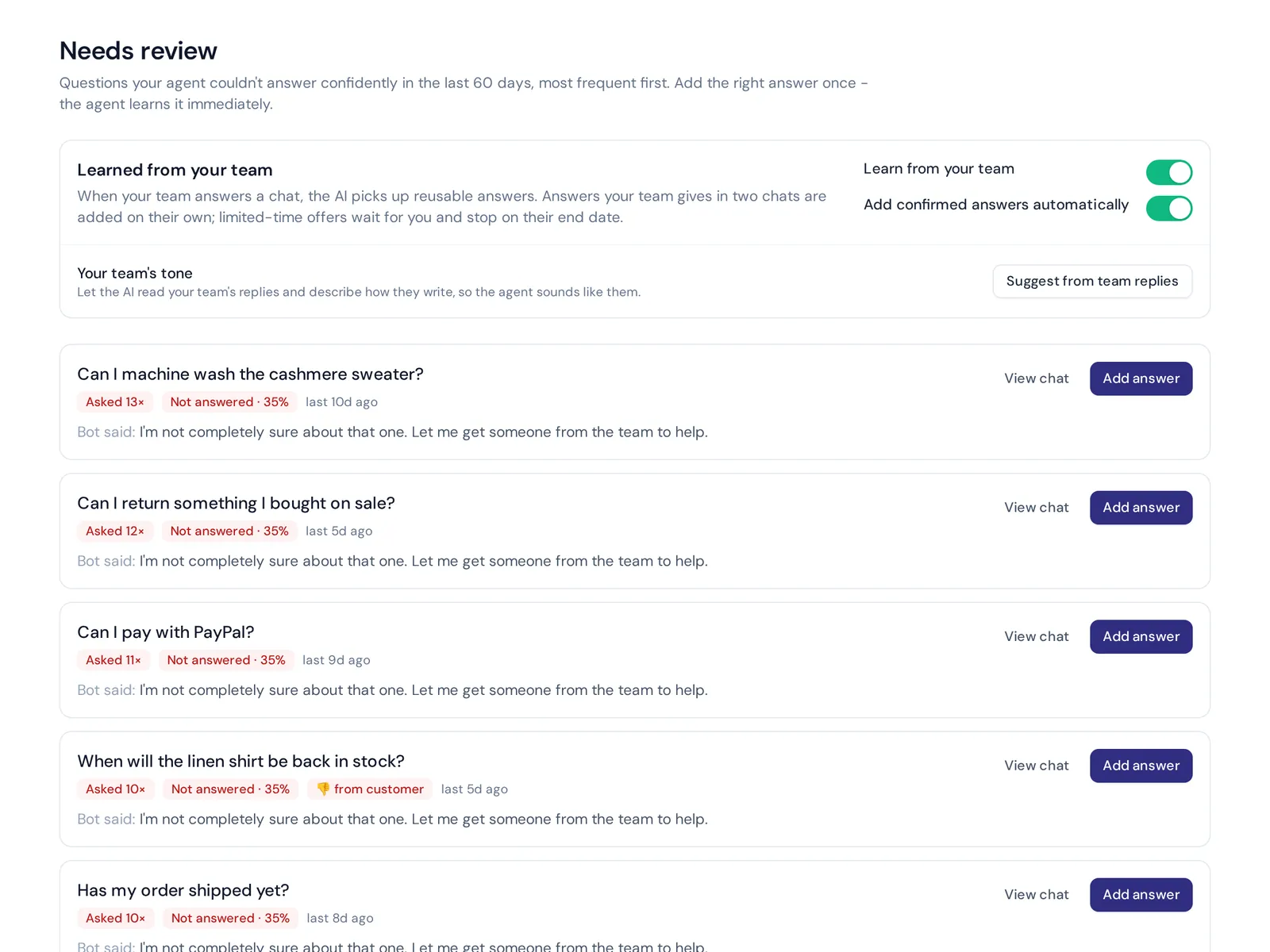
- No guessing. Answers come with a confidence score, and when the agent doesn't know, it says so. Q&A you write always wins over other sources, which helps keep rates and fees exact.
- Handoff to your team. Anything about a specific account goes to a person in the shared helpdesk inbox, with a summary.
- Conversational channels. Website chat, WhatsApp, Messenger, Telegram and email in one inbox. There is no phone or voice channel.
- Languages. It replies in the customer's language, including Bangla, Banglish, Hindi and Hinglish.
On security, customer data is not used to train AI models, integration keys are encrypted and there is a DPA. Read our privacy policy and DPA and decide with your compliance team.
Frequently asked questions
How can AI be used in financial services?
Mostly for customer service: answering questions, checking balances, freezing cards, sending alerts and guiding customers through applications. Banks and insurers also use it internally, to help staff find policies and to spot fraud patterns.
Is conversational banking secure?
It can be, with strong authentication, answers limited to approved content, clear limits on actions, audit logs and an easy path to a human. The risk depends on what you let the AI do.
How can conversational banking be integrated with existing banking systems?
Usually through APIs to core banking, card and CRM systems, often via a vendor that already has connectors. Start with read-only data before allowing actions.
Can conversational banking replace traditional banking methods entirely?
No. Many customers still want branches, phone support and a person for big decisions. Conversational AI adds a faster option; it doesn't remove the others.
How quickly can banks implement conversational AI solutions?
A public FAQ conversational AI assistant can go live in weeks at a bank. Full account servicing with integrations, security reviews and regulator sign-off usually takes months.
Final thoughts
Conversational AI works best in a bank when you start small, keep answers grounded in approved content, and make the human handoff easy. For account-level actions, choose a specialist built for regulated banking.
If you run a fintech or financial services business and want an AI that answers public questions on your website and WhatsApp, start free with AnytimeReply. No card needed.
Published 29 October 2026 by AnytimeReply team