Intercom is a great product. It's also one many teams outgrow in the wrong direction: the bill grows faster than the business. Paying per seat plus a fee for every AI outcome adds up, and smaller teams often pay for features they never touch.
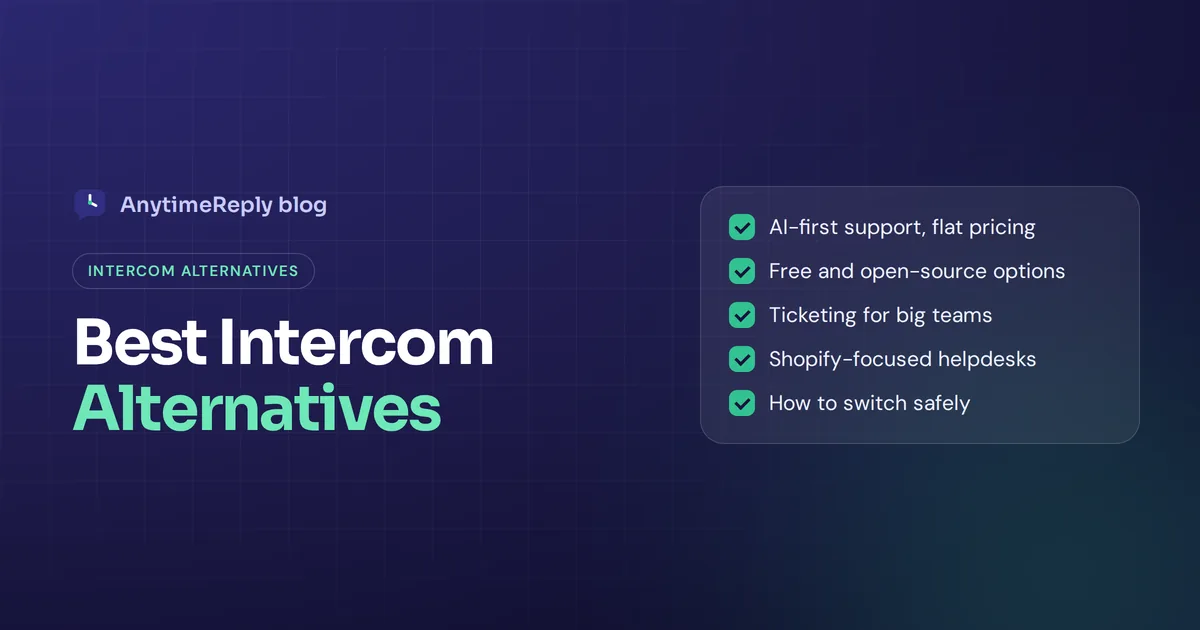
If that sounds familiar, this list of Intercom alternatives is for you. We compare the top alternatives in 2026, what each one does well, who it suits and where it falls short, including free options. We also show how to move off Intercom without losing your history.
A heads-up before we start: AnytimeReply is our product and it's on this list. We'll be honest about where Intercom or another tool is the better choice.
Why teams look for an Intercom alternative
Intercom is built around a polished messenger, its Fin AI agent, in-app messaging and a strong helpdesk. Intercom excels with funded SaaS companies that want one platform for support, onboarding and engagement. But we hear the same reasons again and again from teams exploring alternatives:
- Cost. Intercom's pricing structure combines per-seat plans with a per-outcome fee for its AI. At the time of writing, Intercom's pricing page lists Fin from $0.99 per outcome on top of seat plans. For a busy month, that's hard to predict.
- Complexity. Intercom offers a lot. A five-person support team may only need chat, an inbox and AI.
- Channel needs. Teams selling on WhatsApp, Instagram and Messenger, or in markets like South Asia, may want a tool built around those channels and languages.
- Contracts and lock-in. Some teams want monthly plans they can cancel any time.
- Focus. Ecommerce stores may want deep Shopify order tools, while support teams may want classic support tickets by email.
If you're looking for an alternative mainly because of cost, start by working out what you actually use. Most teams that leave Intercom use only a fraction of it.
Best Intercom alternatives and competitors at a glance
| Tool | Best for | AI | Free option |
|---|---|---|---|
| AnytimeReply | AI-first support on website and messaging apps, lean teams, multilingual customers | Built in | Free plan |
| Zendesk | Larger teams that need deep ticketing | Yes | Free trial |
| Freshdesk / Freshchat | Growing teams wanting helpdesk plus chat | Yes (Freddy AI) | Check their pricing page |
| Help Scout | Email-first support that feels personal | Yes | Check their pricing page |
| Crisp | Startups wanting a lighter, cheaper messenger | Yes | Check their pricing page |
| Tidio | Small online stores | Yes (Lyro) | Check their pricing page |
| HubSpot Service Hub | Teams already on HubSpot CRM | Yes | Free tools available |
| Gorgias | Shopify stores | Yes | Check their pricing page |
| Front | Teams that live in shared email | Yes | Free trial |
| Chatwoot | Open-source, self-hosted support | Yes | Free to self-host |
Pricing and free tiers change often. Check each vendor's pricing page before you decide.
Evaluating Intercom alternatives: what to look for
Before comparing logos, list the Intercom features you actually use today. Most teams rely on four or five:
- A chat widget on the website that looks good and loads fast.
- AI that answers customer queries from your help docs and hands over to a person cleanly.
- A shared inbox with assignment, notes and mentions, so support agents don't step on each other.
- A comprehensive knowledge base customers can search.
- Integrations with your CRM, Slack, Stripe or Shopify, and reporting (or at least exports to tools like Google Analytics).
Compare pricing and support quality, not just features. Then check the things that cause pain later: a predictable pricing structure, omnichannel support (WhatsApp, Instagram, email), whether you can bring your own AI model, data export, and how easy it is to move customer conversations and articles over. Good support tools should streamline customer service and support operations for your team, not add another dashboard to babysit. And they should improve the customer experience, not just cut costs.
10 Intercom alternatives for 2026: live chat, AI and helpdesk tools
1. AnytimeReply
Best for: lean teams that want AI answering first, one inbox for the team, and predictable flat pricing.
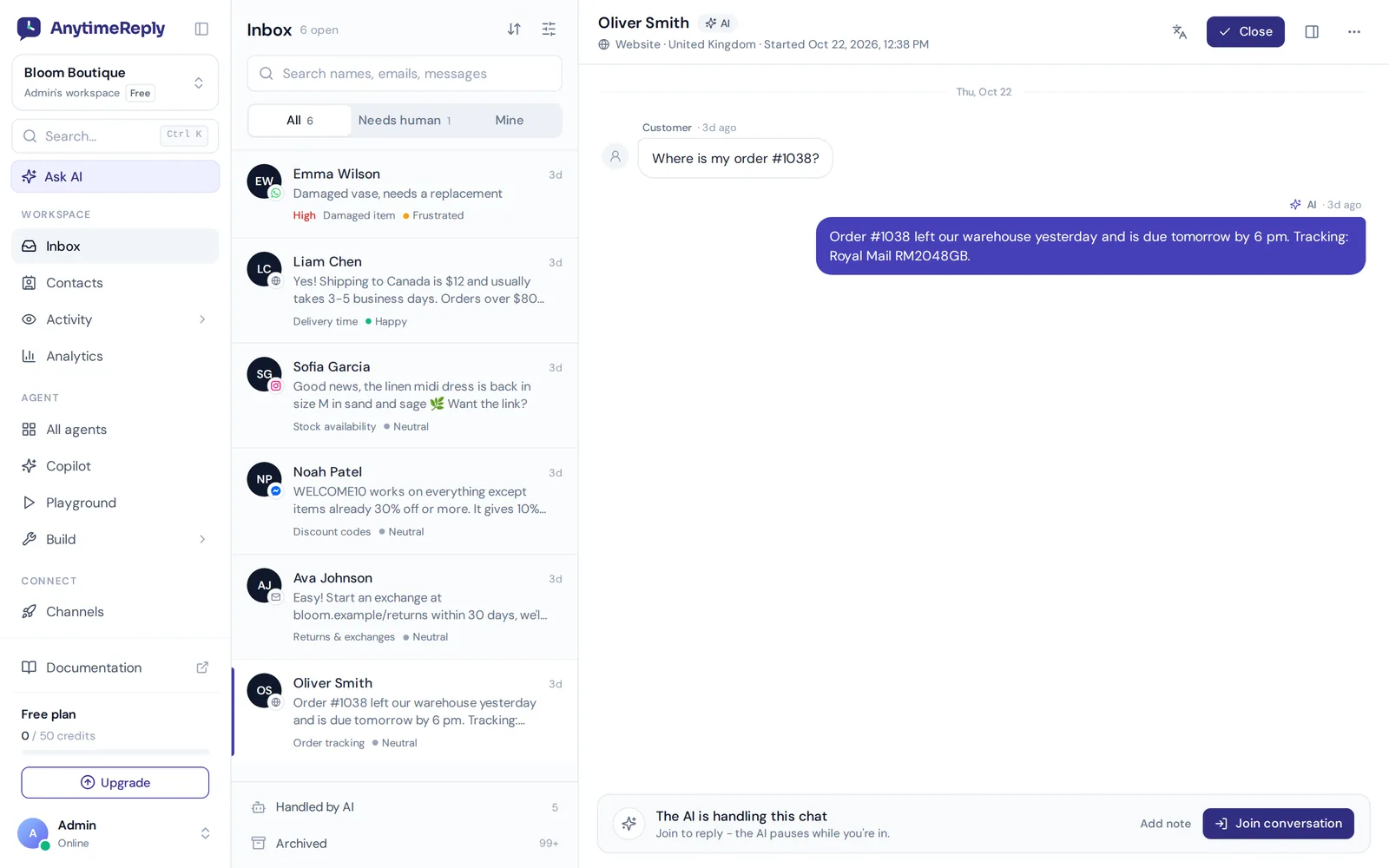
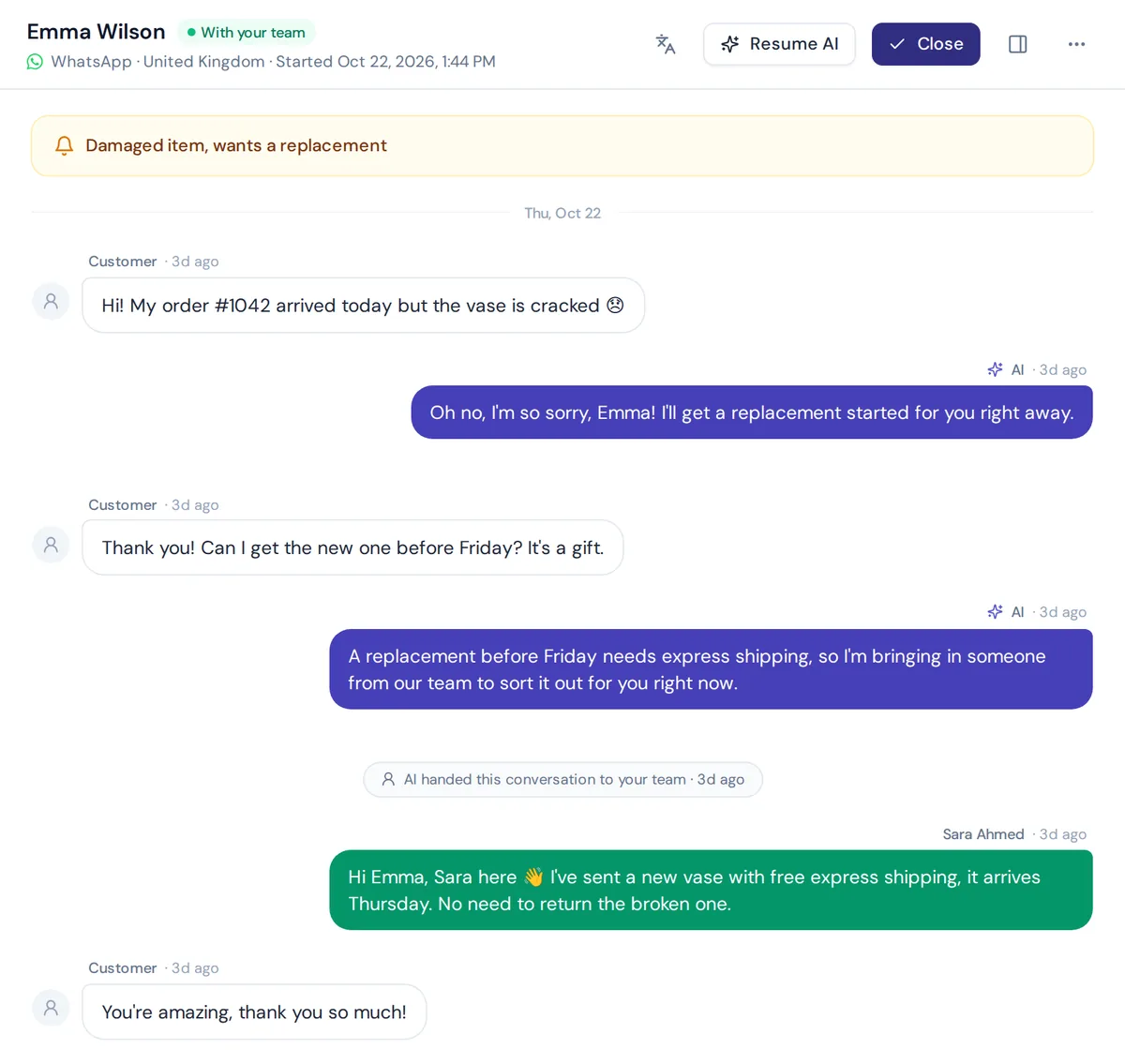
AnytimeReply is a customer support platform that combines an AI agent with a built-in helpdesk. You add your website, PDFs, Notion pages or Shopify products, and the AI answers customers in seconds, in their own language (including Bangla, Banglish, Hindi and Hinglish). Answers come with a confidence score, and when it doesn't know, it says so and hands the chat to your team with a summary.
- One shared inbox for website chat, WhatsApp, Messenger, Instagram, Telegram, email and Slack
- Email tickets from Gmail, Outlook, Zoho or any IMAP mailbox, with statuses and owners
- Help center on your own domain with AI search that answers instead of listing links
- Actions for verified customers: check orders in Shopify or WooCommerce, book meetings, manage Stripe subscriptions (paid plans)
- Flows to automate lead capture and common questions; flow steps use no AI credits
- Analytics with topics, sentiment, CSAT and knowledge gaps
- Choose GPT, Claude, Gemini or DeepSeek per agent, or connect your own AI key from the Standard plan so replies use no credits
- Can hand chats over to Intercom, Zendesk, Freshdesk and others if you keep one of them
Pricing: a free plan forever (website chat, helpdesk inbox, help center, AI with 50 credits a month). Paid plans start at $9 a month, with Standard at $29 and Pro at $79. Team members are included, no setup fees, no contract. See pricing.
Where Intercom is better: product tours, in-app messaging inside mobile apps (AnytimeReply has no native iOS or Android SDK), and very large enterprise setups. AnytimeReply also has no phone or voice channel.
2. Zendesk
Best for: larger support teams that need powerful ticketing, support workflows and reporting.
Zendesk is one of the best known help desk platforms, and one of the few that can truly compete with Intercom at enterprise scale. Zendesk offers email, chat, messaging and voice, with AI agents and a big app marketplace. If your team has strict processes and many agents, it's a strong customer service platform and one of the main Intercom competitors.
Watch out for: it can feel heavy for small teams, and costs grow with seats and add-ons.
3. Freshdesk and Freshchat
Best for: growing teams that want a full helpdesk with chat, at a more approachable price than enterprise tools.
Freshworks offers Freshdesk for ticketing and Freshchat for messaging, with Freddy AI across both. The interface is friendly and setup is reasonably quick.
Watch out for: features and AI are split across plans and products, so compare carefully.
4. Help Scout
Best for: teams that want email support to feel personal, not like a ticket factory.
Help Scout is known for its simple inbox, its Docs knowledge base and its Beacon widget, which adds chat and email help to your site. Customers see normal emails, not ticket numbers. Teams that care about excellent customer support with a human tone often love it.
Watch out for: it's email-first. If most of your volume is WhatsApp or Instagram, look elsewhere.
5. Crisp
Best for: startups that want an Intercom-style messenger without the Intercom bill.
Crisp offers live chat and customer messaging across chat, email and social for real-time customer conversations, plus a knowledge base and AI features, priced per workspace rather than per seat on many plans.
Watch out for: some of the most useful features sit on higher plans.
6. Tidio
Best for: small online stores, especially on Shopify and WordPress.
Tidio combines live chat software, a visual builder for custom chatbots and the Lyro AI. It's easy for non-technical store owners to set up.
Watch out for: AI and automation are priced separately from live chat, so costs can climb. We wrote an honest AnytimeReply vs Tidio comparison if you're weighing them.
7. HubSpot Service Hub
Best for: teams already using HubSpot for sales and marketing.
HubSpot's Service Hub is a customer service solution with a help desk, live chat, a knowledge base and AI, all tied to the HubSpot CRM. Every conversation sits on the contact record next to deals and emails, which is great for customer communication and customer engagement across sales and support.
Watch out for: the move from free tools to paid hubs can get expensive quickly.
8. Gorgias
Best for: Shopify and ecommerce brands with heavy order-related support.
Gorgias pulls order data into every conversation so agents can refund, cancel or edit orders without leaving the inbox. It also handles social comments and DMs well.
Watch out for: pricing is tied to ticket volume, and it's built for stores, not SaaS or service businesses.
9. Front
Best for: teams that run support and account management through shared email.
Front feels like a collaborative email client: shared inboxes, comments, assignments and rules, plus chat and AI features. It suits B2B teams where customer interactions are long and personal.
Watch out for: it's priced per seat, and it isn't primarily a website chat tool.
10. Chatwoot
Best for: technical teams that want an open-source alternative to Intercom they can host themselves.
Chatwoot is an open-source engagement platform with website chat, a team inbox, and channels like email, WhatsApp and social messages. You can self-host it for free or use their cloud plans.
Watch out for: self-hosting means you handle servers, updates and backups. That "free" has a time cost.
Which alternative to Intercom is right for you? 5 best picks
Tools like Intercom all look similar on a features page, and most alternatives support the same basics. Here is how we'd pick, based on who you are:
- Lean team, customers on WhatsApp and Instagram, many languages: AnytimeReply.
- Big support team with strict processes and many support tickets: Zendesk or Freshdesk.
- Email-heavy, personal support: Help Scout or Front.
- Shopify store with lots of order questions: Gorgias, or AnytimeReply if you also want AI on WhatsApp.
- Developers who want full control: Chatwoot.
Free Intercom competitors for customer support
If budget is the main reason you want to leave Intercom, these tools offer a free way in:
- AnytimeReply Free: website chat, helpdesk inbox, help center, flows, analytics and AI with 50 credits a month and 3 team members. Good for trying a real AI-plus-human setup.
- Chatwoot (self-hosted): free software if you have someone to run the server.
- HubSpot free tools: basic live chat and inbox tied to the free CRM.
- tawk.to: free live chat with unlimited agents, with paid add-ons. Limited AI.
Be realistic: a free tier is great for starting out or for low volume. Once AI answers hundreds of questions a month, you'll want a paid plan anyway. The real question is how predictable that plan is.
Pricing model, AI pricing and Fin AI costs compared to Intercom
Exact prices change, so we compare how each one charges instead, because that decides your bill as you grow. This is where most tools try to win on better pricing.
| Pricing model | Examples | What it means for you |
|---|---|---|
| Per seat plus AI per outcome | Intercom | Cost grows with every hire and every AI resolution |
| Per-seat pricing (per agent) | Zendesk, Freshdesk, Front, Help Scout | Predictable per person, AI often an add-on |
| By ticket volume | Gorgias | Busy seasons cost more |
| Flat plans with AI credits, team included | AnytimeReply | Adding teammates doesn't raise the price; AI use is capped by credits, or by your own AI key |
| Free software, you host | Chatwoot | No license fee, but server and time costs |
A quick example: say your team grows from 3 to 8 people and AI handles 1,000 conversations a month. With per-seat plus per-outcome pricing, both parts of the bill go up. With flat plans where members are included, only the AI usage matters. Run your own numbers with real volumes before you sign anything.
How to switch from Intercom without losing customers
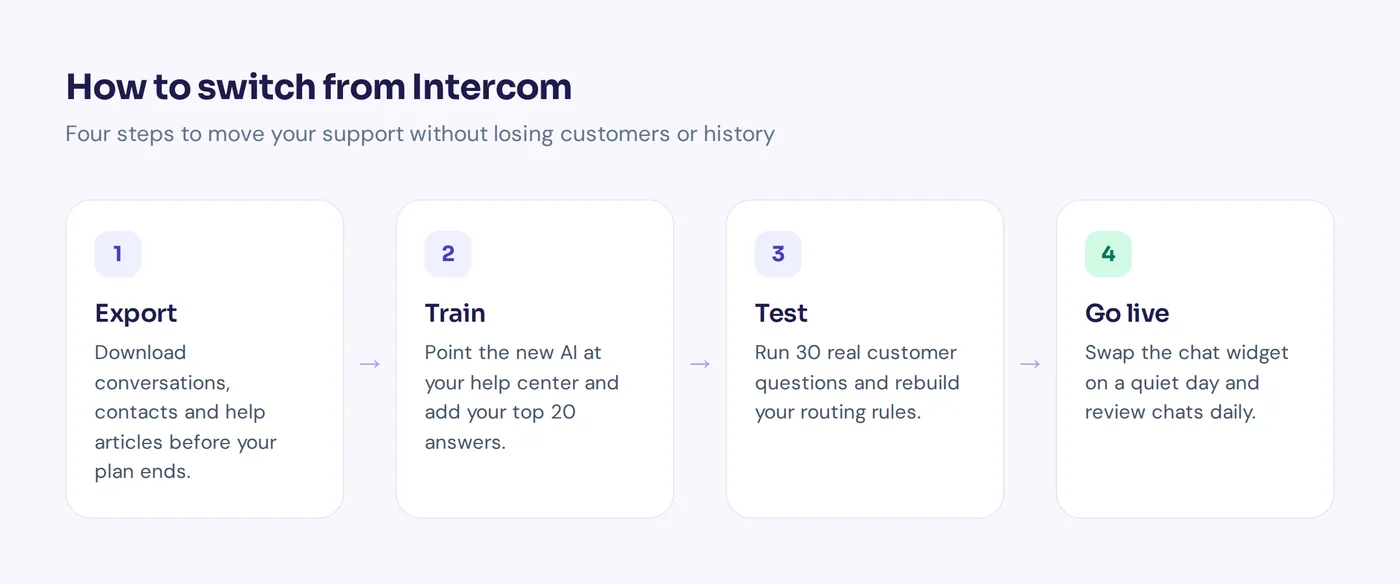
- List what you use. Messenger, Fin, inbox, help center, tours, integrations. Only migrate what matters.
- Export your data. Download conversations, contacts and help articles from Intercom before your plan ends.
- Train the new AI. Point it at your help center and website, and add Q&A answers for the top 20 questions.
- Test with real questions. Copy 30 real customer questions from Intercom and see how the new AI answers them.
- Rebuild routing. Recreate assignment rules, tags and handoff rules in the new inbox.
- Swap the widget. Replace the Intercom snippet with the new one on a quiet day. Keep email forwarding in place so nothing gets lost.
- Watch the first two weeks. Review conversations daily and fix gaps fast.
When Intercom features are worth staying for
Honestly, Intercom is still the right call for some teams:
- You rely on product tours, in-app surveys or messaging inside your mobile app.
- You have a large team with complex workflows already built around it.
- Fin resolves a lot of conversations and the per-outcome cost is clearly worth it.
If you use Intercom for all of that, switching may cost more time than it saves. Review again when your contract renews.
Why teams choose AnytimeReply as their Intercom alternative
Unlike Intercom, AnytimeReply includes team members in every plan, and from the Standard plan you can connect your own OpenAI, Anthropic, Gemini or other key so AI replies use no credits. Most teams that move want three things: AI that answers well from their own content, a simple inbox, and a bill they can predict.
It's also built for messaging apps and support across languages. WhatsApp, Instagram and Messenger sit in the same inbox as website chat and email (on paid plans), and the AI replies in the customer's language, which gives you multilingual support without extra staff. Read our full AnytimeReply vs Intercom comparison for the details.
Frequently asked questions
What is the best alternative to Intercom?
It depends on your team. For AI-first support with flat pricing on website and messaging apps, AnytimeReply. For large ticketing teams, Zendesk. For personal email support, Help Scout. For Shopify stores, Gorgias.
Is there a free Intercom alternative?
Yes. AnytimeReply has a free plan with website chat, an inbox and AI. Chatwoot is free if you self-host it, and HubSpot and tawk.to offer free live chat.
Why is Intercom so expensive?
Intercom charges per seat and adds a per-outcome fee for Fin. As your team and AI usage grow, both parts of the bill grow. For large companies it's often worth it; for smaller teams it can be hard to justify.
Can I keep my helpdesk and just add AI like Fin?
Yes. AnytimeReply can hand conversations over to Intercom, Zendesk, Freshdesk, Zoho Desk, Help Scout or Gorgias, so some teams let it answer first on website and WhatsApp and pass complex customer issues into their existing helpdesk.
Can I switch from Intercom without losing my data?
Mostly, yes. Export conversations, contacts and articles before your plan ends, import articles into the new help center, and keep old transcripts archived. Plan a few days to two weeks for a small team.
Can chatbots handle customer support outside business hours?
Yes, that's one of their biggest strengths. Modern AI chatbots answer common questions at any hour and leave complex cases for your team in the morning, which helps customer satisfaction and support at scale.
Final thoughts
The top Intercom alternatives aren't trying to copy everything Intercom provides. They do the parts you actually use, for a price that still makes sense when your support volume doubles. List what you need, test two tools with real customer questions, and switch only when you're sure.
Want to see if AnytimeReply fits? Start free, add your help center or website and test the AI with your real questions. No card needed.
Published 26 October 2026 by AnytimeReply team