A customer's internet drops at 10 pm. They open the app, wait on hold, give up, and post an angry comment on your Facebook page. Multiply that by a few thousand during a network fault and you have a normal week in telco support.
AI customer service in telecom is about handling that volume without hiring an army. AI agents answer billing inquiries, check service outages, walk people through router resets and pass the hard cases to a human agent with the context already filled in. Customers get instant support, and your support staff spend time on problems that need a person. It's one of the most practical AI applications in telecom customer service today.
Below: the main use cases, what agentic AI changes, the risks, the tools, and how to start. We'll also be upfront: telcos still run on phone calls, and our own product doesn't do voice.
How AI is transforming customer care in telecommunications
Telecom companies have a hard mix: millions of customers, products that are tricky to explain, and services people only notice when they break. Customer expectations keep rising too. People want answers in seconds, on the channel they already use, and every telecommunications customer compares you with the best service experience they've had anywhere.
That's why the industry was one of the first to try AI chatbots. Early bots were menus with a chat window. Today, advanced AI can transform the overall customer experience. A modern AI system understands natural language, reads your help content and account data, and can take action. Vodafone's TOBi assistant is one well-known example of a large operator putting a virtual assistant at the front of its customer care.
Why telcos need AI-powered customer support and automation
- Huge, spiky volume. In telecommunication networks, one fault can bring in more customer queries in an hour than a normal day. AI can absorb thousands of customer queries at once.
- Repetitive questions. "Why is my bill higher?" and "How do I turn on roaming?" arrive all day. Each inquiry is simple, which makes it perfect to automate.
- Complex accounts. Plans, add-ons, devices and family lines make simple questions hard to answer quickly.
- Rising support costs. Every contact handled by people costs money, and a call center is expensive to scale.
- Churn. Switching providers is easy. Bad support is often the final push.
How telecom providers use AI: the main use cases
Billing inquiries and payments
Bills are the top reason for customer inquiries. Connected to billing, AI can explain each charge, show the due date and send a payment link. Without account access, it still explains common fees from your help articles.
Outages and service issues
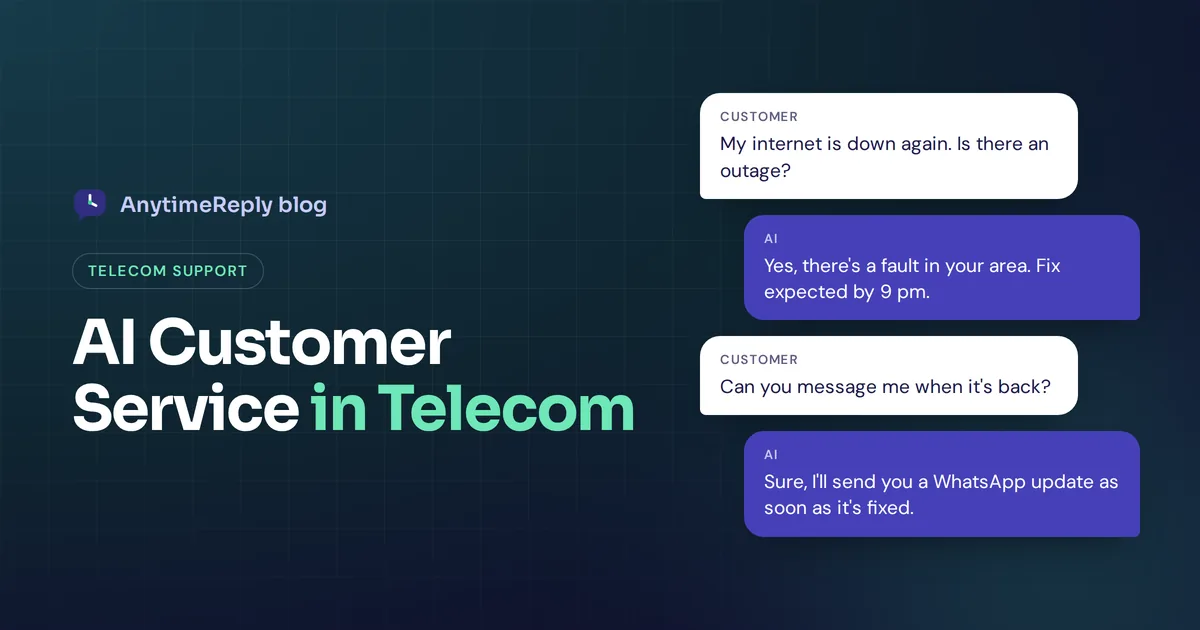
During service outages, the same query arrives thousands of times. AI can check the status for the customer's area, share the latest update and message them when service is back.
Technical support and troubleshooting
Router restarts, eSIM setup, APN settings, slow Wi-Fi. AI walks customers through guided steps and only books a technician if the basics fail.
Plan changes and personalized service
AI can analyze data usage and personalize a recommendation: "You've used all your data three months in a row. This plan would save you money." For verified customers, it can make the change with confirmation.
Retention and customer complaints
When someone says "I want to cancel", AI can ask why, offer a fix within your rules and route high-value customers to a retention specialist.
Help for human agents
AI enables faster work for people too. It summarizes long chats, suggests replies and translates messages, so each support team member resolves customer concerns faster and with better service.
Agentic AI customer service vs classic chatbots
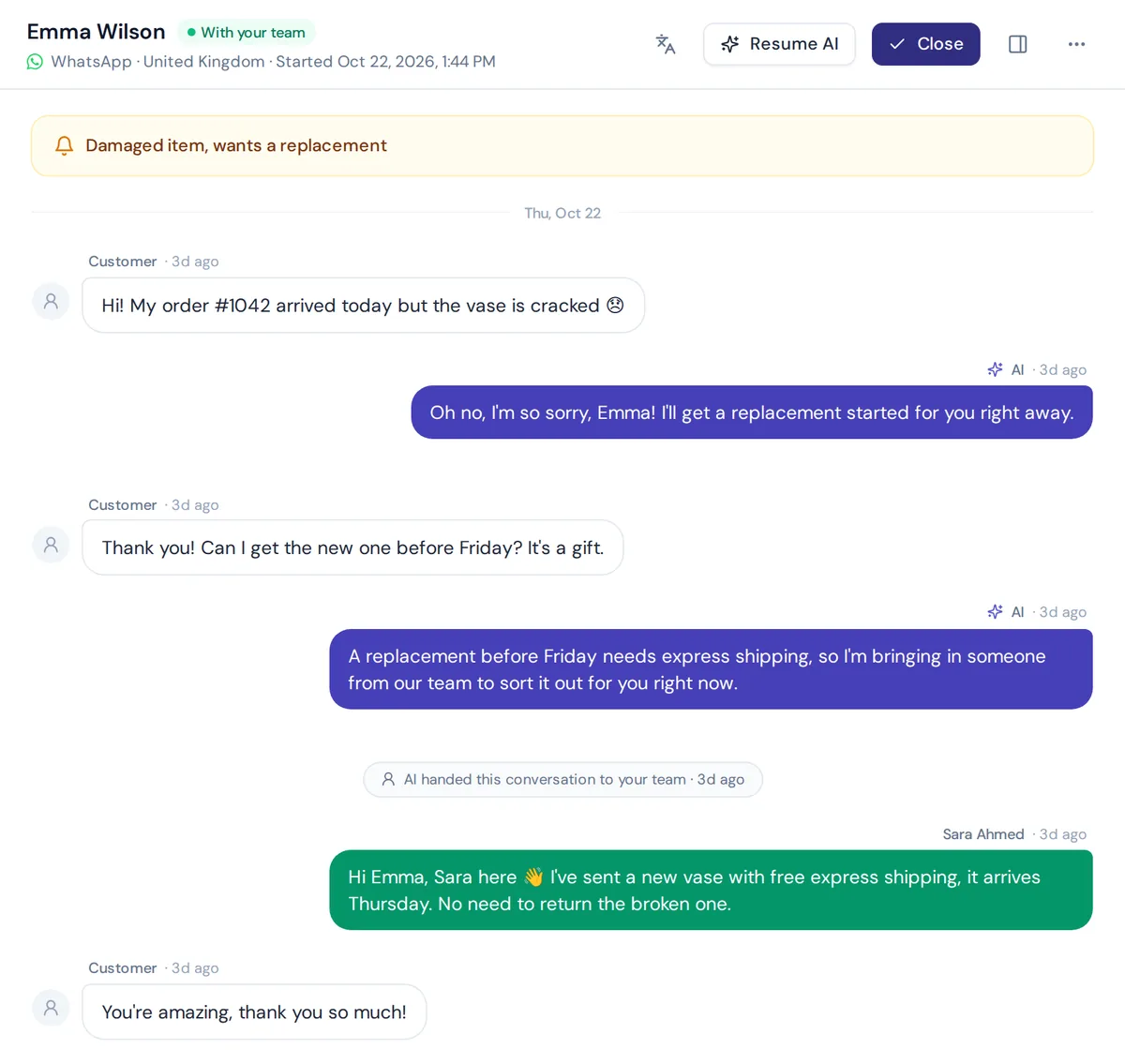
Older chatbots only answered. An agentic system can also do things, like look up an account, add a roaming pass or book a technician, often without human intervention.
| Classic chatbots | AI agent that takes actions | |
|---|---|---|
| How it works | Menus and keywords | Understands the request, plans the steps |
| What it does | Shares links | Checks the account, changes a plan, books a visit |
| Example | "Here is our roaming page." | "I've added the EU pass. It starts tonight." |
| Main risk | Dead ends | Wrong action if guardrails are weak |
Our view: start with answers, add read-only lookups next (outage status, balance), and allow account changes last, with identity checks, limits and approval for anything involving money.
Benefits of AI for the telecom industry
- Round-the-clock service. Support anytime, including 2 am and public holidays.
- Lower support costs and better operational efficiency, because AI resolves the simple volume.
- Consistent answers that improve service quality and personalized support across every channel.
- Many languages. Generative AI replies in the customer's language.
- Better data. AI-driven analytics and machine learning show what customers ask about, where help content is missing and which issues are trending.
- Increased customer satisfaction when people get fast answers and an easy route to a person. Fast, accurate replies improve customer loyalty and enhance customer satisfaction more than any discount.
- Room for new services. Leveraging AI for routine customer interactions frees budget and people for new products.
Challenges telecom providers must plan for
- Wrong answers. AI training on your real data matters. The agent should say "I'm not sure" rather than invent a price.
- Fraud. Never let AI do SIM swaps or number ports without strong verification. It's a known fraud route.
- Customer data and privacy. Check where data is stored, whether it trains models, and what your regulator requires.
- Legacy support systems. Connecting AI to old billing and CRM tools is often the hardest part.
- Voice. Many contacts are still calls. Automating them needs voice AI or IVR from a specialist vendor. Chat tools won't solve that.
The best AI customer service agents for telcos
There's no single best AI platform or innovative AI tool that suits every operator. It depends on your size and channels. Here's an honest overview; check each vendor's pricing page for costs.
- Contact center platforms such as Genesys or NICE: voice, IVR and digital AI in one place. Built for large telecom operators with budget and IT teams.
- Cloud AI platforms from Google Cloud, Microsoft or IBM: flexible building blocks for voice and chat. Usually need developers or a systems integrator.
- CRM and helpdesk AI like Salesforce Agentforce, Zendesk or Intercom: a good fit if your support already runs on that tool.
- AnytimeReply (our product): chat, WhatsApp and email AI for smaller providers. More below, including what it can't do.
How to deploy conversational AI in telecom support, step by step
- Count contacts by channel. If most are calls, start with voice tools. If most are chat and WhatsApp, start there.
- Pick three to five low-risk topics, like outage status, bill explanations, roaming and router resets.
- Clean up your knowledge. AI repeats what you give it, so update plans and policies first.
- Set handover rules. Angry customers, cancellations and fraud signals go to a person.
- Test, launch on one channel, then review weekly. Read failed chats and fill the gaps.
- Measure. Track resolution rate, handovers, response time and CSAT to see if the AI chatbot helps your customer support across channels.
How AnytimeReply fits telco and ISP support
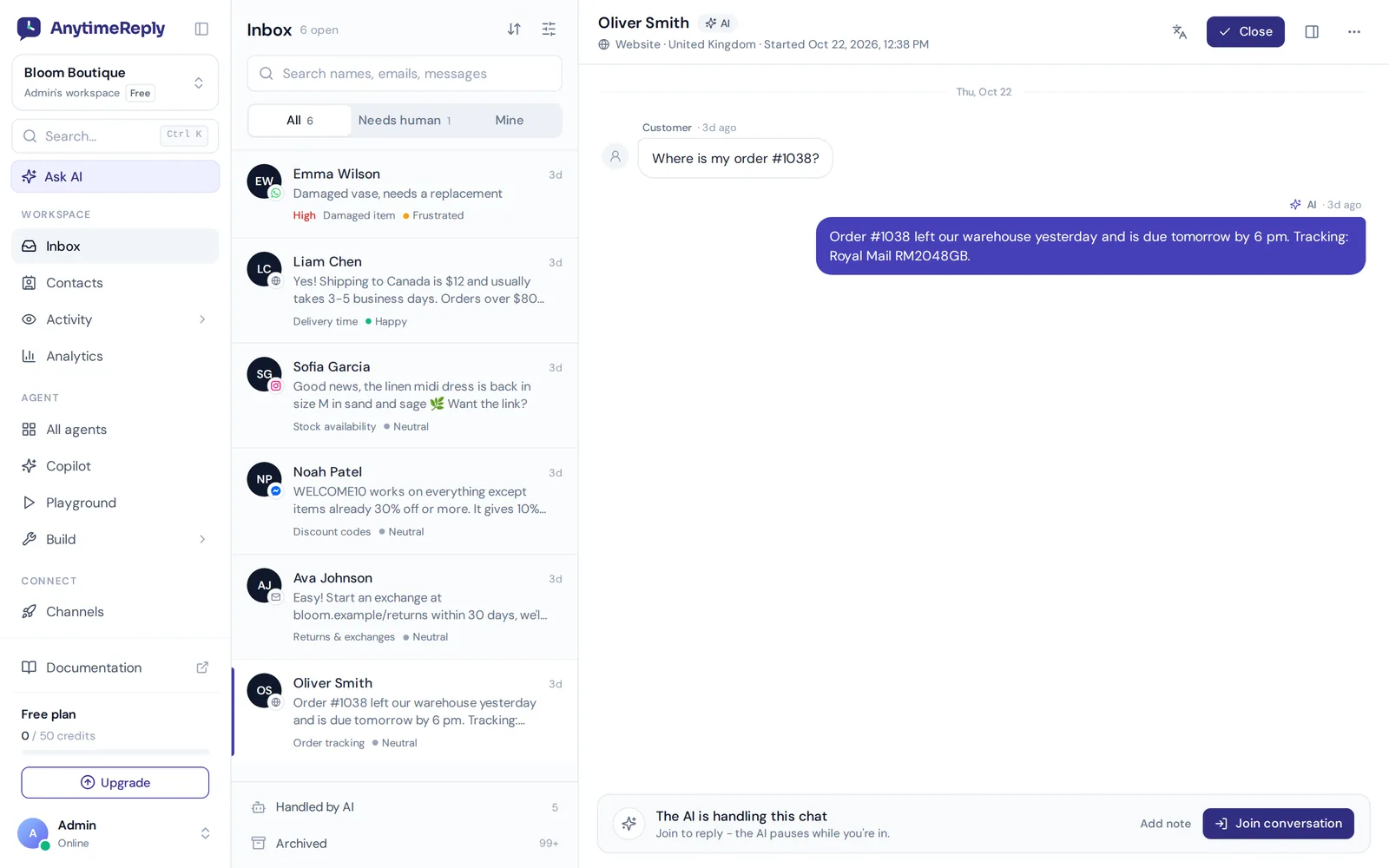
Helping telecom teams with chat and messaging is where we fit best. AnytimeReply suits smaller providers, like regional ISPs, MVNOs and resellers, whose customers mostly write on chat, WhatsApp, Facebook or email.
- Train the AI agent on your website, plan pages and PDFs, and answer plan, coverage, billing and setup questions in seconds.
- Answer on WhatsApp, website chat, Messenger, Instagram and email in one shared inbox. It understands voice notes and photos, handy when someone sends a picture of their router lights.
- Replies in the customer's language, including Bangla, Banglish, Hindi and Hinglish, to match customer needs.
- Hands over with a summary when a customer asks for a person, gets upset or the AI can't answer.
- WhatsApp broadcasts for fault updates, with daily limits and STOP opt-out.
Where it's not the right fit: it does not answer phone calls, run IVR or send SMS. And a national operator wiring AI into legacy billing will be better served by an enterprise platform.
Frequently asked questions
How is AI being used in the telecom industry?
In support, mostly for billing, outages, troubleshooting, plan changes and agent assist. Beyond support, telcos use AI for network planning, predictive maintenance and fraud detection.
Are there AI solutions built for telco customer service?
Yes. Large operators use contact center suites and cloud AI platforms. Smaller ISPs and MVNOs often use lighter chat and WhatsApp tools.
How much does conversational AI cost?
It ranges from a few dollars a month for small chat tools to large enterprise projects. Pricing is usually per conversation, per reply or per seat, plus setup. Model your real volume, including fault peaks.
Will AI replace call center agents?
It replaces repetitive work, not people. Complex faults, fraud and upset customers still need humans.
Start with the questions you answer every day
You don't need a giant project to enhance customer support with AI. Start with the ten questions your team answers a hundred times a day, put AI on the channel where customers already write, and keep a person one click away.
If chat, WhatsApp and email are where your customers are, start free with AnytimeReply, no card needed.
Published 30 October 2026 by AnytimeReply team