You want an AI chatbot that answers your customers, knows your products and doesn't make things up. So you search for AI chatbot development services and get a wall of agencies, each promising a "custom AI solution" and a free consultation. Prices aren't listed. Timelines are vague. Everyone says they use the latest AI technologies and calls itself a leading AI chatbot development company.
This guide clears that up. You'll learn what a chatbot development service actually includes, how the AI chatbot development process works step by step, what drives the cost, which kinds of companies offer it, and the questions that separate a solid development partner from a risky one.
And we'll be honest about one more thing: a lot of businesses don't need custom development at all. A ready-made platform gets them most of the way in an afternoon. We build one of those platforms, so keep our bias in mind, but we'll show you when custom work really is the better choice.
What are AI chatbot development services?
AI chatbot development services are what a company or agency sells when it designs, builds, connects and maintains a chatbot for your business. The goal is a conversational assistant that talks to customers (or employees) in natural language and gets real work done, like answering questions, tracking orders or booking meetings. In plain words, it's a done-for-you service.
A modern AI chatbot is usually built on a large language model (LLM) such as GPT, Claude, Gemini or Llama. That's the generative AI part, the model that writes the replies. The development team brings everything around it: your business data, the conversation design, the connections to your systems, the safety rules and the ongoing tuning.
A typical AI chatbot development service covers some mix of these, so compare each chatbot development service on the same list:
- Strategy and discovery: figuring out what the bot should do, for whom, and how you'll measure success.
- Conversation design: greetings, tone of voice, fallback replies and when to hand off to a human agent.
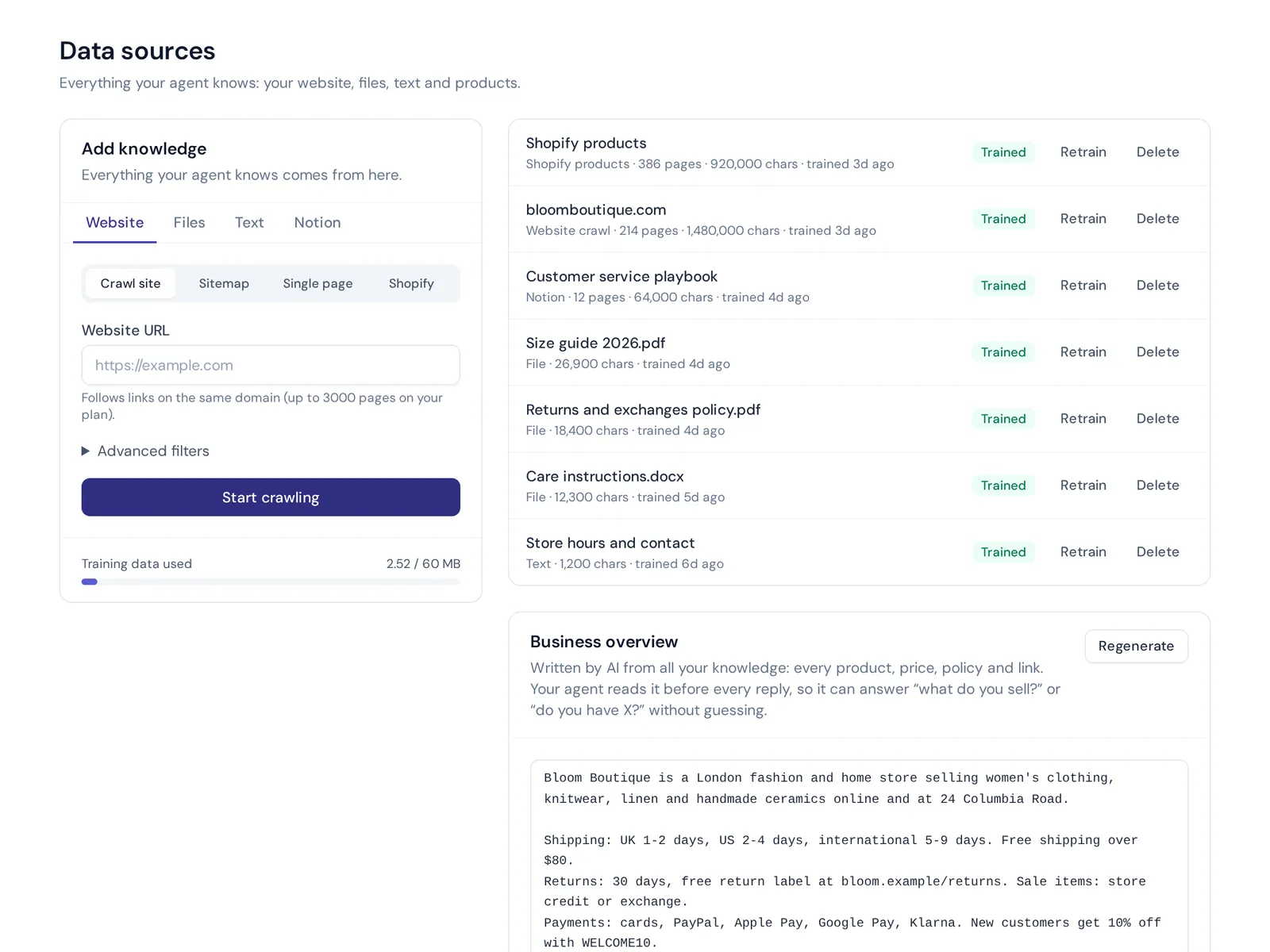
- Knowledge setup: training the bot on your website, help articles, PDFs and product data.
- Integration: connecting the chatbot to your CRM, store, booking tool, helpdesk or internal APIs.
- Channel deployment: website, apps, WhatsApp, Messenger, Instagram, Slack and other messaging apps.
- Testing, launch and maintenance: checking answers, fixing gaps and improving the bot after it goes live.
Types of conversational AI chatbots you can build
Before you talk to any AI chatbot development company, know which kind of bot you're asking for. It changes the price and the timeline a lot.
Rule-based chatbots
These follow a fixed script with buttons and menus. Rule-based chatbot costs are low and the results are predictable, but these bots break the moment a customer types something the script didn't expect. Fine for a simple menu, weak for real customer service.
Conversational AI chatbots (LLM-powered)
Chatbots powered by AI understand natural language, so customers can type the way they talk. A good one answers from your own content using retrieval augmented generation (RAG), which keeps it grounded in your facts instead of the open internet. Conversational AI is what most people mean by "AI chatbots" today, and conversational AI systems for businesses are now the default choice for customer service.
AI agents
An AI agent goes a step further. It doesn't just answer, it takes actions: checks an order in Shopify, issues a refund within limits, books a call, updates a CRM record. Custom AI agents (and custom AI chatbots that act, not just talk) are where much of the business value sits right now, and also most of the risk, so they need careful design.
AI assistants for your team
Not every bot faces customers. An internal AI assistant can answer HR and IT questions, help agents draft replies, or search company documents. These AI systems often connect to enterprise systems like an intranet, HR software or a ticketing tool.
Hybrid bots
Most strong setups mix all of the above. Buttons for common paths, AI for open questions, actions for verified customers, and a person for anything tricky.
Custom AI chatbot development vs a ready-made platform
This is the biggest decision you'll make, so let's be direct about it.
Custom AI chatbot development services mean an agency, software development company or in-house team builds a bot specifically for you, often on top of a model API and frameworks like LangChain or Rasa. You get full control, but you pay for every feature, every fix and every update.
A platform (like AnytimeReply, Intercom, Tidio or Chatbase) gives you a ready-made chatbot solution with an inbox and channels. You add your content, set rules and go live. Less control over the deep internals, much faster and cheaper.
| Custom AI chatbot development | Ready-made AI chatbot platform | |
|---|---|---|
| Time to launch | Weeks to months | Minutes to days |
| Upfront cost | High, project-based | Low, often a free plan |
| Ongoing cost | Hosting, usage fees, developer retainer | Monthly subscription plus usage |
| Flexibility | Anything you can pay to build | What the platform supports, plus APIs |
| Maintenance | Yours or the agency's job | Handled by the platform |
| Human handoff and inbox | Must be built or integrated | Usually included |
| Best for | Unusual workflows, strict data rules, deep enterprise systems | Customer support, sales, FAQs, standard integrations |
Our honest take: if your bot mainly needs to answer customer questions, capture leads and hand off to your team, start with a platform. If you need the bot to run deep inside your own internal software, follow complex regulated processes, or live fully on your own servers, custom chatbot development is worth the money.
The AI chatbot development process, step by step
The best chatbot developers follow a clear method. If a provider can't explain theirs, that's a warning sign. Here's what a solid one looks like:
- Discovery. They study your support tickets, chats and emails to find the top questions and tasks. They ask what success means for you: fewer tickets, faster replies, more leads, more sales.
- Scope and design. They decide what the bot handles, what it never does, and when it passes the chat to a person. They write the tone of voice and sample dialogues.
- Model and architecture choice. They pick the AI model and the stack (front end, back end, data pipeline). A good team explains why, and keeps you free to switch models later.
- Knowledge and training data. They connect your website, documents and product data, clean up messy content and write verified answers for sensitive topics like refunds and pricing.
- Integrations. They connect your CRM, ecommerce store, calendar or ticketing system so the bot can look things up and take actions safely.
- Testing. They run real customer questions through the bot, including tricky and adversarial ones, and fix wrong answers before launch.
- Deployment. They launch on your website, apps and the messaging channels your customers use.
- Monitoring and improvement. After launch they review conversations, track performance indicators, fill knowledge gaps and tune the bot every month.
AI chatbot development cost: what drives the price
Most chatbot development companies don't publish prices, because every project is different. Quotes can range from a few thousand dollars for a simple FAQ bot to far more for an AI agent wired into several business systems. Here's what pushes the price up or down:
- Scope. An FAQ bot is cheap. A bot that handles orders, refunds and bookings with approvals is not. AI agent development cost is usually higher than a plain Q&A bot because of the testing and safety work.
- Number of integrations. Each system (Shopify, HubSpot, a custom database) adds design, coding and testing time.
- Channels. Website only is simpler than website plus WhatsApp, Instagram and email. AI chatbot app development for a native mobile app on iOS and Android adds its own work.
- Languages. Supporting customers in several languages needs more testing.
- Security and compliance. GDPR rules, on-premise hosting and audits add a lot of work.
- Ongoing chatbot costs. Hosting, AI usage per message, and a maintenance retainer. Ask about these early, because they never stop.
Many teams want to build AI chatbots that do everything at once. Not every bot needs to be big. Some AI bots just answer ten common questions, and that's fine.
A simple example: say you run an online shop with 400 support chats a month, mostly "where is my order" and "how do returns work". Paying for a fully custom build to answer those is like hiring an architect to put up a shelf. A platform handles that on day one. But if you're a bank that needs a bot to verify identity and move money inside your own core system, a custom team is the right call.
Enterprise AI chatbot development: what changes
Enterprise chatbot development is a different game. AI for enterprise use means more people, more systems and more rules. Large companies usually need:
- Deep integration with enterprise systems like ERP, CRM, identity providers and data warehouses.
- Security reviews, data residency rules and detailed audit logs.
- Role-based access, so the bot only shows each user what they're allowed to see.
- A scalable AI chatbot setup that holds up under heavy traffic.
- Governance: who approves changes, how answers are reviewed, how errors are reported.
That's why enterprise AI chatbot development services take longer and cost more. Some large companies buy an enterprise conversational AI platform and pay a partner to customize it. Others hire one of the bigger development firms to build from scratch. Either way, enterprise-grade conversational AI is as much about process and governance as it is about the bot.
Benefits of AI chatbots for your business
Whether you build or buy, a well-made AI chatbot helps in a few concrete ways:
- 24/7 availability. Customers get answers at 11 pm on a Sunday, not on Monday morning.
- Faster replies and better customer service. Answers in seconds instead of hours, which improves the whole customer experience.
- Less repetitive work. Agents focus on complaints, sales and tricky cases instead of copy-pasting the same answer. That's what AI for customer support does best.
- More leads. A bot can ask for contact details at the right moment and pass warm leads to sales.
- More languages. AI can reply in the customer's own language.
- Insights. Conversations show what customers ask, what confuses them and what your website fails to explain.
The downside? A badly built bot frustrates customers, gives wrong answers and damages trust. That's why testing, guardrails and an easy path to a human agent matter more than flashy features.
Top AI chatbot development companies in 2026
There's no single "best" provider. The right one depends on your size and what you're building. Here are the main types of providers, with real examples, so you know what each is known for. Always check their own sites for current pricing and service details. Many of these sell AI development as a full service, from strategy to maintenance.
| Provider type | Examples | Known for | Good fit for |
|---|---|---|---|
| Enterprise conversational AI platforms | Kore.ai, Yellow.ai | Large-scale conversational AI services with customization | Big companies, contact centers |
| Open-source frameworks | Rasa | Building and hosting your own conversational AI | Teams with in-house developers |
| Development agencies and firms | Master of Code Global, LeewayHertz, ScienceSoft | Custom AI application development projects | Custom builds, unusual workflows |
| Support platforms with AI agents | AnytimeReply, Intercom (Fin), Tidio (Lyro) | Ready-made AI for customer support with an inbox | Small and mid-sized businesses, support teams |
When people search for the best chatbot development services in 2026, they find lots of "10 best AI chatbot development companies" lists. Many are written by one of the companies on the list, which usually ranks itself first. Read them, but verify with live demos, reviews on sites like Clutch and a direct conversation. Directories of development companies in the US, UK or India can help you build a shortlist, but location matters less than fit.
How to choose the right AI chatbot development company
Before you choose a chatbot development provider, be clear about what you want the bot to do. Then use this checklist to find the right development company for your business:
- Real examples. Ask to try a live bot they built, not just a slide deck.
- Industry fit. Have they built for businesses like yours, such as ecommerce, SaaS, health care, logistics or real estate?
- Clear process. Can they walk you through discovery, testing and launch in plain words?
- Handling wrong answers. Ask: "What does the bot do when it doesn't know?" The right answer is "it says so and hands off", not "it always has an answer".
- Human handoff. How does a chat reach your team? Where do agents reply?
- Data and privacy. Where is customer data stored? Is it used to train AI models?
- Ownership. Do you own the code, prompts and training data? Can you move away later?
- Total cost. Get the build price, monthly running cost and maintenance cost in writing.
- Service after launch. Who fixes things when the bot gives a bad answer at midnight?
Red flags to watch for
- They promise the bot will "never make mistakes".
- No testing phase in the plan.
- They lock you into their own hosting with no export option.
- They can't explain ongoing AI usage costs.
- No plan for what happens after launch.
Questions to ask a chatbot development partner before you sign
Copy these and send them to any provider you're considering:
1. Which AI models do you use, and can we switch models later?
2. How will the chatbot learn from our website and documents, and how do we update it?
3. What happens when the bot isn't sure of an answer?
4. How does the bot hand a conversation to a human, and where does our team reply?
5. Which channels are included (website, WhatsApp, Instagram, Messenger, email, apps)?
6. What does it cost per month to run, including AI usage?
7. Who owns the code, prompts and data when the project ends?
8. How do you test the bot before launch and after each change?
A good AI chatbot development agency answers these in plain words. If you get jargon and dodging, keep looking.
How AnytimeReply fits in
AnytimeReply is a ready-made AI agent with a built-in helpdesk. It's not a development agency, and it won't replace a custom engineering team for unusual projects. But it covers most of what businesses ask chatbot developers to build, as a self-service platform you run yourself:
- Training on your content: website, PDFs, Word files, Notion and Shopify products, plus Q&A answers you write that always win. See training and knowledge.
- Actions for verified customers: Shopify, WooCommerce, Stripe, Cal.com, Calendly, HubSpot, any API with an OpenAPI file, or MCP servers (paid plans).
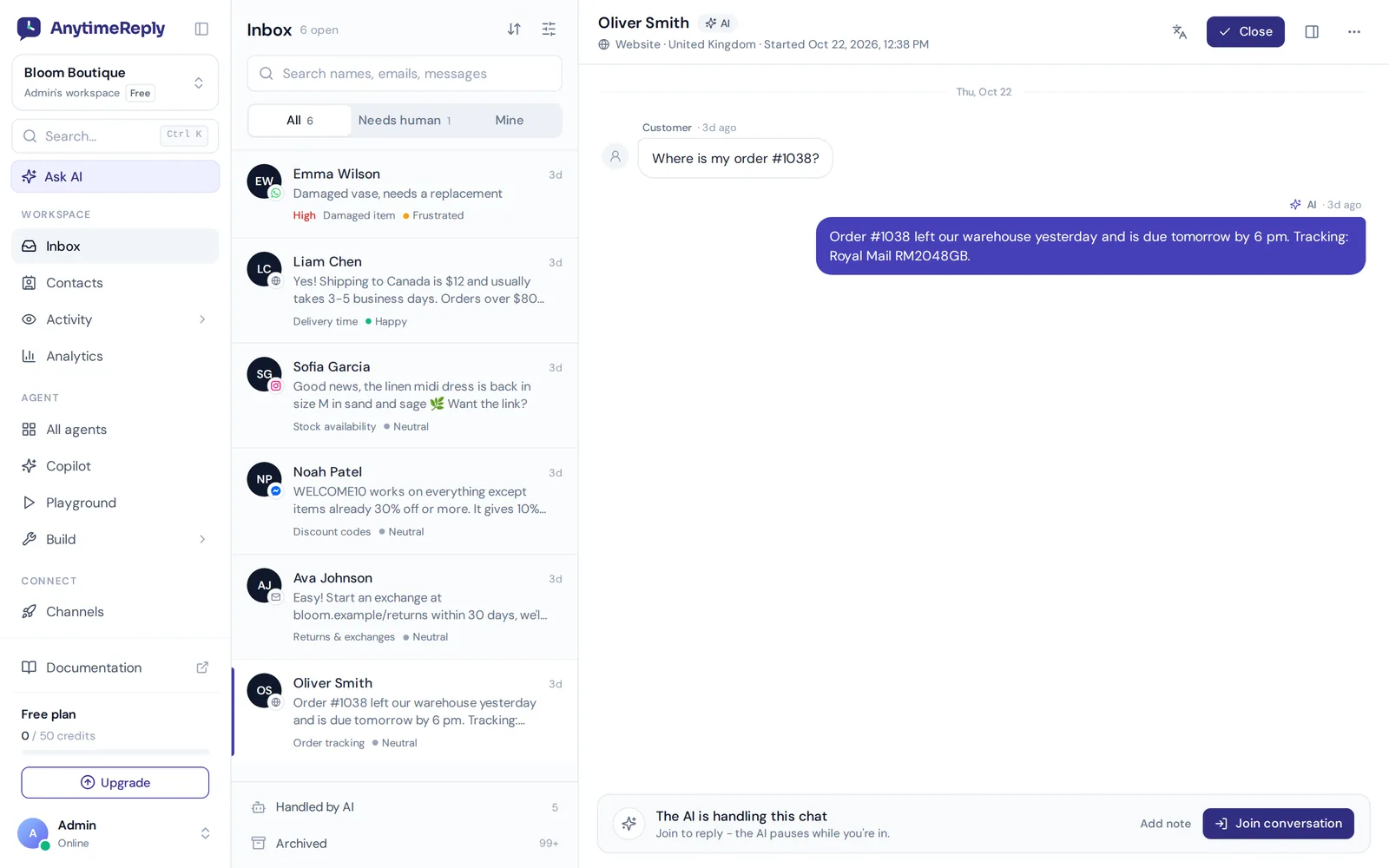
- Human handoff: one shared helpdesk inbox for website, WhatsApp, Messenger, Instagram, Telegram, email and Slack.
- Honest answers: replies come with a confidence score, and when the AI doesn't know, it says so instead of guessing.
- Choice of models: GPT, Claude, Gemini or DeepSeek per agent.
- Testing: plain-language tests run in a sandbox after every change.
If you're an agency that sells chatbot development services to clients, the Agency plan gives you client workspaces and white-label branding, so you can build chatbots for clients and sell your own AI chatbot solutions without building the whole platform yourself. There's a free plan to try it, and paid plans start at $9 a month. Check pricing for current details.
Where it's not the right fit: it has no phone or voice channel and no native iOS or Android SDK, and it isn't built for on-premise hosting. If you need those, a custom build is the better path.
Frequently asked questions
How much do AI chatbot development services cost?
It depends on scope. A simple FAQ bot built by an agency can cost a few thousand dollars, while an AI agent with several integrations, languages and compliance needs can cost much more, plus monthly running and maintenance costs. Ready-made platforms are usually far cheaper to start.
Can a small business afford custom chatbot development?
Sometimes, for a small and focused bot. But most small businesses get better value from a platform first, then pay for custom work only for the parts a platform can't do.
How long does it take to build a custom AI chatbot?
A custom project usually takes several weeks to a few months, depending on integrations and testing. A platform can be live the same day.
Can an AI chatbot be trained on our own documents?
Yes. Most modern bots use your website, PDFs, help articles and product data as their knowledge base, so answers come from your content rather than general internet knowledge.
Can a chatbot integrate with our existing systems?
Usually, yes, through APIs. CRMs, ecommerce stores, calendars and helpdesks are common. Older systems without an API are where custom development earns its price.
Do I need coding skills to build an AI chatbot?
Not with a no-code platform. You add your website and documents, set a few rules and embed one line of code. Custom development, on the other hand, needs developers.
The bottom line
AI chatbot development services make sense when you need something truly custom, and custom chatbot development services are worth paying for when a platform can't do the job. For most businesses that just want fast, accurate answers, lead capture and a smooth handoff to their team, a platform is quicker, cheaper and easier to keep up to date.
Try the platform route before you sign a big contract. Build your AI agent on a free plan first, see what it can do, then decide if you need more. Start free with AnytimeReply, add your website and test the agent on your real questions. No card needed.
Published 26 October 2026 by AnytimeReply team