"AI agents" and "agentic AI" sound like the same thing, and plenty of people use them as if they are. But when you look at AI agents vs agentic AI closely, there's a real difference, and it matters when you're deciding what to build or buy.
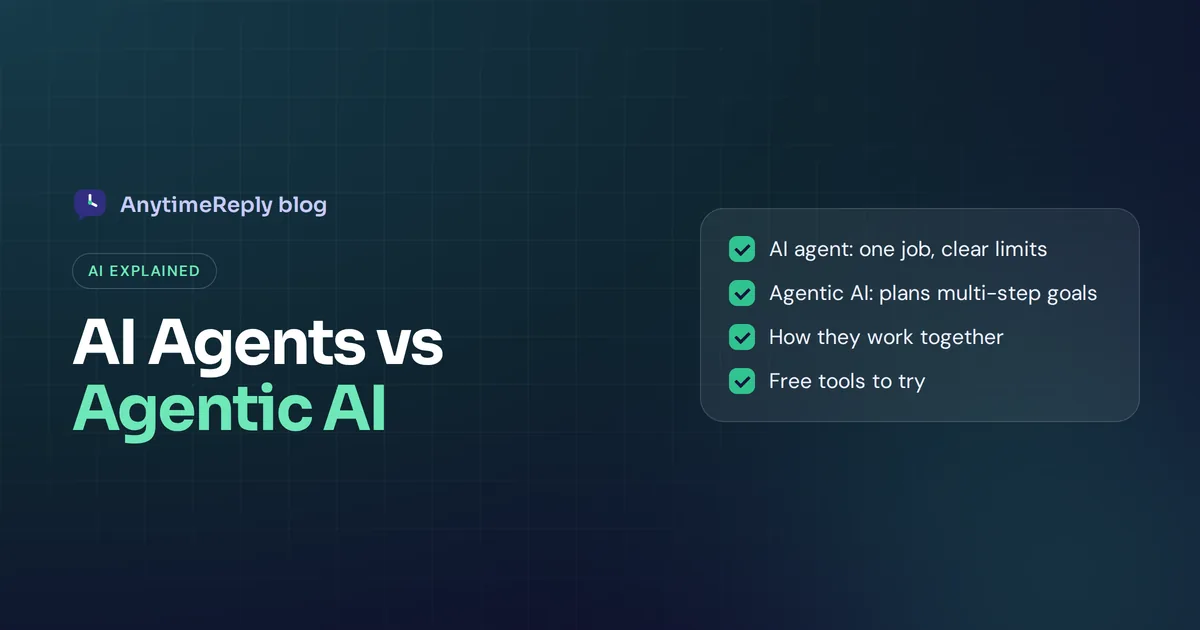
Here's the short version. An AI agent is a single piece of software that does a specific job with some independence, like answering customer questions or booking a meeting. Agentic AI is the bigger idea: AI systems that plan, make decisions and work toward a goal over many steps, often with several agents working together.
In this guide we'll explain both in plain words, compare them side by side, show real-world examples, and point you to tools you can try at no cost. We build an AI agent for customer support, so we'll also be honest about where that fits and where it doesn't.
What is an AI agent?
An AI agent is software that can sense what's happening, decide what to do and take an action to reach a goal, without a person approving every step. In classic AI research these are called intelligent agents, and the idea is decades old. What's new is that modern agents run on large language models (LLMs) like GPT, Claude or Gemini, so they understand plain language.
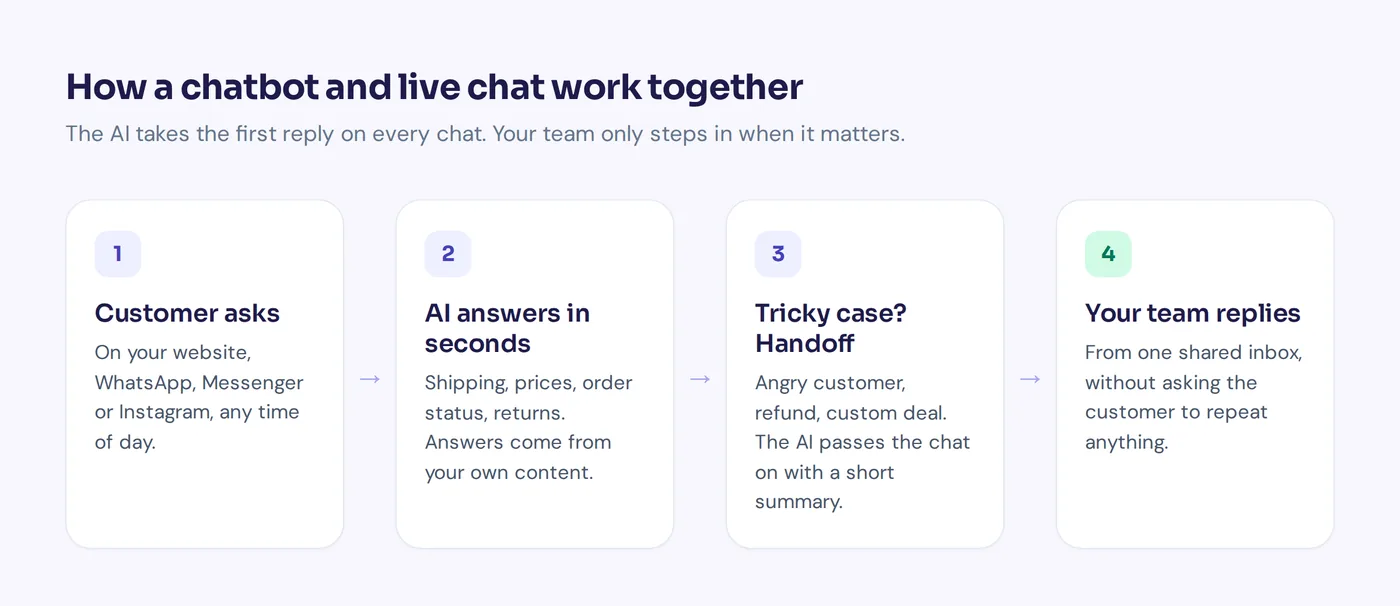
Think of it as a capable assistant with a clear job description. A customer support agent reads a message, looks up the answer in your knowledge base (often using RAG, retrieval augmented generation), checks the order status in your store and replies. If it can't help, it passes the chat to a human.
Most AI agents have these parts:
- A model that understands language and reasons about what to do.
- Instructions that define its role, tone and limits.
- Tools it can call, such as a search, a calendar, a CRM or an API.
- Memory or context so it remembers the conversation and relevant data.
- Guardrails that shape agent behavior and stop it from doing things it shouldn't.
The key point: an AI agent usually handles predefined tasks or a narrow set of jobs. It's good at that job, within boundaries someone set.
What is agentic AI?
Agentic AI is not one product. It's a broader approach where AI systems act with more autonomy. They break a big goal into smaller steps, plan, use tools, check their own work, adapt when something changes and keep going until the goal is met. That's why people describe it as goal-driven and adaptive.
Often, an agentic AI system is a multi-agent setup: multiple agents working together. One plans, another researches, another writes, another reviews. An orchestration layer coordinates them, passing tasks and results between agents and deciding dynamically who does what next.
Say you give such a system the goal "find out why refunds went up last month and draft a fix". It might pull the support data, group the complaints, read the related product pages, spot that a size chart is wrong, draft a new chart and send it to a person for approval. Nobody told it each step. It worked them out.
So "agentic" describes a quality: how much the AI acts on its own toward goals. Agents operate on a scale, from a little independent to very independent. Agentic AI is the umbrella term for systems built around that higher level of autonomy.
Agentic AI vs AI agents: the key differences
Here's the AI agent vs agentic AI comparison at a glance:
| AI agents | Agentic AI | |
|---|---|---|
| What it is | A single software component with a defined role | A broader approach or system built around autonomy |
| Scope | Specific tasks (answer, book, look up) | Complex, multi-step goals |
| Autonomy | Works within clear rules and limits | Plans, decides and adapts with less human input |
| Structure | Usually one agent | Often several agents plus orchestration |
| Decision-making | Short, reactive steps | Long-term planning and self-correction |
| Predictability | Higher, easier to test | Lower, harder to test and control |
| Example | A support agent that answers and tracks orders | A system that researches, plans and runs a whole project |
| Best for | Repetitive, well-defined work | Open-ended work with many moving parts |
A simple way to remember it: an AI agent is a building block. The bigger system is what you get when you design around blocks like that acting on their own.
How agentic AI and AI agents work together
The two ideas aren't rivals. The bigger systems are built from agents. And a single agent becomes "more agentic" as you give it more freedom: more tools, more steps, less human approval.
Picture it as a ladder:
- Rule-based chatbot: follows a script or menu. No real understanding, no actions.
- Conversational AI assistant: understands questions and answers them, while a person stays in control.
- AI agent: takes actions on its own within limits, like checking an order or booking a call.
- Agentic system: several autonomous agents that plan and complete multi-step goals with little supervision.
Most businesses get the best results around step 3. You get real automation, but humans still own the risky decisions.
Agentic AI vs generative AI
This is the other comparison people mix up. Generative AI (gen AI for short, or generative artificial intelligence in full) creates content: text, images, code. You prompt a generative model, it gives you an output, and that's it. It's reactive.
Agentic AI uses generative AI models as its brain, but adds goals, planning, tools and memory. Instead of "write me an email", it's "handle this customer's return from start to finish".
And traditional AI? That usually means older machine learning systems built for one prediction task, like spam filtering or fraud scores. Useful, but not conversational and not agentic. Many modern AI applications combine all three: a traditional model to score risk, a language model to write replies, and an agent to act.
Types of AI agents
Textbooks usually list five classic types of agents, from simplest to smartest:
- Simple reflex agents: react to the current input with fixed rules, like a thermostat.
- Model-based agents: keep an internal picture of the world, so they handle situations they can't fully see.
- Goal-based agents: choose actions that move them toward a goal.
- Utility-based agents: weigh options and pick the one with the best outcome, not just any outcome that works.
- Learning agents: improve over time from feedback, sometimes with reinforcement learning.
Today's LLM-based agents borrow from several of these. They're context-aware, they work toward goals, and the better ones learn from feedback your team gives them.
Real-world examples of agents and agentic systems
AI agent examples
- Customer support agent: answers questions on your website and WhatsApp, tracks orders, hands off to a human.
- Coding assistant: writes and fixes code inside your editor when you ask.
- Scheduling agent: finds an open slot and books a meeting.
- Sales agent: qualifies leads in chat and sends them to your CRM.
Agentic AI examples
- Research systems: one agent searches, one reads, one summarizes, one fact-checks, until a full report is ready.
- Software development agents: plan a feature, write code across many files, run tests and fix failures in a loop.
- Operations automation: watch inventory in real-time, predict shortages, reorder stock and notify the team.
- Self-driving cars: the classic autonomous system, constantly sensing, deciding and acting.
Benefits and risks of autonomous, adaptive AI
Why AI agents are useful
- Easier to set up, test and trust, because the job is clear.
- Fast wins on repetitive work, like answering the same 20 questions every day.
- Lower cost and lower risk.
Why agentic AI is exciting
- Can handle complex, multi-step work that used to need a person to coordinate.
- Adapts when things change instead of failing at the first surprise.
- Scalable across whole processes, not just single tasks.
The risks you shouldn't ignore
- Errors compound. A small mistake in step 2 can snowball by step 10.
- Harder to control. More autonomy means more ways to go off track.
- Cost. Many agents calling a model many times can get expensive quickly.
- Security and governance. Autonomous AI agents with access to real systems need strict permissions, approvals, logs and limits.
Our honest opinion: for customer-facing work, more autonomy isn't always better. A customer doesn't care how clever your system is. They care that the answer is right and that a human steps in when it matters.
Free AI agents and agentic AI tools to try
If you want to experiment without spending money, many of the frameworks for building AI agents are open source. You'll still pay for model calls unless you run a model yourself, so "agentic AI free" usually means the software costs nothing, not the usage.
| Tool | What it is | Good for |
|---|---|---|
| LangGraph | Open-source framework from the LangChain team for agent workflows | Developers building custom agents and agentic systems |
| CrewAI | Open-source framework for teams of role-based agents | Experiments with several cooperating agents |
| AutoGen | Microsoft's open-source framework for agent conversations | Research and prototyping |
| n8n | Workflow automation with AI agent steps and a self-host option | Connecting agents to business apps with little code |
| AnytimeReply | Customer support AI agent with a helpdesk and a no-cost plan | Businesses that want a working support agent, no coding |
One caution: no-cost tiers usually come with tight limits on usage, features or model choice. That's fine for learning. For a live business, check what happens when you hit the limit.
Best AI agents in 2026: what to look for
People often ask for the top 5 AI agents. The honest answer is that it depends on the job. Well-known examples include ChatGPT's agent mode for general tasks, coding agents like GitHub Copilot and Claude Code, Salesforce Agentforce for CRM work, and customer support agents like Intercom Fin or AnytimeReply. These lists change every few months, so judge any agent on these points:
- It knows your business. It answers from your own data, not general internet knowledge.
- It admits when it doesn't know. Guessing is the fastest way to lose customer trust.
- Actions are safe. Verified users only, confirmation before changes, approvals and limits for anything involving money.
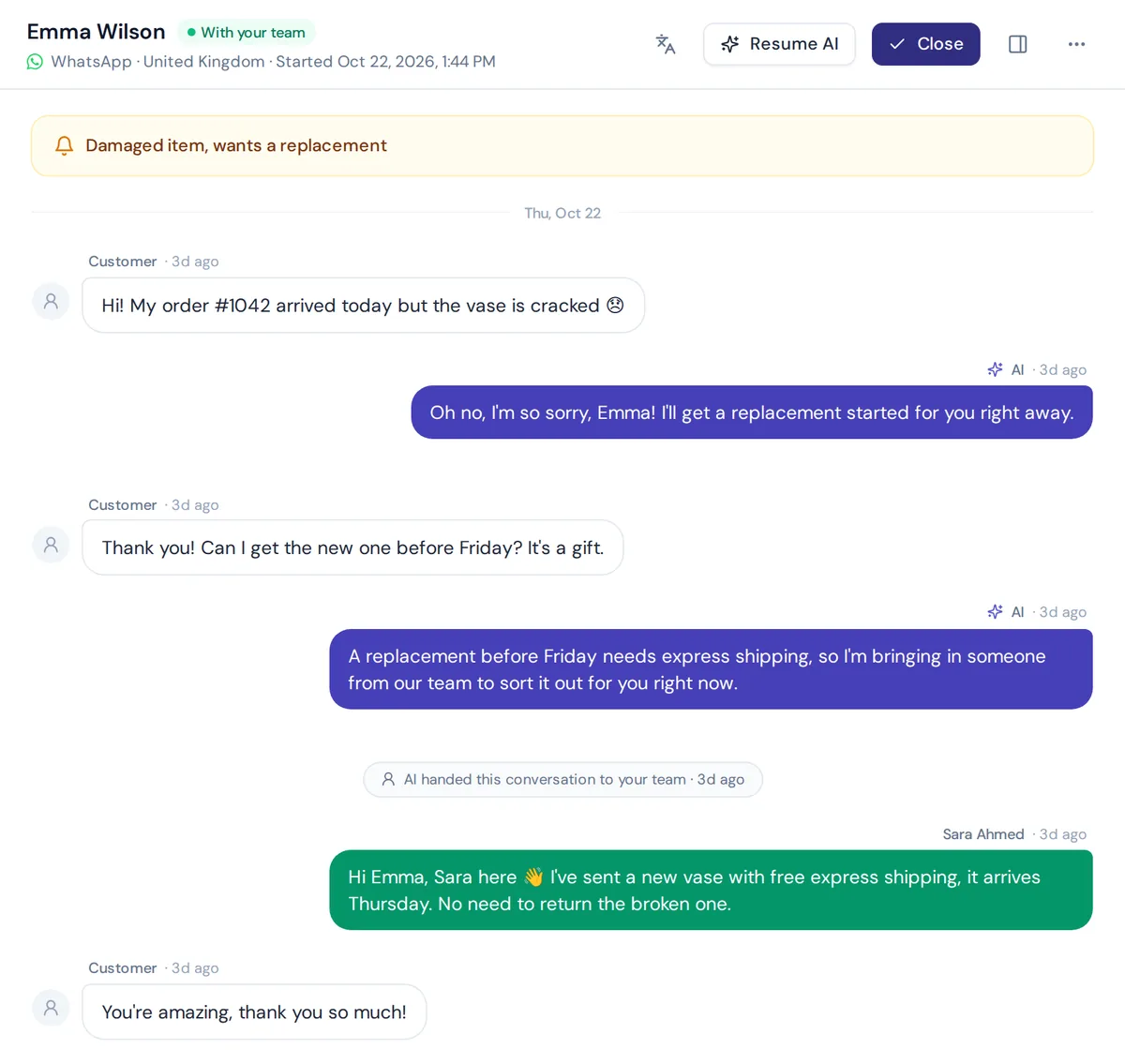
- Humans can step in. A clear handoff with context, so customers don't repeat themselves.
- You can test it. Run real questions before and after every change.
- You can see what it does. Logs, analytics and the questions it couldn't answer.
Which one fits your automation workflow?
- Is the task well defined? If yes (answer support questions, book meetings, track orders), a focused AI agent is the right tool.
- Does the work need long, open-ended planning across many systems? If yes, and you have engineers to build and watch it, agentic AI may be worth exploring.
- What happens if it gets something wrong? The higher the cost of a mistake, the more human oversight you need, whichever approach you pick.
For most small and mid-sized businesses, start with a focused agent that does one job very well. Add autonomy step by step as you trust it more.
How AnytimeReply uses AI agents for customer support
AnytimeReply is a customer support AI agent with a built-in helpdesk. It sits near the "focused agent" end of the ladder, on purpose:
- Learns from your website, documents and Notion pages, and answers in the customer's language on your website, WhatsApp, Messenger, Instagram, Telegram and more.
- Takes actions for verified customers, like checking orders, booking meetings and managing subscriptions, with confirmation, optional team approval and limits (paid plans).
- Follows procedures you write in plain steps for refunds, exchanges and disputes, with required steps and amount limits enforced.
- Hands the chat to your team in a shared inbox when a customer asks for a person, gets upset, or the AI can't answer.
What it isn't: a general platform for autonomous research or coding projects. If you need that, look at the frameworks above. If you need a support agent that works today, with no code, you can try it at no cost.
Frequently asked questions
Is ChatGPT an intelligent agent?
Plain ChatGPT chat is an assistant: it answers when you ask. When it uses tools on its own, browses, runs code or completes multi-step tasks in agent mode, it acts like an AI agent, and that moves it toward agentic AI.
What is the main difference between an AI agent and agentic AI?
AI agents are individual systems that perform specific tasks within set limits. Agentic AI is the broader approach of building systems that plan, decide and act autonomously toward complex goals, often by coordinating several agents.
Are AI agents and agentic AI the same thing?
No, but they're closely linked. The difference between agentic AI and a single agent comes down to scope and autonomy: agents are the parts, the agentic approach is the whole system acting with more independence.
Is n8n an AI agent or agentic AI?
n8n is a workflow automation tool. You can build AI agents inside it, and by chaining several agent steps you can build fairly autonomous workflows, but the tool itself is neither.
Can agentic AI work without human supervision?
Technically, sometimes. In practice, anything that touches customers, money or production systems should have human checkpoints, approvals and limits.
Is agentic AI safe for customer service?
It can be, with strict limits: verified customers only, approvals for refunds, spending caps and an easy path to a human. Without those, full autonomy in front of customers is risky.
Final thoughts
Single agents and agentic systems aren't competing ideas. Agents are the building blocks. The bigger system gives them goals, plans and freedom. For most businesses, the smart move is a focused agent that does one job well, with humans in the loop.
Want to see a customer support agent working on your own site? Start free with AnytimeReply, add your website and test it in a few minutes. No card needed.
Published 28 October 2026 by AnytimeReply team