You want AI agents working for your business. Maybe one should answer customers at 2 am, another should sort support tickets, and a third should pull order details from Shopify without anyone copying and pasting. So you search for an AI agent development company, and suddenly you're looking at quotes from a few thousand dollars to well over $100,000 for what sounds like the same thing.
Here's the honest truth. Some projects really do need a development team that builds AI agents from scratch. Many others don't. Plenty of businesses pay for months of development when a ready-made tool would have done the job in an afternoon.
This guide to AI agent hiring explains what these companies actually do, what AI agent development cost looks like, how to choose the right partner, and when you should skip the agency entirely. Quick note: we build a ready-made AI agent for customer support, so we have a bias. We'll still tell you where hiring developers is the better choice.
What does an AI agent development company do?
AI agents are software that understand a request, decide what to do, and take action. A chatbot answers questions. AI agents can also do things: look up an order, book a meeting, update a CRM record, or start a refund after checking the rules.
An AI agent development company designs, builds and maintains those agents for you. Typical AI agent development services cover:
- Discovery and AI consulting services. Working out which tasks the agents should handle, what data they need and which business goals they serve.
- Architecture. Choosing the AI models (GPT, Claude, Gemini or an open-source large language model), the framework, memory, and how the agent connects to your systems.
- Data and knowledge. Preparing your documents, product data and policies so the agent answers from your information, not from guesses. This is often retrieval-augmented generation (RAG).
- Integrations. Connecting AI agents to your CRM, ERP, help desk, payment tool or internal APIs so they can take real actions.
- Testing and guardrails. Checking accuracy, adding limits, approvals and safe fallbacks so the agent doesn't do something expensive by mistake.
- Deployment and support. Putting deployed AI agents live, monitoring them, and improving them as your business changes.
Some firms are large consulting groups with thousands of engineers. Others are small studios of five people who know one industry very well. Both can be the right fit.
AI agents vs chatbots vs automation tools
Before you hire anyone, it helps to know what you're buying. These three get mixed up all the time.
- Rule-based automation (like Zapier flows or RPA bots) follows fixed steps. Great for predictable tasks, useless when something unexpected happens.
- Chatbots and conversational AI answer questions in natural language. A good conversational agent is trained on your content and can handle the way people actually type.
- AI agents combine conversation with decision-making and tools. They plan the next step, call an API, check the result and continue. Rule-based AI agents still exist, but most new agent systems are built on large language models.
Autonomous AI sounds exciting, but for most companies the best AI agents are not fully autonomous. They act within clear limits and ask a human when something is risky.
Custom AI agent development company vs an AI agent platform
This is the most important decision, and most people make it too late. Ask one question first: is my problem unusual, or is it a common problem many businesses share?
Customer support, lead capture, appointment booking, order tracking and FAQ answering are common problems. A ready-made AI agent platform already solves them well, and most businesses don't need AI agents built from scratch for them. A fraud review agent that reads your internal risk models, or AI agents that run inside your own warehouse software, are unusual. That's where a custom AI agent development company earns its fee, because the AI solution has to fit systems nobody else has.
| AI agent development company | Ready-made AI agent tool | |
|---|---|---|
| Best for | Unique workflows, deep internal systems, strict data rules | Customer support, sales chat, bookings, FAQs, help desks |
| Time to launch | Usually weeks to months | Often the same day |
| Upfront price | Thousands to six figures | Free plan or a monthly subscription |
| Running costs | Hosting, model usage, maintenance contract | Subscription plus usage |
| Control | Full control of code, model and hosting | You configure, the vendor runs the software |
| Updates | You pay for every change | New features arrive without a new contract |
| Risk | Project can run late or over budget | You depend on the vendor's roadmap |
Neither side always wins. If your use case sits in the left column, call developers. If it sits in the right column, try a ready-made tool first. You can always hire a firm later if you outgrow it.
AI agent development cost: what to budget
AI agent development cost depends on how much the agent has to do, how many systems it touches, and how careful it must be. Public price guides give a useful starting point. For example, Cleveroad's 2026 guide lists simple agents from about $20,000, mid-level contextual agents from about $40,000, complex autonomous AI systems from about $80,000, and enterprise AI agent projects from about $100,000 to $200,000 and up.
Your quote will vary by country, team seniority and scope. A freelancer in a lower-priced market may charge far less. A big consulting firm may charge more. But the shape of the budget is usually similar:
- Build. Discovery, design, development, integrations and testing. This is the big number on the proposal.
- Model usage. Every reply uses tokens from a provider like OpenAI or Anthropic. Busy AI agents can run up hundreds or thousands per month in API fees alone.
- Hosting and data. Servers, a vector database for knowledge, logging and monitoring.
- Maintenance. Models change, your products change, your policies change. Someone has to update prompts, fix integrations and retest.
- Your team's time. Meetings, reviews, writing knowledge content and testing. People forget this one.
A simple way to estimate
Say you want AI agents that answer customer questions on your website and WhatsApp and check order status in Shopify. Built from scratch, that means paying a team to create the chat interface, the knowledge pipeline, the WhatsApp connection, the Shopify integration, a handoff to humans, an inbox for your team and analytics. Each one is real engineering work.
With a ready-made tool, those parts already exist. You pay a monthly fee and spend your time on what matters: teaching the agent about your business. That's why build vs buy changes the budget so much.
Signs you really need custom AI agents
Hire a development partner when several of these are true. These are the real business needs that justify custom agentic AI solutions:
- AI agents must work inside internal systems with no public API, or with old software that needs special connectors.
- You have strict regulatory compliance rules about where data lives, for example in financial services or health care.
- The workflow is your competitive advantage, so you want to own the code of your custom agent.
- The agent makes multi-step decisions across many tools, such as reviewing claims, reconciling invoices or handling supply chain exceptions.
- You need a fine-tuned or self-hosted model for price, privacy or specialist language reasons.
- You have the budget and someone inside the company who can own the project after launch.
If only one or two apply, a ready-made tool plus a few integrations usually gets you most of the value for a fraction of the price.
Signs a ready-made tool is enough
- Most questions are about products, prices, shipping, returns, bookings or account help.
- Your knowledge already lives on your website, in PDFs, Word files or Notion.
- The actions you need are common: check an order in Shopify or WooCommerce, book a slot in Calendly, look up a Stripe subscription, add a lead to HubSpot.
- You want customers on your website, WhatsApp, Messenger and Instagram answered from one place.
- You'd rather spend money on growth than on a six-month software project.
Honestly, this describes most small and mid-sized businesses we talk to. They need well-trained AI agents and a good handoff to humans, not a bespoke build.
The AI agent development process
If you do go custom, a solid project normally follows these steps:
- Define the job. Write down the exact tasks, agent capabilities, systems involved and what the agent must never do.
- Run AI pilots. The firm builds a small working version for one task. This tells you quickly if the idea works with your real data.
- Pick architecture and models. They choose the model, framework, memory and hosting. Ask why they chose each one.
- Build integrations. Connect AI agents to your tools with proper permissions. Read-only first, then actions.
- Test with real conversations. Use past tickets and chats as test cases. Measure accuracy and failure modes, not just happy paths.
- Launch to a small group. Start with a share of traffic or one channel, with humans watching.
- Monitor and improve. Track what the agent gets wrong, add knowledge, adjust rules, and retest after every change.
A pilot is your best protection before you implement AI agents widely. If a vendor wants a big contract before showing anything working with your data, be careful.
Choosing the right AI agent development company: checklist
There are now a lot of AI agent development companies in 2026, and many were web agencies a year ago. Not every leading AI agent development company on a list has shipped real work. Use this checklist to find the right partner and avoid people reselling a prompt.
- Relevant case studies. Ask how their AI agents are built and request production-ready AI agents they built in your industry, ideally live ones you can try.
- Clear technology choices. They should explain which models, frameworks and databases they use, and why, in plain words.
- Testing and KPIs. A reliable AI agent needs measurement. Do they track accuracy, response time and price per task? What happens when the agent is unsure?
- Security and governance. Where is data stored? Is customer data used to train models? Who has access? Are there approvals and audit trails? Get it in writing.
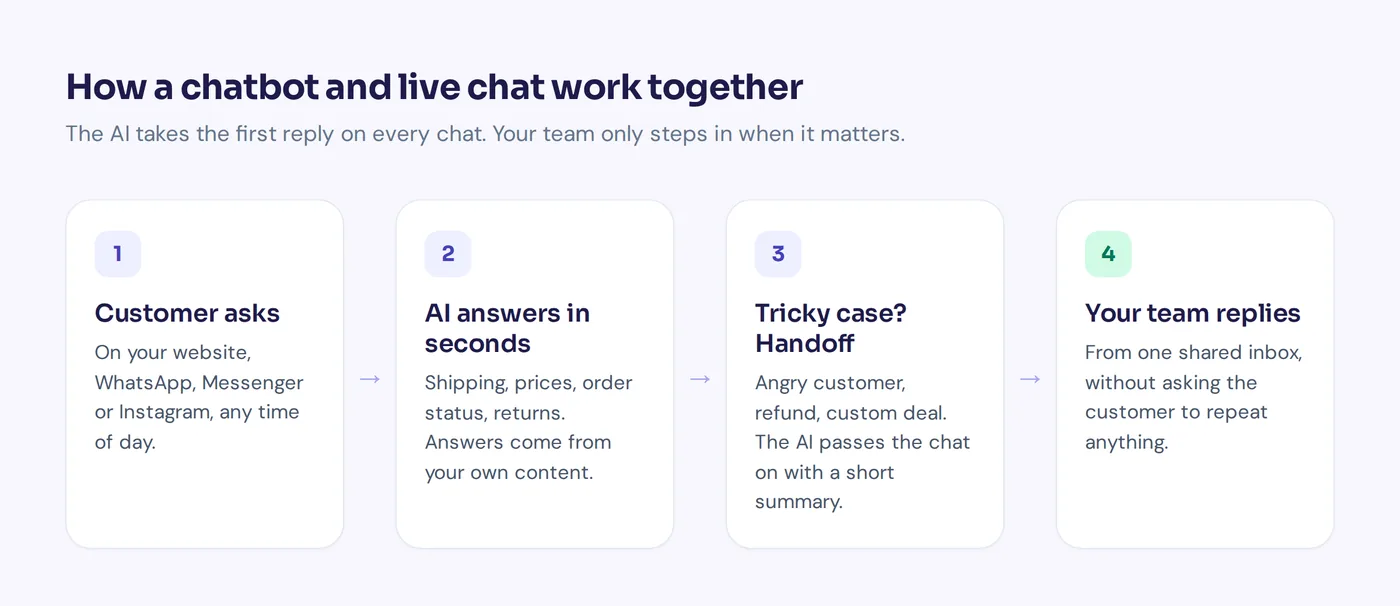
- Human handoff. A customer-facing agent must know when to pass the conversation to a person. Ask to see it.
- Ownership. Who owns the code, prompts and data pipelines at the end? Can you move to another vendor?
- Total price. Ask for the build fee, expected monthly model and hosting bills, and the maintenance fee. All three.
- Support after launch. Response times, who fixes problems, and what changes are included.
Questions to ask on the first call
- "What would you build first, and what would you leave out of version one?"
- "What will this cost per month to run at 5,000 conversations?"
- "What does the agent do when it doesn't know the answer?"
- "Is there an existing product that could do this? Why should we build instead?"
That last question is a good test. An honest firm will tell you when you don't need them.
Top AI agent development companies by category
Ranked lists of the "top 10 AI agent development companies" are everywhere, and most are written by one of the companies on the list. So instead of a ranking, here are the main types of vendors and well-known names in each. We haven't worked with these firms, so check their portfolios yourself.
- Large consulting firms. Accenture, IBM Consulting, Capgemini and Cognizant all offer agentic AI consulting and enterprise AI programs. Good for Fortune 500 companies with complex systems. Slower and pricier.
- Specialist agentic AI development studios. Smaller firms offering agentic AI development services and generative AI. Often fast and skilled. Check their capacity and the AI agent developers who will actually work on your project.
- Software agencies with an AI practice. Strong at app development and integrations. Ask how many agent projects they've shipped to production, and how they deploy AI agents and keep them reliable.
- Freelancers. Cheapest for a prototype. Risky for anything business-critical, since one person is a single point of failure.
- Agent development platforms. These are AI platforms, not an AI agent development firm. Tools like Google's Vertex AI Agent Builder and Microsoft Copilot Studio let your own developers build AI agents. These suit teams with engineers who want control without starting from zero.
- Ready-made AI agents for a specific job. Products built for one use case, like customer support. You configure, not code.
AI agent use cases that work well today
- Customer support. AI agents handle repeat questions, order status and returns, and hand complex cases to people.
- Sales and lead qualification. Answer product questions, ask qualifying questions and book meetings.
- Internal help desks. HR and IT questions about leave, payroll dates, VPN and passwords.
- Operations. Invoice matching, data entry and report building inside ERP and CRM tools.
- Healthcare and finance. AI agents in healthcare can help with scheduling and paperwork, and in financial services with document review. Both need strict governance, which is where specialist developers help most.
Across these, the AI agents that automate well share one trait: a narrow, clear job with a human ready to step in.
Trends in AI agents and enterprise AI for 2026
- Standard tool connections. The Model Context Protocol (MCP) makes it easier for AI agents to connect to tools without one-off code.
- Cheaper, faster, more advanced AI models. Running AI agents costs less each year, so more businesses can afford them.
- Testing as a habit. Serious teams now run test sets after every change, just like software, and build AI agents that continuously learn from reviewed chats.
- Human approval for actions. Refunds, cancellations and payments increasingly require a person to confirm.
- Buy first, build later. More companies are turning to AI tools for common jobs and saving development budgets for the unique parts.
How AnytimeReply fits in
AnytimeReply is a ready-made AI agent for customer support and sales, with a helpdesk built in. Think of it as one of the AI agent solutions you can implement in a day, without a development project. If your goal is to answer customers, capture leads and take simple actions, it covers what many businesses ask developers to build.
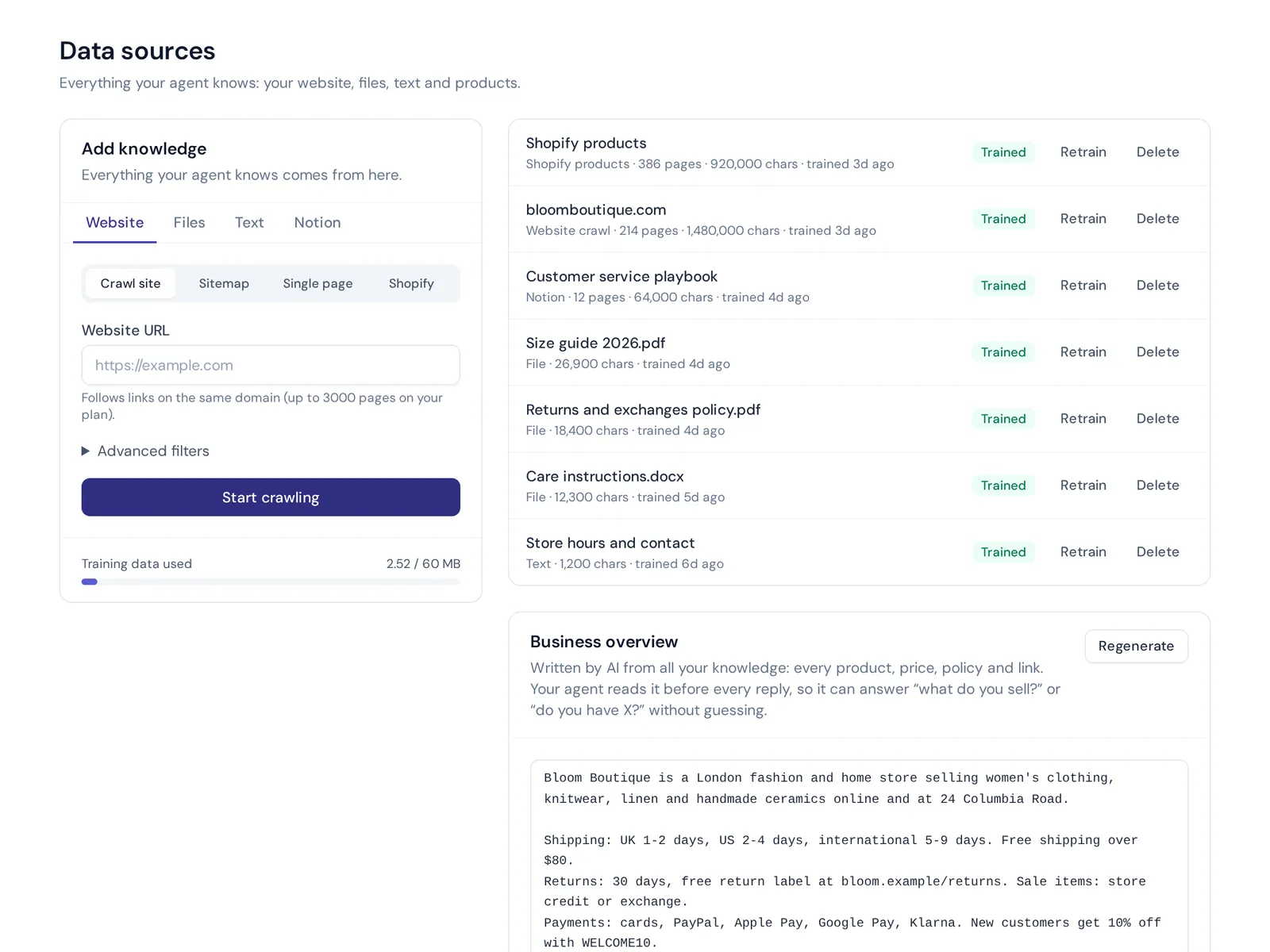
- Training on your content. Add your website, PDFs, Word files, Notion pages and Shopify products. Q&A you write always wins over other sources. See the AI agent.
- Every channel in one inbox. Website chat, WhatsApp, Messenger, Instagram, Telegram, email and Slack, with a shared helpdesk where your team takes over.
- Actions for verified customers. Shopify, WooCommerce, Stripe, Cal.com, Calendly, HubSpot, Airtable, AfterShip, MCP servers and any API with an OpenAPI file, with confirmation, optional team approval and limits. See actions and integrations.
- Honest answers. Each answer has a confidence score, and when the agent doesn't know, it says so instead of guessing, then hands over with a summary.
- Your choice of model. GPT, Claude, Gemini or DeepSeek per agent. From the Standard plan you can connect your own API key.
There's a free plan, no card needed, and paid plans start at $9 a month (prices can change, check our pricing page). No setup fees, no contract.
Where it's not the right fit: it works in chat and messaging only, with no calling or text-message channel, and it isn't built to run deep inside back-office software with no API. If that's your project, a development firm is the better call. And if you're an agency building AI agents for clients, look at our Agency plan.
Frequently asked questions
How much does it cost to hire an AI agent development company?
It depends on scope. Public guides put simple agents at around $20,000 and complex or enterprise builds at $80,000 to $200,000 or more. Add monthly model usage, hosting and maintenance on top.
How long does it take to develop a custom AI agent?
A pilot can take a few weeks. A production agent with integrations, testing and security reviews usually takes a few months. A ready-made tool can be live the same day.
Are AI agents the same as chatbots?
No. A chatbot mainly answers questions. AI agents can also take actions, like checking an order or booking a meeting, and decide which step to take next.
Are AI agent platforms the same as development companies?
No. A platform is software you set up yourself. A development company builds for you, often on top of platforms and models. Many businesses use a platform first and hire developers only for unique parts.
Do I need AI agents built by developers, or can I buy them?
Buy when your problem is common, like customer support, bookings or lead capture. Build when the workflow is unique, touches systems with no API, or must meet data rules a product can't meet.
Can a small business afford AI agents?
Yes, with a ready-made tool. Bespoke development is usually out of reach for small budgets, but ready-made AI agents start with free or low monthly plans.
Final thoughts
A good AI agent development company is worth every dollar when your problem is truly unique. But for customer support, sales chat and help desk work, the smartest first step is usually to try a ready-made agent, see how far it gets you, and only then decide if you need developers.
Want to see how far it goes for your business? Start free with AnytimeReply, no card needed. Add your website, test the agent, and decide from real answers instead of a proposal.
Published 27 October 2026 by AnytimeReply team