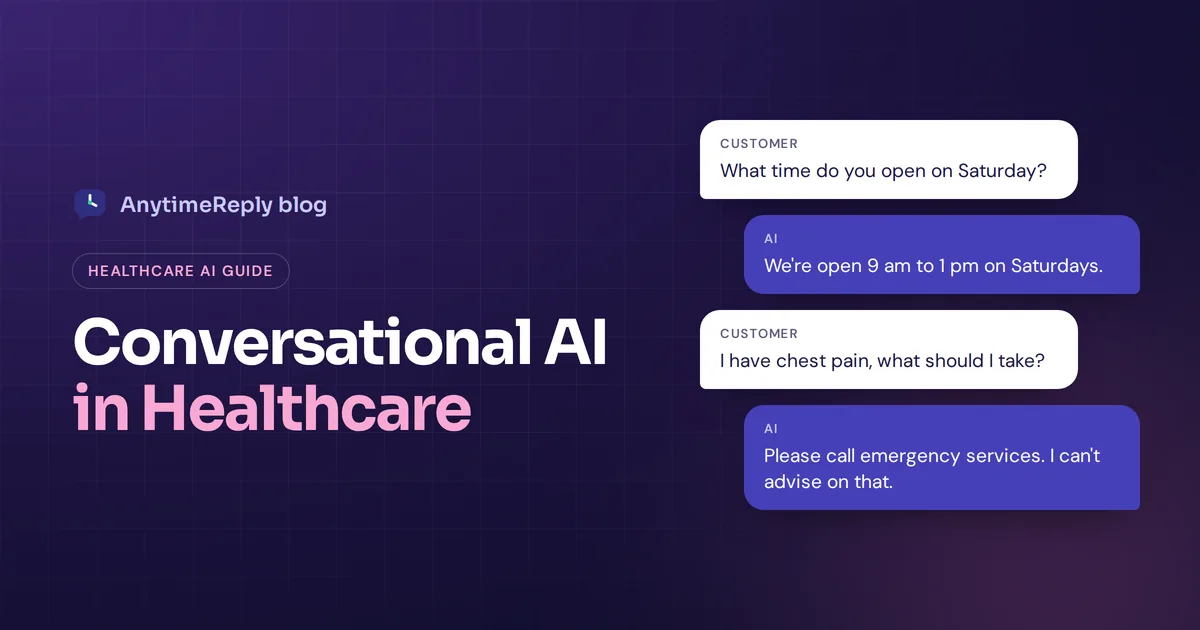
Conversational AI in healthcare means chatbots and voice assistants that talk with patients and staff in plain language. They answer questions, schedule visits, send reminders, help with intake and route people to the right place, at any hour of the day.
Done well, it takes a lot of repetitive work off front desk teams and gives patients faster answers. Done badly, it gives wrong medical information or exposes private data. So the real question in 2026 isn't "should we use it?" but "for what, and with which safeguards?"
This guide covers how it works, the main use cases, examples from the healthcare industry, the benefits, the real risks and a practical way to start. We build AnytimeReply, an AI customer support tool, so we'll also be clear about where a general tool like ours fits in a clinic, and where it absolutely does not.
What is conversational AI in healthcare?
Conversational AI is software that understands what people type or say and replies in natural language. It combines artificial intelligence techniques like natural language processing (NLP), natural language understanding and machine learning. Since 2023, most new systems also use generative AI, meaning large language models that can write fresh answers instead of picking from a script.
In healthcare settings, these conversational agents usually show up as:
- AI chatbots on a hospital or clinic website, patient portal or messaging app like WhatsApp.
- Voice assistants that answer phone lines and handle simple requests.
- Virtual health assistants that check in with patients between visits.
- Documentation tools that listen to a consultation and draft notes for the doctor.
- Internal helpers that help care teams find policies or procedures.
Conversational AI vs chatbots vs IVR: what's the difference?
People use these words loosely, so here is a simple breakdown.
| IVR (phone menus) | Rule-based chatbot | Conversational AI | |
|---|---|---|---|
| How patients interact | "Press 1 for appointments" | Click buttons in a chat | Type or speak freely |
| Understands open questions | No | Barely | Yes |
| Keeps context | No | Limited | Yes, across the conversation |
| Main risk | Frustrated callers | Dead ends | Confident wrong answers |
| Setup effort | Medium | Low | Medium to high |
Conversational artificial intelligence is the broader idea. So every one of these conversational AI systems can act as a chatbot, but not every chatbot is conversational AI. The flexibility of the newer AI systems is exactly what makes accuracy and safety harder to manage.
How healthcare conversational AI works
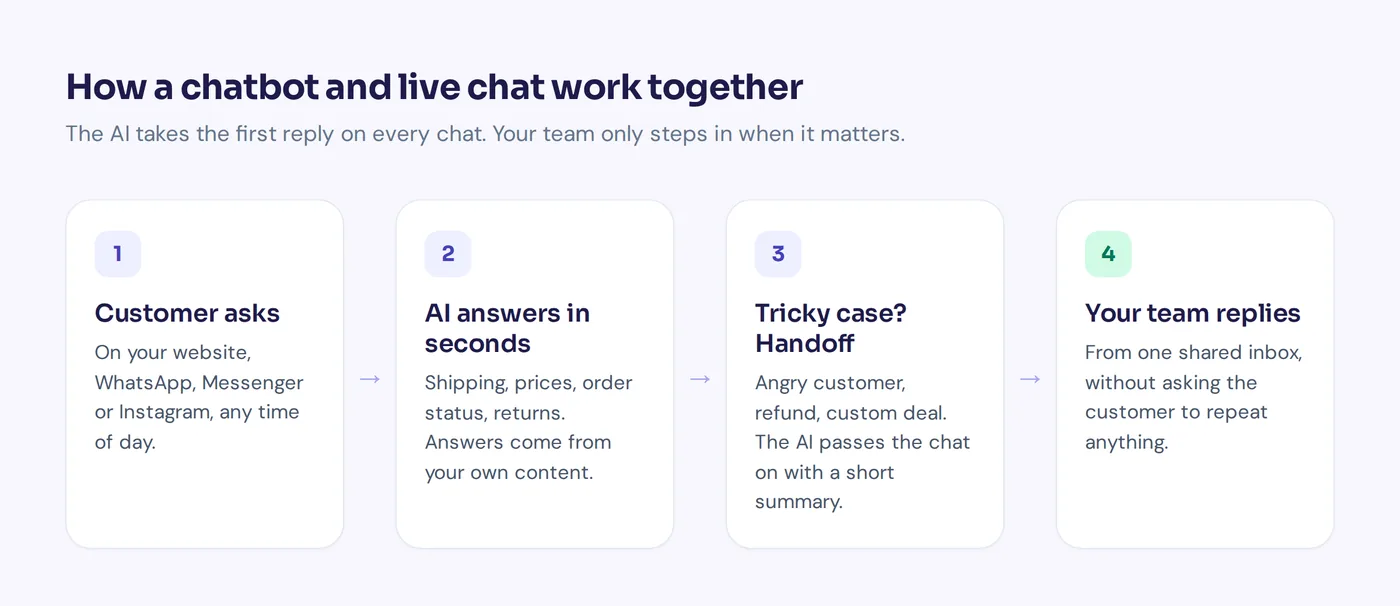
Most systems follow the same loop. This process enables the AI to stay useful without going off the rails:
- Understand the message. The AI model works out the intent: book, reschedule, cancel, ask about hours, ask about a bill.
- Look up approved information. A good system answers from the provider's own content (opening hours, services, prices, insurance accepted) instead of the open internet.
- Reply or act. It answers, or connects to a scheduling system to book a slot in real-time.
- Hand over to a person. When the question is medical, urgent, emotional or unclear, it passes the conversation to staff.
That last step matters more in the healthcare sector than anywhere else, and conversational AI healthcare projects that skip it tend to fail. A good assistant knows its limits. Newer AI agents can also take actions, like moving an appointment, but the same rule applies: medical decisions stay with people.
Top use cases in healthcare: from AI chatbot booking to triage
1. Appointment scheduling and reminders
This is the most common and lowest-risk use case. Patients pick a slot, reschedule or cancel by chat, and get a reminder before the visit. Fewer phone calls for the front desk, and fewer no-shows. Many teams use AI appointment tools to automate this part first.
2. Administrative questions
Opening hours, directions, parking, which insurance plans are accepted, what to bring to a first visit, how to get a copy of an invoice. These make up a big part of what any health center hears every day, and they have clear, fixed answers.
3. Patient intake
The AI walks a patient through intake questions before a visit. This saves time in the waiting room, but it collects health information, so it needs a platform built for healthcare.
4. Symptom checking and triage
Some systems ask about symptoms and suggest a level of care, like self-care, a GP visit or emergency. This is high risk. It needs clinical validation, oversight by a medical professional and, in many countries, approval as a medical device.
5. Medication adherence and prescription refill requests
Reminders to take medication, nudges for a prescription refill, or check-ins after surgery. These support chronic disease management and health coaching, but they touch sensitive records.
6. Clinical documentation
Ambient "AI scribe" tools listen to consultations and draft notes for the doctor to review and add to the patient record. They cut paperwork, but healthcare professionals must still check every note.
7. Billing and insurance
Explaining a bill, payment options or how to submit a claim. Administrative, but sometimes linked to personal records, so check what data the bot can see.
8. Internal staff support
New nurses or admin staff asking where a policy is or how to log a request. An internal assistant answers from approved documents and improves the workflow for busy care teams.
Real-world examples of conversational AI for healthcare and patient engagement
A few examples show the range:
- The World Health Organization's S.A.R.A.H. In 2024, the WHO unveiled a digital health promoter prototype that uses generative AI. It answers general health questions about healthy habits, mental health and quitting tobacco, in 8 languages, around the clock. WHO itself flagged accuracy, privacy and bias as concerns that need ongoing research.
- Patient portal chat. Many large health systems now offer chat in their patient portal for booking, directions and billing questions.
- Research on chronic conditions. A systematic review published in the US National Library of Medicine's PMC looked at AI conversational agents for chronic conditions and found the field promising but still early, with a need for stronger evaluation.
Notice the pattern across healthcare systems large and small. The safest and most common deployments are general health information and admin tasks, the everyday side of healthcare communication. The clinical ones move slowly, with a lot of testing.
Benefits of conversational AI for patients and providers
When healthcare providers start using AI healthcare tools to talk with patients, these are the gains they usually look for:
- 24/7 access. Patients get simple answers or schedule a visit at 10 pm, not just during office hours.
- Less admin work. Front desk staff spend less time on repeat questions and more time with patients in the room.
- Shorter waits. Fewer people stuck on hold for a question that takes ten seconds to answer.
- Fewer missed appointments. Automated reminders and easy rescheduling help.
- More languages. AI can reply in the patient's language, which helps diverse communities.
- Better patient engagement. Follow-ups happen consistently and match each person's health needs, which can support better health outcomes for people with ongoing health conditions.
- A better user experience. Patients use the communication channel they already like, such as web chat or a messaging app.
Healthcare AI risks that healthcare organizations can't ignore
Wrong or unsafe information
Language models can sound confident and still be wrong. In retail that's annoying. In healthcare it can hurt someone. Any AI giving medical information needs clinical review, strict limits and a clear route to a human.
Privacy and data security
Health data is some of the most sensitive data there is. Where it's stored, who can access it, whether the vendor trains models on it and how it's encrypted all matter. A breach is both a legal problem and a trust problem.
Bias and fairness
AI trained on unbalanced data can work worse for some groups, languages or accents. Test with real patients from the communities you serve.
Missed emergencies
A patient describing chest pain should not be chatting with a booking bot. Every system needs clear messages telling people to call emergency services.
Integration with existing systems
Connecting to electronic health records (EHR) and scheduling software is often the hardest and most expensive part of a project.
HIPAA, GDPR and other rules
Rules depend on where you are. A few you'll hear about:
- HIPAA (United States). Covers protected health information. If a vendor handles that data for you, you generally need a Business Associate Agreement (BAA) with them. HHS has an overview of the Privacy Rule.
- GDPR (EU and UK). Treats health data as a special category with stricter rules on processing and consent.
- Medical device rules. Tools that diagnose may count as medical devices and need regulator approval, for example from the FDA.
- Local laws. Many countries have their own health data and privacy laws.
One common myth: calling a product "conversational AI" doesn't make it compliant. Compliance depends on the vendor's contracts, security and how you use it. We're not lawyers and this isn't legal advice, so talk to your compliance officer before any AI tool touches patient data.
Safe vs risky uses at a glance
| Use | Risk level | What you need |
|---|---|---|
| Opening hours, directions, parking | Low | Accurate, up-to-date content |
| General booking questions | Low | Clear handoff to staff |
| Accepted insurance, service prices | Low to medium | Regular content checks |
| Intake forms with health details | High | A compliant platform built for healthcare |
| Symptom checking | Very high | Clinical validation, oversight, possible approval |
| Medication or treatment advice | Very high | Licensed clinicians, not a general chatbot |
How to choose a conversational AI platform for healthcare
Conversational AI solutions vary a lot in what the tools provide. Before you sign with any vendor, ask:
- Will you sign a BAA or equivalent data agreement for our region?
- What AI infrastructure do you run on, and which AI providers see our data?
- Where is data stored, and is it used to train any AI model?
- Can we limit what the AI answers, and force a handoff on medical topics?
- Does it connect to our EHR, scheduling and messaging tools?
- Do you offer a voice AI platform for phone lines, or only chat?
- Can you show a case study from an organization like ours?
- How do we review conversations and fix wrong answers?
A small dental practice and a large health system need very different healthcare solutions. Global healthcare groups often want a full communication platform with EHR links, while a single clinic may only need an AI chatbot on its website. Pick for your size, not for the flashiest demo.
How to get started: a simple conversational AI strategy
- List your common questions. Ask the front desk to note every question for a week. Most find a big share are admin questions.
- Split admin from medical. Decide which topics the AI may answer and which always go to a person.
- Choose a tool that fits the data. For anything with patient data, use a platform built and certified for healthcare. For general admin questions, a general support tool may be enough.
- Write clear limits. Tell the AI to never give medical advice, never ask for health details and always show emergency contacts.
- Test with staff. Have your team try to break it before patients see it.
- Measure and review. Track completed appointments, handoffs, patient ratings and unanswered questions. Read real chats every week.
Adopting AI this way keeps risk low. The use of conversational tools for admin first also shows you where AI can facilitate more later, and where it can't. Healthcare chatbots that start small tend to earn trust from staff faster.
Most clinics can launch an admin-only assistant in days. Projects with EHR integration and clinical use usually take months.
Where AnytimeReply fits for clinics (and where it doesn't)
Let's be direct. Our tool is not HIPAA compliant. It is not built for patient health data. Clinics should only use it for non-medical, administrative questions like opening hours, booking information, directions, parking and which services you offer. Never use it to collect symptoms, diagnoses, test results or any other health details. And check your own local regulations before using any AI tool.
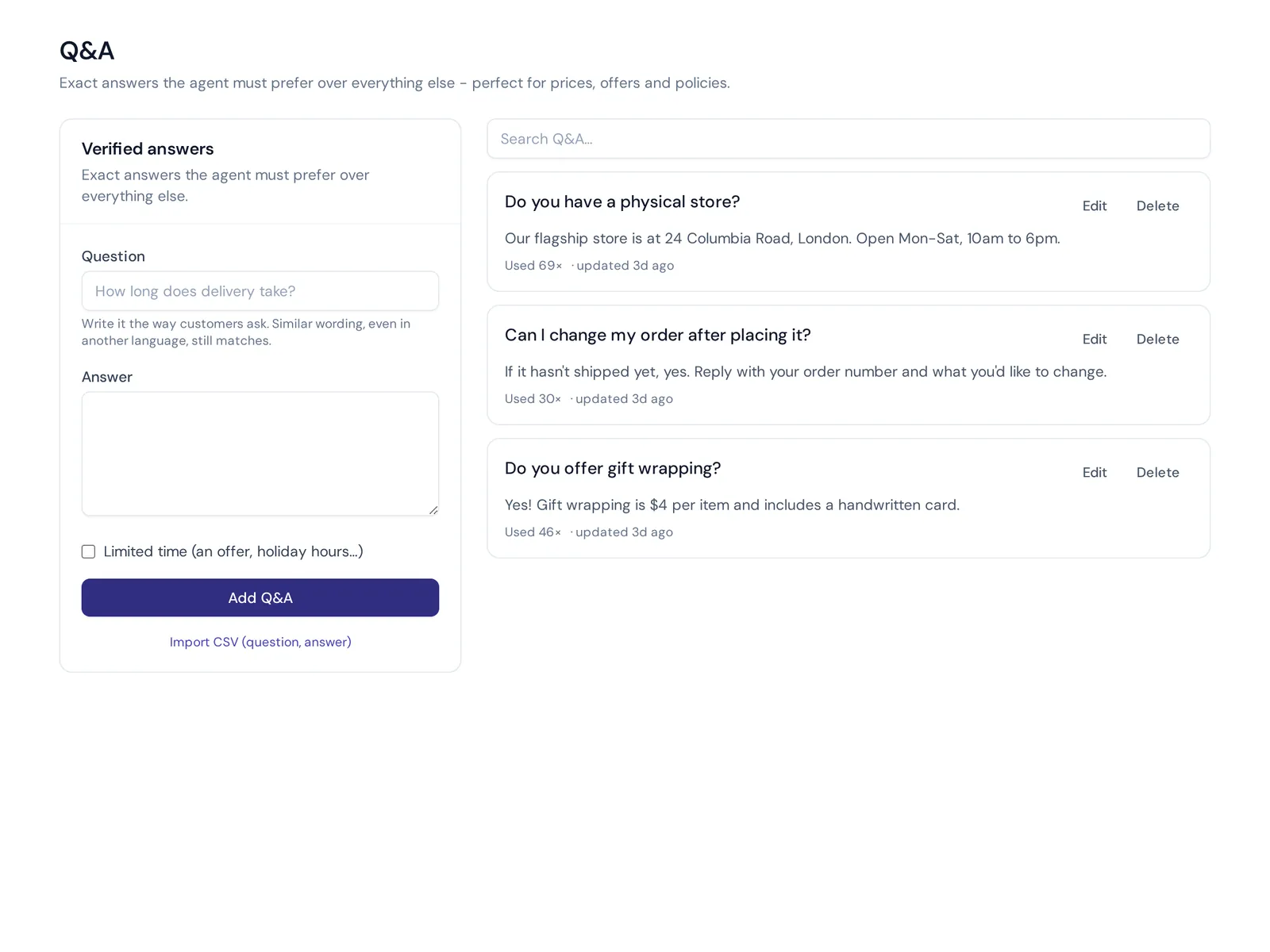
Within those limits, it can save a front desk a lot of time. You add your website and a few documents, and the AI agent answers admin questions on your website chat or messaging channels in the patient's language. When it doesn't know, it says so instead of guessing, and it hands the chat to your staff in a shared inbox. You can add verified Q&A answers, like your exact address or cancellation policy, which always win over other sources.
A good instruction for a clinic: "Only answer questions about opening hours, location, booking and services. For any health or medical question, do not answer. Tell the patient to contact the clinic directly, or call emergency services if it is urgent."
It has no phone channel, so it won't replace your phone line either.
Frequently asked questions
What is an example of conversational AI in healthcare?
A chatbot on a clinic website that lets patients book or cancel appointments and answers questions about opening hours and accepted insurance. AI scribes that draft clinical notes are another example.
Can a healthcare chatbot be used without violating HIPAA?
Yes, if the vendor is set up for it, signs a BAA and you configure it correctly. Many general chatbot tools, including AnytimeReply, are not, so keep patient data out of them.
Can conversational AI replace doctors or nurses?
No. It reduces paperwork and handles simple questions, but diagnosis, treatment and personalized care need trained professionals.
How long does it take to implement?
An admin-only chatbot can go live in days. Clinical tools with EHR integration and compliance reviews often take several months.
How can you tell if it's working?
Track how many bookings and questions it completes without staff, how often it hands over, patient ratings and fewer calls to the front desk.
Start with the simple questions
The safest way to bring AI into patient communication is to start with admin questions, keep medical topics with your staff and add more only with the right compliance in place. If you want an AI assistant for opening hours, directions and booking info, start free with AnytimeReply, no card needed.
Published 27 October 2026 by AnytimeReply team