Two support agents get the same angry message: "My order is three days late and nobody is answering!" One copies a policy paragraph and hits send. The other says sorry, checks the tracking, explains what happened and offers a fix. Same company, same product, completely different customer experience.
The difference is customer service skills. They decide whether a customer leaves calmer or angrier, whether they buy again, and what they tell their friends about you. The good news: almost every skill on this list can be learned and practiced.
Below are the 25 essential customer service skills you need, split into people skills and technical ones, with real examples of what good looks like and how to develop each one. Whether you're hiring, training a customer support team or applying for your first job in the service industry, you'll find something useful here.
What are customer service skills?
Customer service skills are the abilities that help you understand customers, solve their problems and make them feel looked after. They include people skills like empathy, patience and clear communication, and practical abilities like product knowledge, writing and using support software.
They matter in all customer service roles: customer service representative, customer support agent, retail staff, receptionist, account manager, even the founder answering the inbox at night. And they matter on every channel, from phone and email to live chat, WhatsApp and social media.
Why customer service skills matter for the customer experience
Every customer service interaction is a small moment of truth, and customer expectations keep rising. Handle it well and you build customer satisfaction and loyalty. Handle it badly and one poor customer experience can undo months of marketing.
- Customer retention: people stay with businesses that treat them well, even when something goes wrong.
- Word of mouth: a strong customer relationship turns buyers into fans who recommend you.
- Fewer repeat contacts: a clear first answer stops the same customer from writing three more times.
- A calmer team: skilled agents handle tough moments without burning out.
In short, great customer service is a growth tool, not a cost center. It's about building and nurturing customer relationships, one conversation at a time. And it all comes down to the people delivering it.
Customer service soft skills vs hard skills: the difference
It helps to split good customer service skills into soft and hard skills:
| Customer service soft skills | Customer service hard skills | |
|---|---|---|
| What they are | How you deal with people and emotions | Knowledge and technical skills you can test |
| Examples | Empathy, patience, active listening, positive attitude | Product knowledge, typing, helpdesk software, data |
| How you learn them | Practice, feedback, role-play, experience | Training, documentation, courses |
| How you measure them | Customer satisfaction ratings, chat reviews | Tests, accuracy, speed |
Most hiring managers say the same thing: product knowledge can be taught in a few weeks. People skills take longer, so they're often what gets someone hired. The best agents combine soft skills and technical know-how.
Soft skills for customer service: the top skills to master
1. Empathy
Empathy is the key customer service skill, and it means understanding how the customer feels and showing it. It's not about agreeing with everything. It's about making the customer feel heard before you fix the problem.
Weak: "Delivery times are listed on our website."
Better: "That's frustrating, especially when you were waiting for it. Let me check where it is right now."
2. Active listening
Active listening means paying full attention, not just waiting for your turn to talk. In written support, it means reading the whole message. Many bad replies happen because the agent answered the first sentence and missed the real question in the third.
A simple habit that builds listening skills: repeat the problem back in one line. "So the size was right, but the color looks different from the photo?" Customers relax when they see you got it.
3. Patience
Some customers are confused, stressed or not great with technology. Patience is a customer service skill you notice most when it's missing. It means explaining the same thing a second time without sounding annoyed, and not rushing someone just to close the ticket.
4. Clear communication
Customer service and communication skills go hand in hand. Use simple words, short sentences and one step at a time. Skip internal jargon like "your RMA is pending in the WMS". Say "your return is approved and we'll refund you when it arrives".
5. Positive language
Positive language focuses on what you can do. Instead of "We can't ship that until Monday", try "It will ship first thing Monday". Same fact, very different feeling. It's a small skill with a big effect on positive customer reactions.
6. Problem-solving
Customers don't contact you to chat. They have a problem. Problem-solving means finding the real cause, thinking of options and picking the fix that works for both the customer and the business. Sometimes the best fix is a creative one nobody wrote in the manual.
7. Adaptability
Every customer is different. One wants a quick answer, another wants details, a third just wants to vent. Adapt your tone and pace to the person. Adaptability also matters when policies, products or tools change.
8. Staying calm under pressure
Angry customers, a busy sale day, a system outage. Staying calm keeps the conversation from getting worse. Take a breath before replying, and don't take rude words personally. They're angry at the situation, not at you.
9. Conflict resolution
This is where great agents shine. Acknowledge the feeling, apologize for the experience (even if it's not your fault), explain what you can do, and follow up. A well-handled complaint often builds more customer loyalty than a problem-free order.
10. Ownership and follow-through
"I'll take care of this" are powerful words. Ownership means you don't bounce the customer around. If you promise an update tomorrow, you send it tomorrow, even if the update is "still checking".
11. Time management
Support work is a constant stream of customer inquiries. Knowing what to answer first (urgent issues, upset customers, big orders) and not getting stuck on one ticket for an hour keeps the queue healthy.
12. Attention to detail
The right order number, the correct spelling of a name, the right refund amount. Small mistakes make customers lose trust fast.
13. Confidence
Customers trust agents who sound sure of themselves, and it makes customer interactions shorter and smoother. Confidence doesn't mean knowing everything. It means saying "I'll find out" calmly instead of guessing nervously.
14. Anticipating customer needs
The best agents can anticipate customer needs based on what they see. A customer asks about shipping to Canada? Mention customs fees before they ask. Someone buys a camera? Point them to the memory card guide. It saves a second message and feels thoughtful.
15. Gentle persuasion
Sometimes service and sales overlap. Suggesting a better-fitting plan or a product that solves the problem isn't pushy if it truly helps. The rule: recommend what you'd recommend to a friend.
Technical skills every customer service rep should learn
16. Product or service knowledge
You can't help someone with a product or service you don't understand. Know your pricing, policies, shipping times and common problems. Great agents know the product well enough to suggest a better option the customer didn't think of.
17. Written communication and typing
A lot of customer support now happens in writing: email, live chat, WhatsApp, Instagram DMs. Fast, accurate typing and clear writing matter as much as a friendly voice did on the phone.
18. Helpdesk and CRM software
Most teams use a helpdesk or shared inbox, and many use customer relationship management (CRM) tools. Knowing how to use tags, internal notes, assignment, saved replies and customer history makes you faster and more consistent.
19. Multitasking across channels
Live chat agents often handle two or three chats at once. That takes practice: keeping context straight, not mixing up customers, and knowing your limit.
20. Working with AI tools
Many teams now use AI to answer customer questions that repeat, draft replies or translate messages. Knowing how to review an AI draft, correct it and improve the knowledge it learns from is becoming a real job skill.
21. Languages
A second language is a big plus, especially for businesses with international customers.
22. Basic data and KPIs
Reading simple reports like response time, customer satisfaction and top contact reasons helps you spot patterns and suggest fixes. Customer feedback is data too: read it.
23. Technical troubleshooting
For software and electronics, you'll need to walk people through steps: clear the cache, restart the app, check the settings. Logical step-by-step thinking makes this much easier.
24. Writing help articles
Agents who can turn a repeated answer into a clear help article reduce future tickets for the whole team.
25. Triage and escalation
Knowing which customer issues you can solve and which need a specialist, a manager or the tech team, and passing them on with full context, saves everyone time.
The best customer service skills in action: real examples
Here's how each customer service skill looks in a real conversation. Copy the approach, not just the words.
A late delivery
I'm sorry your order hasn't arrived yet, I know you were counting on it. I checked and it's at your local depot, scheduled for delivery tomorrow. I'll keep an eye on it and message you if anything changes.
A customer who has the policy wrong
I can see why that was confusing. Our return window is 30 days, and your order was 40 days ago. I can't do a refund, but I can offer store credit as a one-time exception. Would that work for you?
Something you don't know yet
Good question, and I don't want to guess. Let me check with our product team and get back to you by 3 pm today.
An angry customer
You're right to be upset, this isn't the experience we want for you. Here's what I'm doing right now: sending a replacement by express shipping, at no cost. You'll get tracking within the hour.
A new customer who is unsure
Welcome! Since you mentioned you're just starting out, the Basic plan covers everything you need for now. You can upgrade any time, and I'm happy to help you set it up.
The 5 C's of customer service
You'll see different versions of the "5 C's" online, and there's no single official list. One version we like, because it sums up the skills above:
- Courtesy: be polite and respectful, even when the customer isn't.
- Clarity: explain things simply, without jargon.
- Competence: know your product and solve the problem.
- Consistency: give the same quality answer on every channel, every time.
- Convenience: let the customer reach you where they already are.
Quick checklist of top customer service skills
Use this as a self-check, or as a scorecard when you review a teammate's chats. Each line checks one of the essential skills above:
- Did I greet the customer and use their name?
- Did I read the whole message and answer the real question?
- Did I show I understood how they feel?
- Was my reply clear, short and free of jargon?
- Did I focus on what I can do, not what I can't?
- Did I check the facts (order number, amount, dates) before sending?
- Did I anticipate the next question and answer it too?
- Did I take care of the customer until the issue was solved, or hand over with full context?
- Did I follow up when I said I would?
- Did I log what I learned so the team (or the AI) can answer it faster next time?
If you can tick most of these on most conversations, you're already doing the work that helps a team provide stellar customer service. The rest is practice.
How to improve customer service skills, step by step
Whether you're new or an experienced customer service professional, these habits will improve your customer service skills:
- Read your own replies back. Pick five recent conversations a week. Would you be happy getting that reply?
- Ask for feedback. From customers (ratings and surveys) and from teammates or a manager.
- Role-play tough situations. Practice the refund refusal, the furious customer and the "I want your manager" moment before they happen for real.
- Learn the product deeply. Use it yourself. Read the docs. Ask the product team about common issues.
- Build a library of good replies. Save your best answers as templates, then personalize them each time.
- Study great service. Notice when a company treats you well. What exactly did they say or do?
- Look after yourself. Burnout kills patience and empathy. Short breaks during busy shifts help more than you'd think.
For managers who want their people to improve their customer service as a team, add regular chat reviews and celebrate good saves in public. That builds a culture of customer focus faster than any policy document.
How to show customer service skills on a resume
Don't just list "good communication skills". Everyone writes that. Show evidence instead:
- "Handled 40 to 60 live chats a day while keeping customer satisfaction ratings high."
- "Resolved escalated complaints and turned many into repeat customers."
- "Wrote help articles that reduced repeat questions about shipping."
- "Trained three new team members on our helpdesk and refund process."
Use real numbers from your own work if you have them. Add the tools you know (helpdesk, CRM, live chat software) in a skills section, and mention languages. No formal job yet? Volunteering, retail, hospitality and even helping customers in a family business all count as relevant experience.
Interview questions that test customer service skills
Hiring? These questions reveal a lot. Applying? Prepare a short story for each.
- Tell me about a time you dealt with an angry customer. What did you do?
- How do you handle a question you don't know the answer to?
- Describe a time you went beyond what was expected for a customer.
- How would you say no to a customer without losing them?
- How do you stay calm when the queue is full and everyone is waiting?
Strong answers follow a simple pattern: the situation, what you did, and the result.
How the right tools support great customer service
Skills come first, but tools decide how much time your team has to use them. If agents spend half the day answering "where is my order?" and switching between five apps, there's little energy left for the conversations that need real empathy.
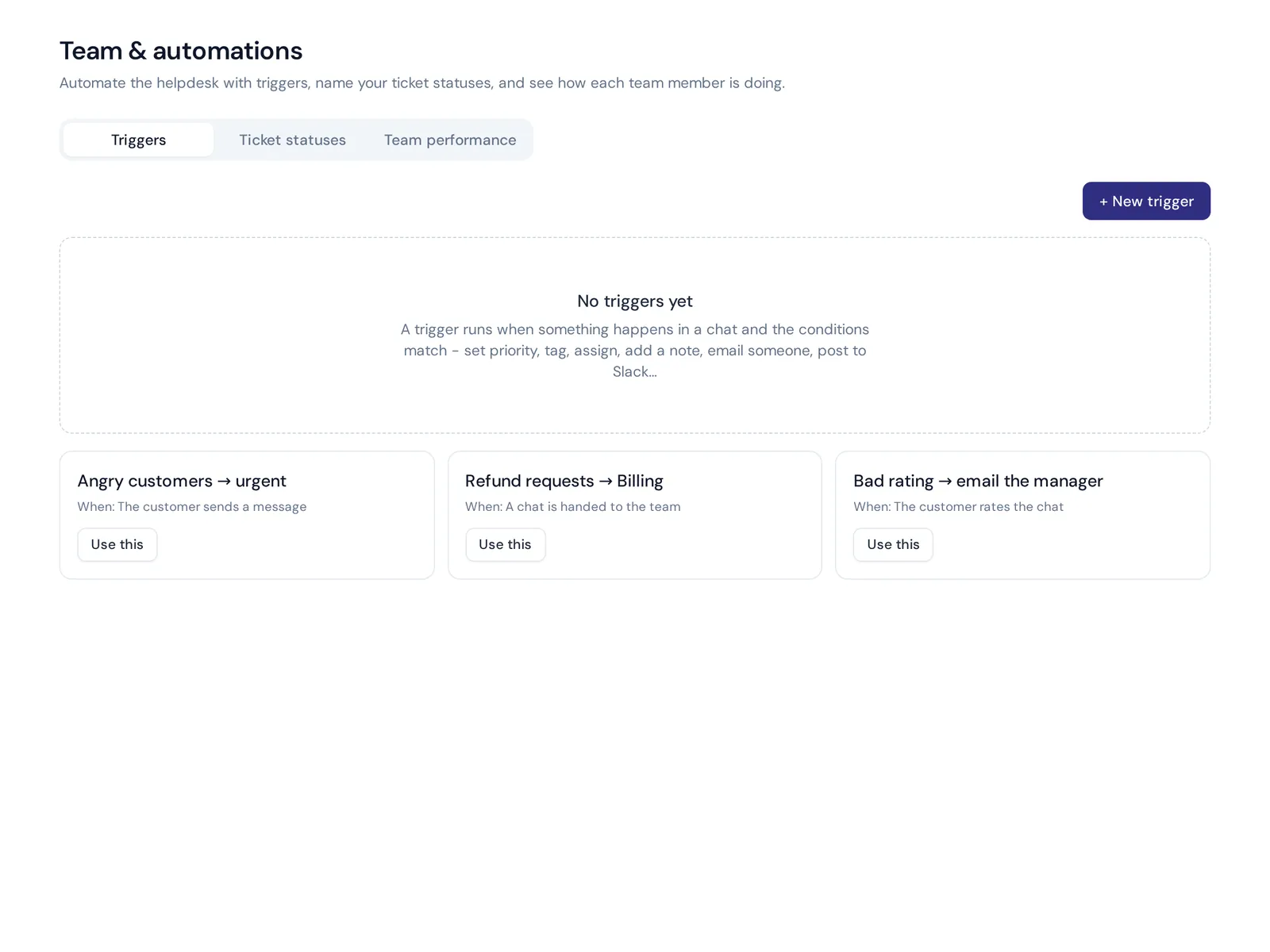
That's what we built AnytimeReply for. An AI agent trained on your website answers repeat questions in seconds, in the customer's language, and hands chats to a person when a customer asks for one, gets upset, or the AI isn't sure. Your team works from one helpdesk inbox with internal notes, assignment and AI help to rewrite or translate replies, so each customer service agent spends their skill where it matters most.
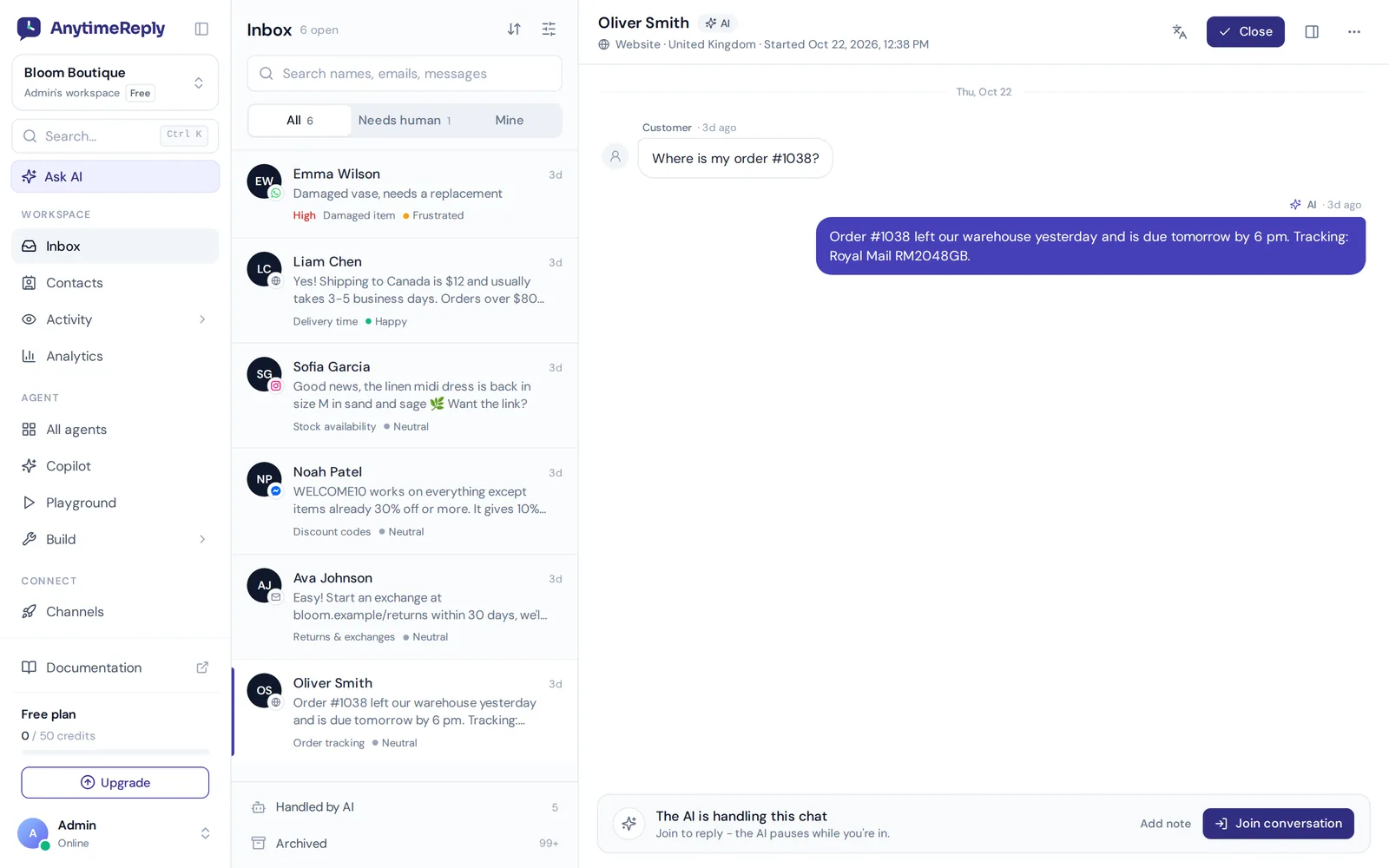
Analytics show ratings (CSAT), sentiment and team performance, which makes coaching much easier. The helpdesk inbox is on the Free plan.
Frequently asked questions
What are the most important customer service skills?
Empathy, active listening, clear communication, patience and problem-solving. Together they cover understanding the customer, explaining things simply and actually fixing the issue.
What's the difference between customer service and customer support?
Customer service is the whole experience of helping customers before, during and after a purchase. Customer support usually means helping with a specific problem, often technical. The skills overlap a lot.
What are 5 professional skills examples?
Communication, problem-solving, time management, teamwork and adaptability. All five are valuable in support roles and almost any other job.
What counts as customer service experience?
Any role where you helped customers or the public: retail, restaurants, call centers, reception, hospitality, volunteering, or answering messages for a small business.
Can customer service skills be learned?
Yes. Some people find empathy or patience more natural, but everyone improves with practice, feedback and good examples to follow.
Will AI replace customer service skills?
AI handles a lot of repeat questions now, but complaints, exceptions and emotional moments still need people. If anything, human skills matter more, because agents spend more of their time on the tricky conversations.
Final thoughts
Excellent customer service isn't magic. It's a set of skills: listening, caring, explaining clearly and following through, backed by solid product knowledge and good tools. Pick two skills from this list, practice them on purpose this month, and they'll become habits.
If you want your team to spend less time on repeat questions and more time on real conversations, start free with AnytimeReply. No card needed.
Published 26 October 2026 by AnytimeReply team