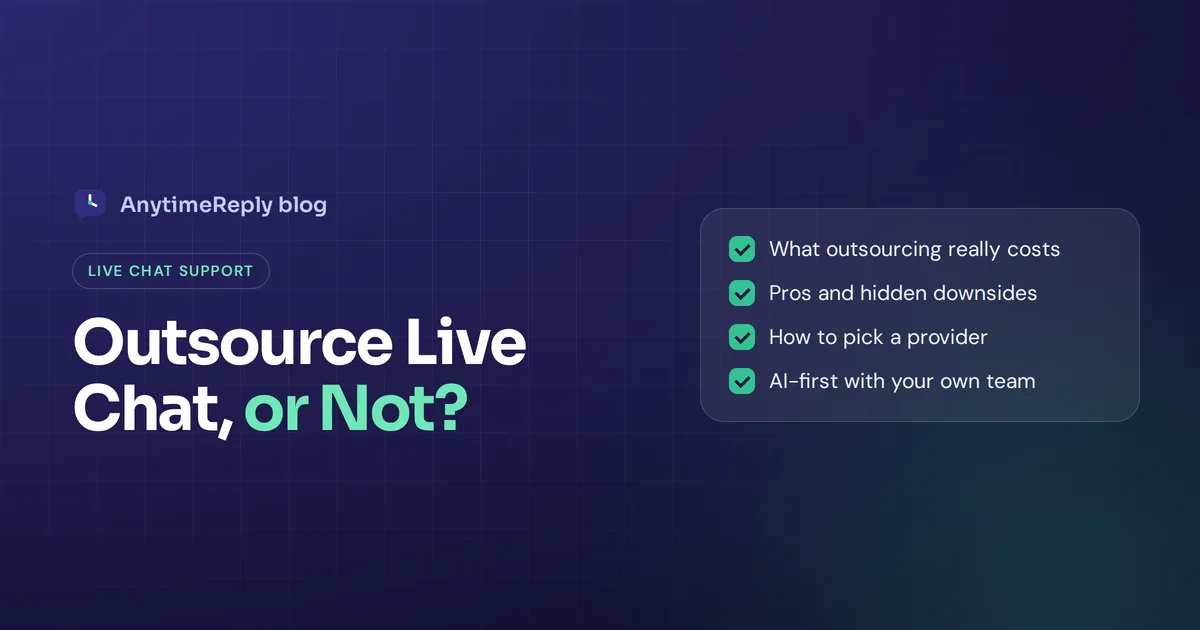
Your chat widget is getting busy. Customers write at night, on weekends and during your lunch break. You can't hire a full support team yet, and you're tired of answering "do you ship to Canada?" at midnight. So you start looking at companies that outsource live chat support services.
Outsourcing can be a smart move. It can also be an expensive way to get slow, robotic replies from people who don't know your products. This guide explains how live chat outsourcing works, what it costs, how to pick a service provider and how to run the handover well.
We'll also be honest about one alternative that didn't exist a few years ago: an AI agent that answers first, with your own small team taking the hard chats. We build a tool like that, so keep our bias in mind. But for some businesses it's still better to outsource, and we'll say when.
What does it mean to outsource live chat support?
When you outsource live chat support, a third-party company provides trained chat agents who answer chats on your website (and often WhatsApp, Messenger or email) in your brand's name. They log into your live chat software, follow your scripts and policies and pass tricky cases back to you.
Customers usually can't tell the agent works for another company. The agent uses your tone, your greeting and your answers. To the customer, every live chat conversation looks like it came from your own customer service team.
Most live chat outsourcing services come in a few shapes:
- 24/7 coverage: the provider covers every hour, including nights and holidays.
- After-hours only: your live chat support team handles the day, the provider takes nights and weekends.
- Overflow: the provider steps in when your queue gets too long, like during a sale.
- Full outsourcing: the provider runs all chat support, and you only handle escalations.
Some companies also bundle email, technical support, back-office support services (order entry, data updates) and call center services. Ask what's included, because "chat support services" can mean very different things from one company to the next.
How the live chat support process works
Here's the typical live chat support process from first call to go-live:
- Discovery. The provider learns your products, customer needs, chat volume and hours.
- Proposal. You get a quote based on hours, agents or chats.
- Knowledge transfer. You share policies, FAQs, saved replies and access to your tools.
- Training. Agents practice on your real questions. Good providers test them before go-live.
- Soft launch. The outsourced live chat operators start on part of your traffic, like nights only.
- Full launch and reviews. You review chats together each week and adjust.
Setup can take anywhere from a few days to several weeks. It depends on how complex your products are and how ready your knowledge base is.
Benefits of live chat support outsourcing
These are the main reasons businesses outsource, and the main benefits of outsourcing your live chat for small and growing teams:
- Round-the-clock coverage without hiring night shifts. Customers get a reply at 3 am.
- Faster scaling for busy seasons. Adding five agents for Black Friday is easier through a provider than through hiring.
- Lower cost per hour in many cases, especially with offshore teams.
- Experienced live chat agents and managers who already know chat etiquette, quality checks and support tools.
- Languages your team doesn't speak, if the provider has native speakers.
- More focus for founders and in-house staff, who can spend time on products and sales.
Done well, this can improve customer satisfaction and enhance customer experience, because people get faster answers at any hour. Faster replies usually mean increased customer satisfaction, and that is the whole point of live chat customer support. Many customers prefer live chat to email or phone for quick questions, so fast chat replies really do matter.
The downsides nobody puts on the sales page
- Product knowledge takes time. New agents won't know your products like you do. Expect a learning period full of "let me check with the team".
- Quality can vary. Agents rotate, and the person answering today may not be the one you trained last month.
- Scripts can sound robotic. Agents under pressure to handle many chats at once often paste canned replies.
- Less control. You can't walk over and fix a reply. Feedback goes through a manager.
- Security and access. Outside agents need access to your chat tool, and sometimes to orders or customer data. You need clear rules.
- Costs grow with volume. Most pricing scales with hours, agents or chats. Double the chats, roughly double the bill.
None of these are deal breakers. They just mean you should plan for them before you outsource, not after. Many businesses that outsource well keep one person in-house for customer service management: reviewing chats, updating answers and owning the relationship.
How much does it cost to outsource live chat services?
Prices vary a lot by country, language, hours and how skilled the agents are, so get quotes from a few providers. These are the pricing models you'll usually see:
| Pricing model | How it works | Good for | Watch out for |
|---|---|---|---|
| Per hour | You pay for agent hours on shift | Predictable coverage, like nights only | Paying for quiet hours with few chats |
| Dedicated agent per month | One or more agents work only on your account | Steady volume, complex products | Minimum terms and notice periods |
| Per chat or per resolution | You pay for each conversation handled | Spiky or seasonal volume | How "resolved" is defined, and spam chats |
| Shared agents | Agents split time across several clients | Small budgets, simple questions | Slower replies and weaker product knowledge |
Also ask about setup and training fees, minimum contracts, language surcharges and holiday rates. Those hidden extras change the real cost more than the headline price.
Before you outsource, count your chats. A simple way to compare: say you get 1,500 chats a month. Ask each provider for the total monthly price at that volume, including every fee. Then ask what happens at 3,000.
Outsourcing vs in-house vs AI-first: cost, speed and customer satisfaction
Here's how the three main options compare for a small or growing business:
| Outsourced live chat | In-house team | AI-first with your own small team | |
|---|---|---|---|
| Response time | Minutes, depends on staffing | Minutes in work hours, slow at night | Seconds for common questions, minutes for handovers |
| Hours | Up to 24/7 | Your team's hours | 24/7 for the AI, team hours for humans |
| Product knowledge | Medium, improves over time | Highest | AI knows what you train it on, team knows the rest |
| Empathy and judgment | Good with trained agents | Best | Strong when a human takes the hard chats |
| Cost as volume grows | Grows with agents or chats | Grows with every hire | Grows slowly, mostly per AI reply |
| Control | Through the provider's manager | Full | Full |
| Setup effort | Training docs, scripts, onboarding | Hiring and training | Good content, rules and testing |
Every chat service has trade-offs. Our honest view: if most of your customer inquiries are repeat questions (shipping, returns, prices, order status), an AI agent with a good knowledge base will cover a big part of them, and your own team can handle the rest. If your chats are long, emotional or very technical, or you also need phone support, a good outsourcing partner may suit you better. Many businesses end up doing both: AI first, outsourced or in-house humans behind it.
When to outsource your live chat support
- You need humans on chat 24/7 and can't staff nights yourself.
- Your chats need judgment on almost every message, not just repeat answers.
- You have big seasonal peaks and need extra people for a few weeks.
- You need native speakers in languages your team doesn't cover, and AI replies aren't acceptable in your industry.
- You also want phone support or call center services from the same company.
- You'd rather outsource the hiring, scheduling and training work entirely.
When an AI-first setup with your own team is the better fit
- Most chats ask the same 20 or 30 questions.
- You want instant replies at night, but a person only for real problems.
- You care about tight control over tone and accuracy.
- Your customers write in several languages or mix them, like Banglish or Hinglish.
- Your budget can't keep up with chat volume growth.
And yes, you can use ChatGPT-style AI for customer service, but a general chatbot doesn't know your policies. AI customer service works when the AI is trained on your own content and hands over to a person when it isn't sure.
Types of live chat outsourcing companies
Not every support outsourcing company is the same. You'll mostly see three kinds:
- Large BPO services firms. A business process outsourcing company like TaskUs or Helpware runs big teams across many channels. Good for scale and structure, less personal for small brands.
- Specialist chat providers. Firms such as HelpSquad or LTVplus focus on live chat and messaging for small and mid-size businesses, often ecommerce.
- Specialized customer support for software. Companies like SupportYourApp focus on SaaS and technical support, often in many languages.
Whichever type you pick, you outsource the work, not the responsibility. We haven't worked with these companies ourselves. Names are just examples of the types. Check reviews, ask for samples and look at their pricing page before you decide. Directories like Clutch also list chat support companies with client reviews.
How to choose the best outsourced live chat service provider
If you decide to outsource, check these before signing:
- Ask for chat samples. Real anonymized transcripts show tone, grammar and speed better than any sales deck.
- Check languages and time zones. Native-level writing matters in chat because every typo is visible.
- Run a paid trial. Two to four weeks on part of your traffic, like nights only, before a long contract.
- Agree on service levels. First response time, resolution rate and customer satisfaction levels, written into the contract. High customer satisfaction should be a target you both track, not a promise on a slide.
- Ask how they train and keep agents. High turnover means you keep re-training.
- Check data security. Who has access to what, how access is removed and what happens to your data at the end.
- Confirm they can use your tools. Agents should work inside your helpdesk so you keep the history and can watch chats live.
- Read the exit terms. Notice period, minimum term and how you get your knowledge and data back.
A good outsourcing service will answer all of these happily. If a provider dodges the trial or the samples, move on. Reliable customer support starts with a partner who is happy to be checked.
How to onboard your customer service outsourcing team
The first month decides whether outsourcing customer service works for you. Prepare these before day one:
- A clear knowledge base with policies, shipping times, product details and refund rules.
- Saved replies for the top questions, written in your brand voice.
- An escalation list: what agents can decide alone and what must come to you (refunds over a set amount, legal threats, VIP customers).
- Access in your own helpdesk, with roles and departments so the outsourced customer service team only sees what it needs.
- A weekly review call to go through a few chats together and fix gaps.
Whether you outsource all chats or just nights, treat the outsourced live chat team like new hires, not like a vendor you forget about. That's how you get excellent customer service from people who don't sit in your office. Customer service agents who feel part of your brand write better replies.
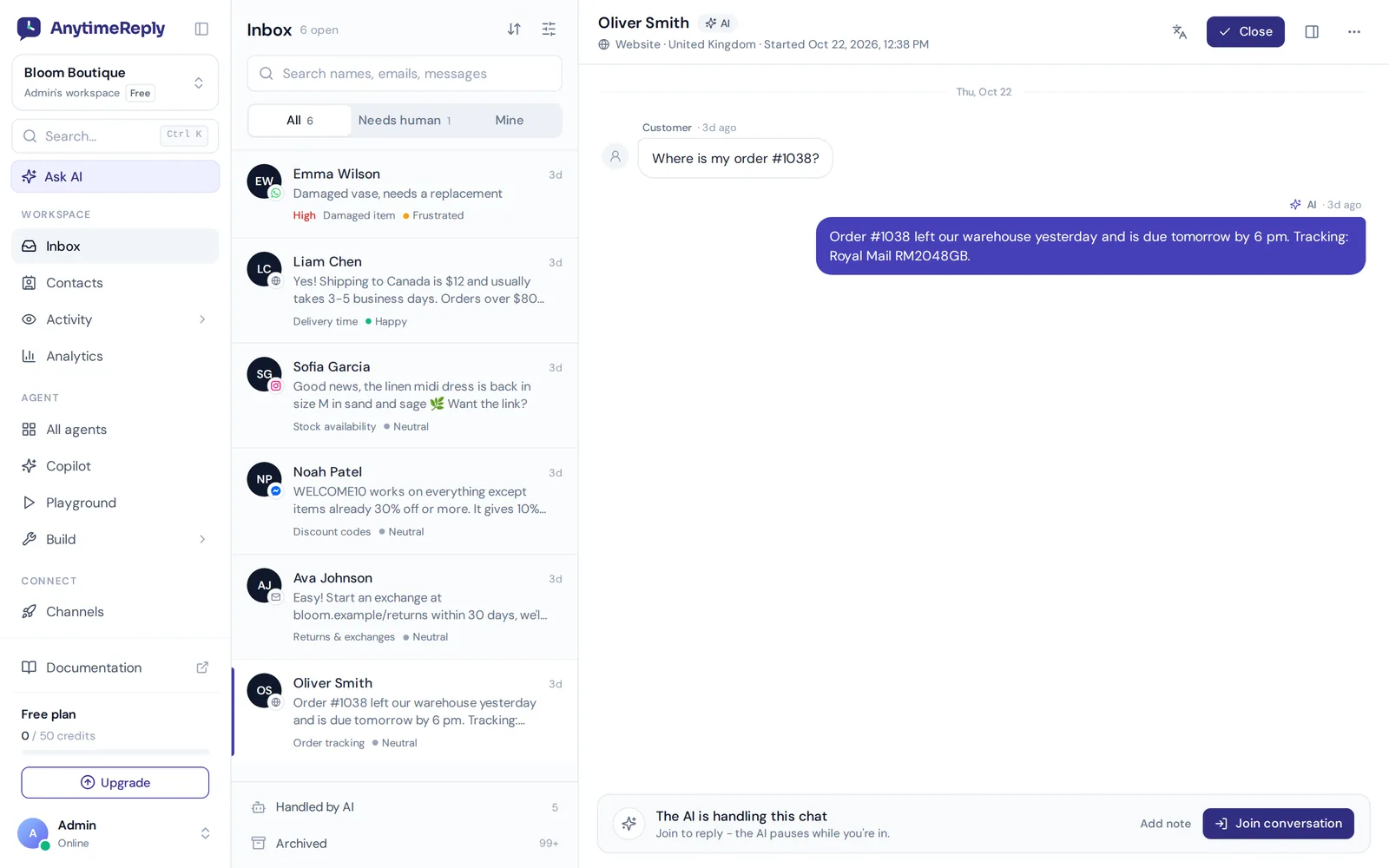
The hybrid model: AI answers first, people take over
A lot of customer support teams now combine both ideas, and it's one of the latest live chat trends. An AI agent answers the common questions in seconds, around the clock. When a chat needs a person, it goes to your team (or your outsourced agents) with a short summary, so nobody asks the customer to repeat themselves.
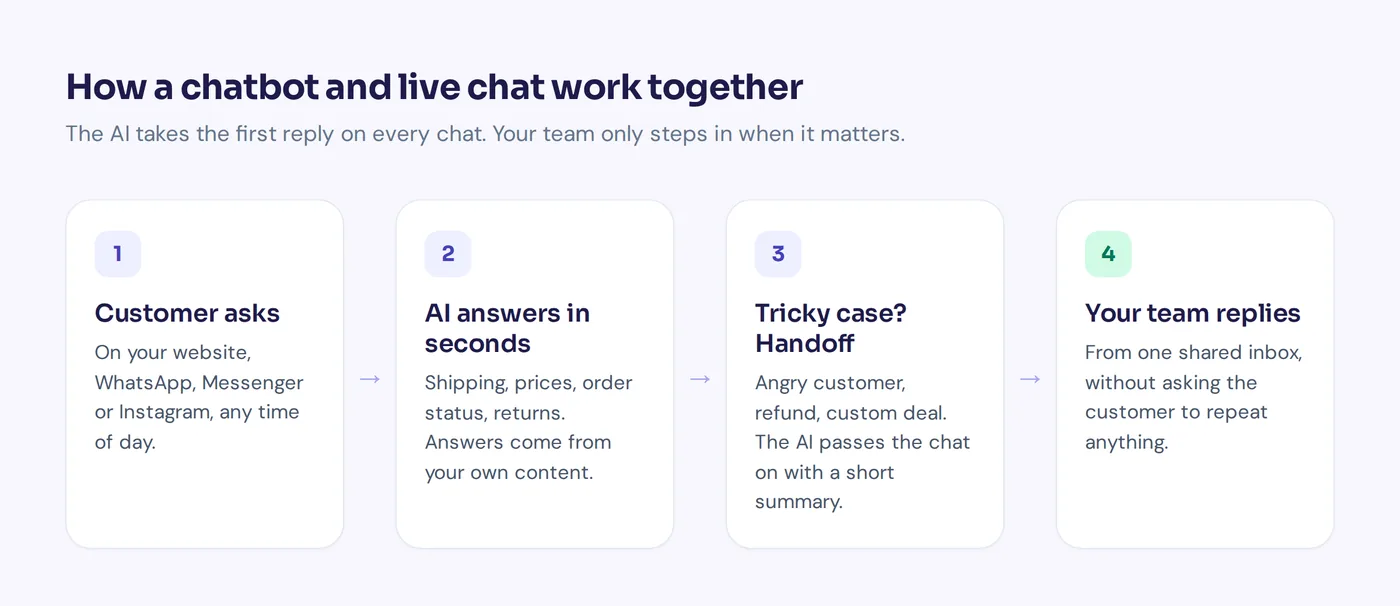
This often means you need fewer outside hours, or none. All your customer interactions still end with the right answer, from the AI or from a person. Your humans spend their time on refunds, complaints and sales instead of copy-pasting the returns policy. It's also a cheaper way to test before you outsource live chat services at full scale.
Customer support with AI: how AnytimeReply fits in
AnytimeReply is an AI support agent with a built-in helpdesk. It doesn't give you outsourced people. It gives your own team (or an outside team you already use) a faster way to work:
- An AI agent trained on your website and documents that answers in seconds, in the customer's language, and says so when it doesn't know.
- One shared inbox for website, WhatsApp, Messenger, Instagram, Telegram, email and Slack. The AI hands over with a summary when a customer asks for a person, gets upset or the AI can't answer.
- Departments, assignment and internal notes, so outside agents can work in your workspace with the chats you route to them.
- Escalation to tools like Zendesk, Freshdesk or Intercom, if your outsourcing provider already works there.
Honest limits: there's no phone or SMS channel, so if you need call center support, you'll still want a partner for that. The Free plan includes website chat, the helpdesk inbox and the AI agent. Messaging channels like WhatsApp start on Hobby. See pricing.
Frequently asked questions
Is it cheaper to outsource live chat support?
Customer support outsourcing is often cheaper than hiring a full in-house team for 24/7 coverage. But costs grow with volume. If many of your chats are repeat questions, an AI agent plus a small team can cost less than outsourcing all of them.
Can I outsource only during peak hours?
Yes. Many providers offer after-hours or overflow plans, so your own team keeps the day shift and the outside agents cover nights, weekends or sale days.
Can I outsource live chat and keep my own helpdesk?
Most providers can work inside your tools. It's a good idea, because you keep the chat history, can watch quality live and can switch providers without losing data.
How do providers protect customer data?
Ask about access controls, staff background checks, data handling rules and what happens when the contract ends. Only give agents the access they really need.
Can I use ChatGPT for customer service?
A general chatbot doesn't know your policies or orders. An AI agent trained on your own content, with a handover to people, is the safer way to use AI in support.
What is the difference between live chat outsourcing and a call center?
A call center mainly handles phone calls. Live chat outsourcing focuses on written channels like website chat, messaging apps and email. Some providers offer both.
Final thoughts
Outsourcing live chat support can give you 24/7 coverage and room to grow, and a good live chat service can help you deliver exceptional customer experiences. Go in with clear rules, a trial period and your chats in your own tools. And before you sign, check how many of your chats are really the same few questions. You might need fewer outside hours than you think.
If you want to see what an AI-first setup handles on your own site, start free with AnytimeReply. No card needed.
Published 26 October 2026 by AnytimeReply team